A Closed Loop, An Honest Pitch: imaginAItion for Impact-Aligned Capital
When this was written, nAItion OS was called pAIrtner OS. The name changed in October 2026; pAIrtner is now a separate personal app.
Before the pitch
Most impact investing works against a tension: the return profile and the impact profile pull in different directions. You either optimize for return and call it responsible, or you optimize for impact and accept compressed economics.
We don't believe that tension is structural. We think it's a product design problem. And we think we've solved it.
This is an honest pitch. No inflated projections. No unnamed "partnerships in final stages." No vague gestures at total addressable markets. Just the actual thesis, the actual mechanics, and the actual reason we think impact and return compound together here — rather than trade off.
What we're building
imaginAItion is a network operating system for small and mid-size businesses — the 33 million owner-operators in America who run on disconnected tools, pay extractive platform fees, and own nothing at the end of it.
nAItion OS is the OS. One login. Every suite. CRM, books, marketing, delivery, service, compliance, capital — all connected, all AI-native, all running on the same substrate.
The nAItion is the network. Members don't just use the platform. They co-own a piece of it. Sub-co revenue funds a shared pool. Members earn on every dollar that stays in the system — insurance premiums, capital interest, supply margins, data intelligence. The longer they stay, the more they earn. The more they earn, the more they refer. The network compounds.
That's not a loyalty program. That's structural realignment of the SMB software relationship.
Where impact and return converge
The businesses we serve are not abstractions. They are gyms and coaches helping people get healthy. Recovery operators doing what amounts to ministry — serving people in their worst moments. Family planning services preserving what matters most across generations. Property and hospitality operators building experiences worth traveling for. Fitness brands built by people who care about what they put in their bodies.
These operators are being extracted by the platforms they built.
They paid Salesforce's early bills. They gave feedback that shaped the product. They trusted their data to the cloud. In return: price increases. Per-seat licensing. Add-on fees. Overseas support. The privilege of buying stock they don't control.
We intercept that extraction. Not rhetorically — structurally. The sub-co model routes insurance premiums, capital interest, supply margins, and data intelligence back to the members whose behavior generated them. The pool grows with the network. The network grows with member success. Member success compounds platform value.
The return and the impact are the same mechanism.
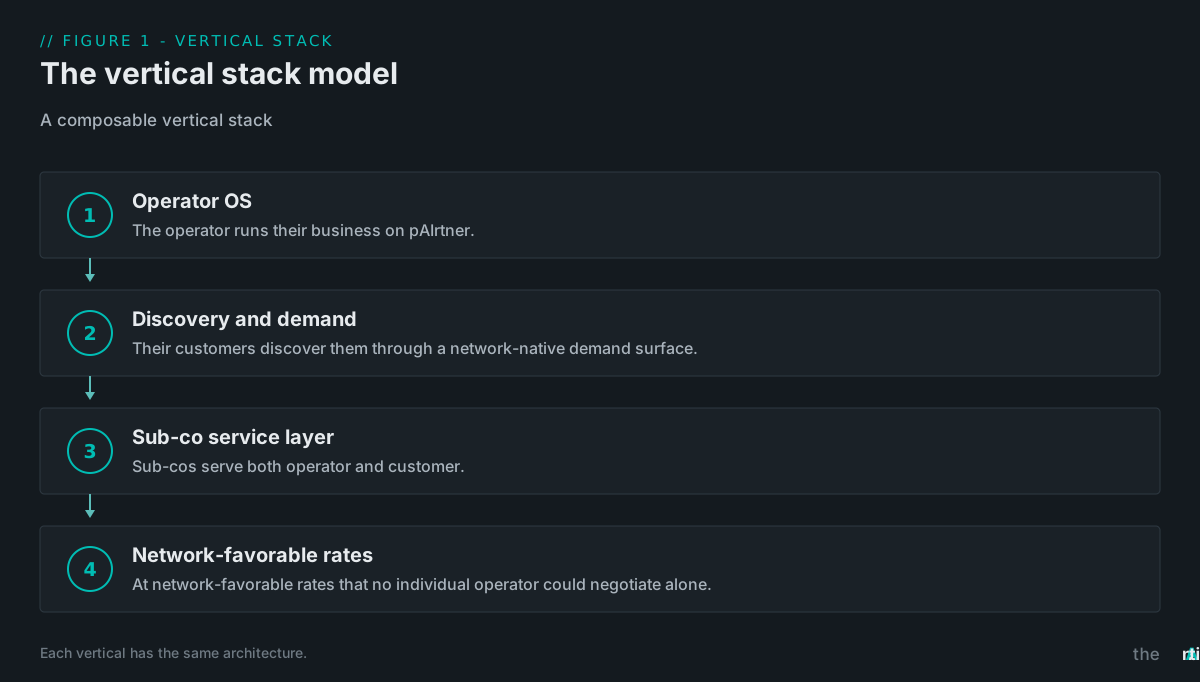
The vertical stack model
We don't deploy one product into every industry. We deploy a composable vertical stack — an operator OS, a discovery and demand layer, and a cascading sub-co service layer — into industries where small operators are being extracted by large platforms.
Each vertical has the same architecture. The operator runs their business on nAItion OS. Their customers discover them through a network-native demand surface. Sub-cos serve both operator and customer — capital, insurance, supply, legal, data intelligence — at network-favorable rates that no individual operator could negotiate alone.
The flywheel: more operators → richer supply → more demand → more sub-co consumption → larger pool → better member economics → more operators.
We are building this across multiple verticals. Each one validates the architecture. Each one expands the pool. Each one makes the network harder to leave and harder to replicate.
The compounding thesis
Three vectors multiply simultaneously. Not add — multiply.
Engagement — every sub-co touchpoint is another reason to stay, another data point, another referral moment.
Data — longitudinal operator and customer data across verticals becomes more valuable with time. Year-one data is signal. Year-five data is infrastructure. Fraud detection. Demand forecasting. Pricing intelligence. Outcome measurement. These compound with time in ways that real-time scrapers cannot replicate.
Enterprise value — member LTV grows as sub-co consumption grows. Network EV grows as member LTV grows. The operator's own enterprise value grows because the network serves their customers in ways they couldn't serve alone.
Each vector reinforces the others. The network's value is not a function of user count. It's a function of engagement depth × data richness × enterprise value compounding across every operator and their customers simultaneously.
At sufficient scale, this is not a software network. It is infrastructure — for SMB America, for ethical data brokering, for cascading human-services delivery. The path from here to there is deliberate: Visa didn't start as payment infrastructure. GS1 didn't start as commerce-numbering infrastructure. They evolved. We are designing for that evolution from day one.
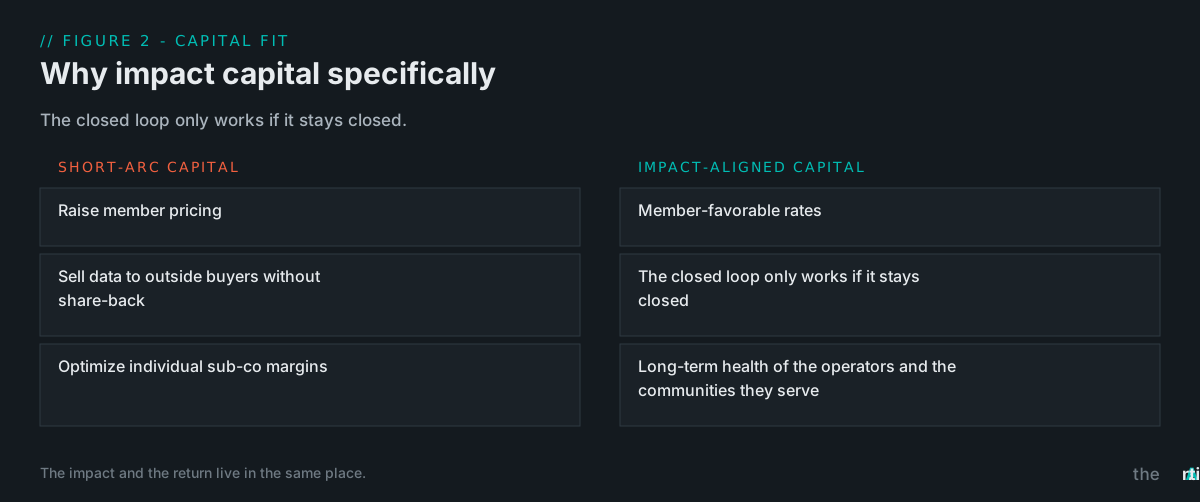
Why impact capital specifically
Most venture capital optimizes for the fastest path to the largest exit. That is not this.
The closed-loop ownership model requires patient capital. Members earn on pools that grow over years, not quarters. Sub-co economics compound over operator tenure. The data asset appreciates with longitudinal depth. The infrastructure thesis matures over a decade.
We are not asking for patient capital as a concession. We are asking for it because it is the only capital structurally compatible with what we're building.
Short-arc capital would pressure us to raise member pricing, sell data to outside buyers without share-back, and optimize individual sub-co margins at the expense of member-favorable rates. That destroys the thesis. The closed loop only works if it stays closed.
Impact-aligned capital understands this because the impact and the return live in the same place: the long-term health of the operators and the communities they serve. A gym that thrives serves healthier people. A recovery operator with honest metrics saves lives. A family planning platform that routes subscription fees into 529s builds generational wealth for families who otherwise wouldn't have it.
We are not building charity. We are building the infrastructure that makes those outcomes economically rational — and we are building it to last.
What we're asking for
We are in early validation. Our first member businesses are live. Founding Believer investment opportunities are available, repaid through a share of the pool. When that ends, membership doesn't — Founding Believers hold their seat for life at standard pool status.
Update, 7 Oct 2026: the Founding Believer seat levels are retired. Investment opportunities are available: investors.imaginaitioninc.com.
We are not raising a round today. We are identifying the capital partners who understand the thesis before the thesis needs capital — so that when we raise, we raise with people who will not pressure us to betray what we built.
If that is you, the conversation starts now.
ImaginAItion Inc · Believe · Build · Evolve