A Rising Tide Raises All Ships
There is a story we have been told so many times we stopped noticing it was a story.
It goes like this: a company is born. It finds a problem worth solving. Early customers take a chance on it — they pay, they give feedback, they trust it with their data, their workflows, their people. The company grows. It goes public. The founders get rich. The shareholders get returns. And the customers? They get a price increase letter and a new add-on they didn't ask for.
That's not a bug. That's the model working exactly as designed.
The Machine Underneath
When a company takes venture capital, it makes a promise. Not to customers. Not to employees. To capital. The promise is growth — not sustainable growth, not healthy growth, but infinite growth. This is the never enough game: every quarter has to be bigger than the last, every market has to be expanded, every existing customer has to be squeezed a little harder. The kind of growth that requires raising prices on the base you already built and finding new ways to extract value from it.
This is what the IPO and debt model demands. The moment a company needs outside capital to survive, it begins serving two masters. And capital always wins.
The customer is not a partner in this model. The customer is the asset. The thing that gets monetized. The unit of extraction.
We watched this happen to an entire generation of enterprise software. Companies that started with a genuine mission — make business simpler, connect people, move money faster — and ended up as rent collectors. Not because the founders were evil. Because the machine they built their company on required it.
The machine has a name. It's called the extractor model — the never enough game played at industrial scale. And it has been the only game in town for so long that most people never thought to ask whether the field itself could be redesigned.
What a Tide Actually Does
The phrase "a rising tide raises all ships" gets used as a platitude. A way of saying everyone benefits when things go well. But there's something more precise underneath it.
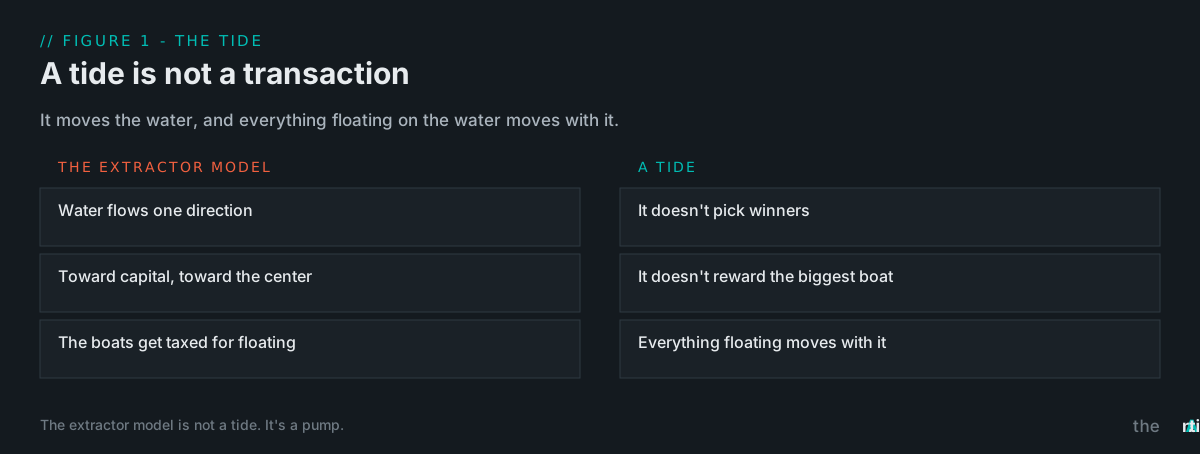
A tide is not a transaction. It doesn't pick winners. It doesn't reward the biggest boat or punish the smallest one. It moves the water, and everything floating on the water moves with it.
The extractor model is not a tide. It's a pump. Water flows one direction — toward capital, toward the center, toward whoever owns the infrastructure. The boats don't rise. They get taxed for floating.
We are building a tide.
The Structural Correction
Here is the question that started all of this:
Who built Salesforce?
Marc Benioff had the vision. But the small businesses that signed up early — that paid when it was unproven, that submitted the feedback that shaped the product, that trusted it with their customer data and their sales pipelines and their growth — they built it too. Their risk was real. Their contribution was real. Their trust was the foundation the whole thing was built on.
What did they get in return? Price increases. Paid add-ons. The privilege of buying stock they don't control. Overseas customer service.
That's what rent buys you.
The nAItion exists because that deal is wrong. Not just strategically wrong — structurally wrong. The people who power a network should own a piece of it. Not as a loyalty program. Not as a marketing gesture. As a fundamental redesign of who the platform serves.
Rewriting the Rules
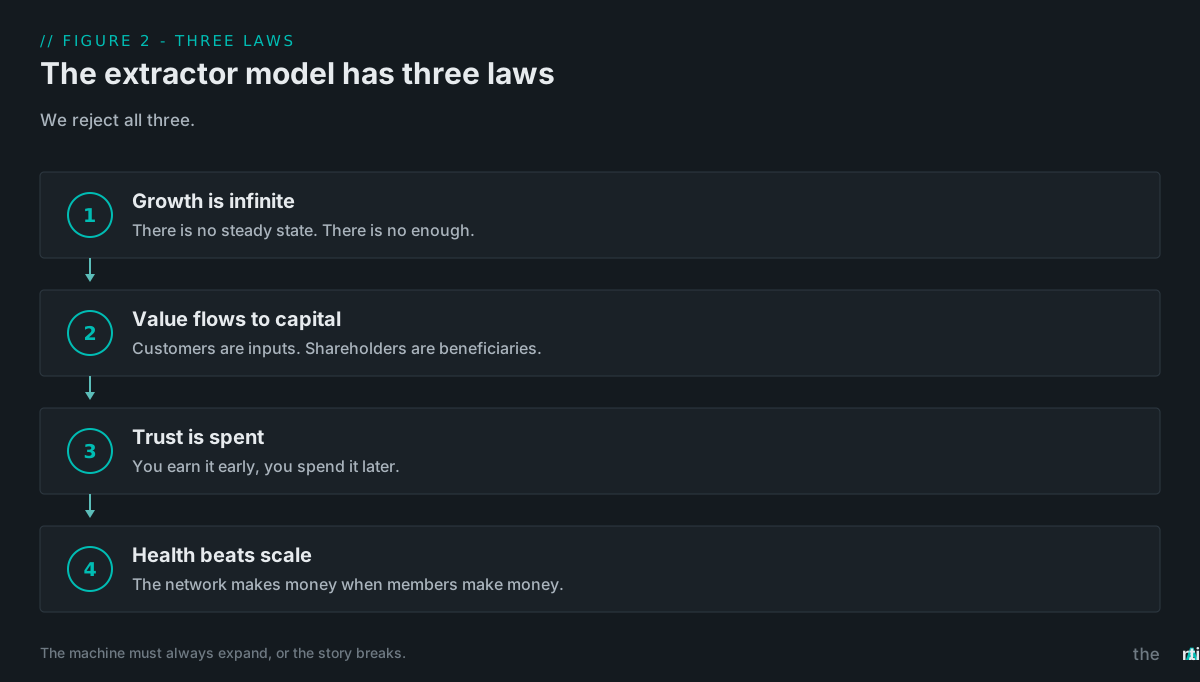
The extractor model has three laws:
Law one: Growth is infinite or it's failure. There is no steady state. There is no enough. This is the never enough game — the machine must always expand, or the story breaks.
Law two: Value flows to capital. Customers are inputs. Shareholders are beneficiaries. The distance between those two groups is the business model.
Law three: Trust is a resource to be spent. You earn it early, you spend it later. Price increases are just trust being converted to revenue.
We reject all three.
Our first law: Health beats scale. A network of ten thousand operators who are genuinely better off because of their membership is worth more than a network of a million customers who barely notice they're subscribed.
Our second law: Value flows to contribution. Members who use the platform, Contributors whose technology powers it, Champions who carry it into new markets — they all have a claim on what the network earns. Not as charity. As architecture.
Our third law: Trust compounds. Every price increase letter is a withdrawal from an account that took years to fill. We don't spend trust — we build it into the structural terms of membership. The network makes money when members make money. That alignment is not an accident. It's the design.
The Field Itself
Most disruption is tactical. A better product. A lower price. A faster onboarding flow. The incumbent's customers migrate, the new company grows, and eventually the new company becomes the incumbent — running the same extractor model with a fresher coat of paint.
We are not interested in tactical disruption.
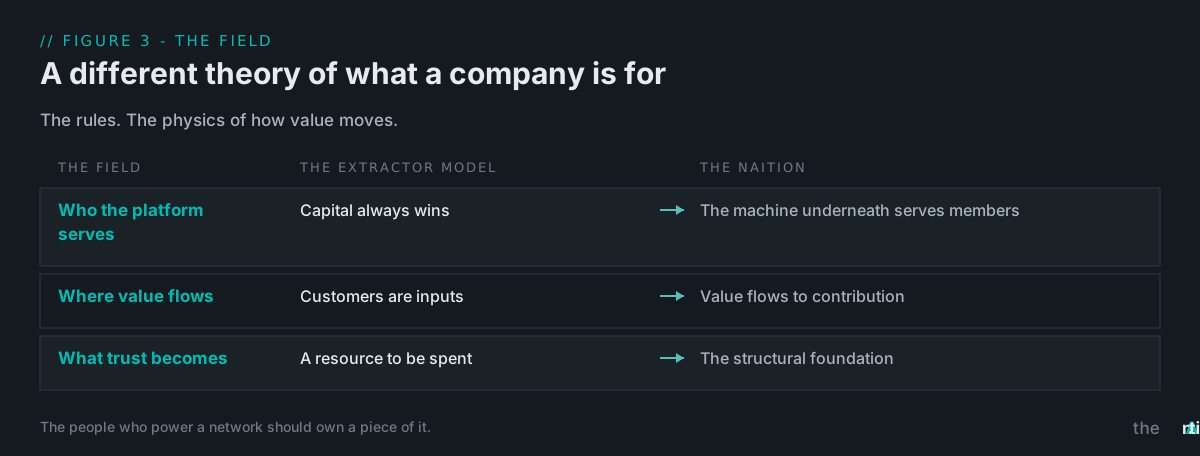
We are interested in the field. The rules. The physics of how value moves between the people who build something and the people who use it. The question of who gets to own a piece of what they helped create.
A rising tide is not a product feature. It's a different theory of what a company is for.
The nAItion is that theory made operational. A network where the model, the platform, and the upside belong to the people who power it. Where the machine underneath serves members instead of extracting from them. Where trust isn't a resource to be spent — it's the structural foundation everything else is built on.
The tide is rising.
The question is whether you want to be on the water when it does.
Believe · Build · Evolve