Agentic Commerce: When the Buyer Isn't a Person
For thirty years, e-commerce assumed a human at the other end — someone to persuade, someone who could be nudged by a photo, a review count, a countdown timer. Agentic commerce breaks that assumption. The entity evaluating your offer is software acting on someone's behalf, and it doesn't respond to any of that.
What's actually being built
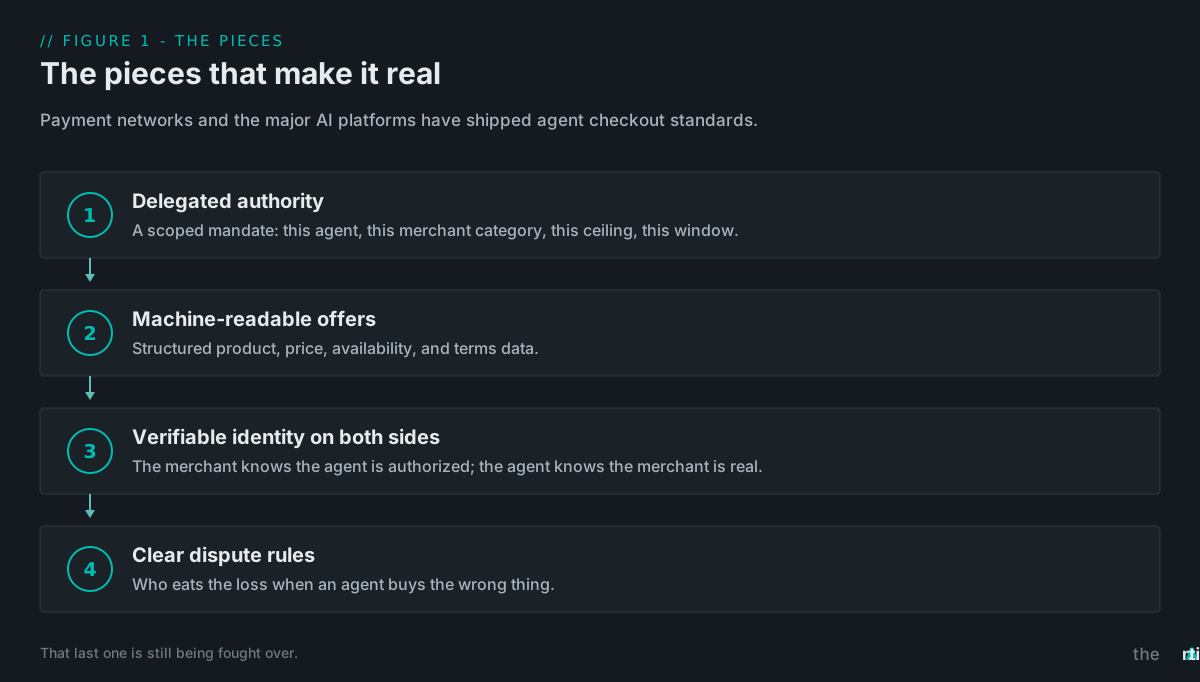
The plumbing arrived faster than most people noticed. Payment networks and the major AI platforms have shipped agent checkout standards: a way for an agent to present verified payment credentials, prove it's authorized to spend on a specific person's behalf, stay inside a spend limit, and complete a purchase without a human filling in a form.
The pieces that make it real:
- Delegated authority — a scoped mandate: this agent, this merchant category, this ceiling, this window.
- Machine-readable offers — structured product, price, availability, and terms data, not a rendered page an agent has to scrape.
- Verifiable identity on both sides — the merchant knows the agent is authorized; the agent knows the merchant is real.
- Clear dispute rules — who eats the loss when an agent buys the wrong thing.
That last one is still being fought over, and it's the one that will shape adoption most.
What changes for a business that sells
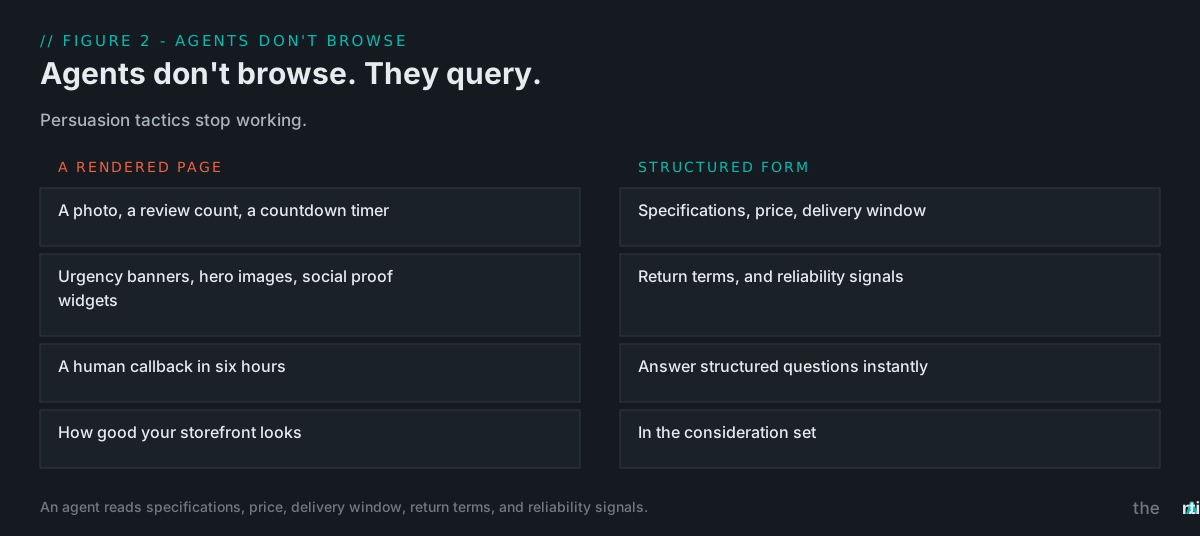
Discovery moves upstream. Agents don't browse. They query. If your catalog, pricing, availability, and policies aren't available in structured form, you're not in the consideration set — no matter how good your storefront looks.
Persuasion tactics stop working. Urgency banners, hero images, social proof widgets. An agent reads specifications, price, delivery window, return terms, and reliability signals. Full stop.
Response time becomes a ranking factor. If an agent asks for a quote and gets a human callback in six hours, the decision was made five hours ago. Businesses that can answer structured questions instantly win by default.
Comparison gets brutal and honest. Agents will compare on the terms their principal actually specified. That's bad news for margin built on friction and confusion. It's good news for anyone whose real advantage is quality, speed, or service — those become legible for the first time.
Small can compete. An agent doesn't know or care whether you're a 500-person company. It sees data, terms, and track record. This is one of the few structural shifts in twenty years that doesn't automatically favor the incumbent.
What changes for a business that buys
The same capability points the other direction. Recurring supply orders, reordering against actual consumption, quote collection across vendors, subscription audits, renewal negotiation prep. Procurement is one of the clearest early wins because the decisions are frequent, rule-bound, and boring — the exact profile where an agent outperforms a distracted owner.
The guardrails matter more than the capability: spend ceilings, approved vendor lists, categories that always require a human, and a log of every action with its reasoning.
What to have in place
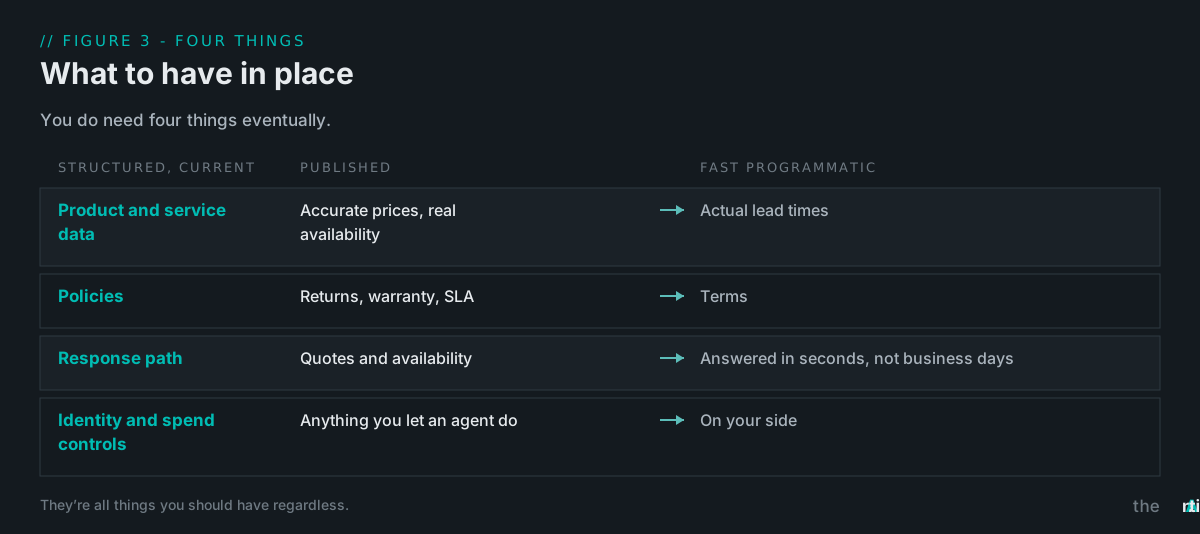
You don't need to rebuild anything this quarter. You do need four things eventually, and they're all things you should have regardless:
- Structured, current product and service data — accurate prices, real availability, actual lead times.
- Published, machine-readable policies — returns, warranty, SLA, terms.
- A fast programmatic response path — quotes and availability answered in seconds, not business days.
- Identity and spend controls on anything you let an agent do on your side.
Where we sit
Agent-facing commerce is a native surface in the OS, not a bolt-on. Your catalog and pricing already live in the same system as your CRM and your books, which means an agent-facing offer is generated from the record of truth rather than a stale export. On the buying side, procurement agents run inside the same spend controls and audit log as everything else.
The transition here will be slower than the hype and faster than the skeptics. The businesses that come out ahead are the ones whose data was already clean and structured when the agents showed up.
Next: what happens when those agents are also connected to physical equipment.
— ImaginAItion