Agentic Commerce Meets the Machines
Connected equipment has been sending telemetry for a decade. The data mostly went into dashboards nobody opened. What changes when an agent is watching that stream and has authority to act is that the sensor stops being a report and becomes a trigger.
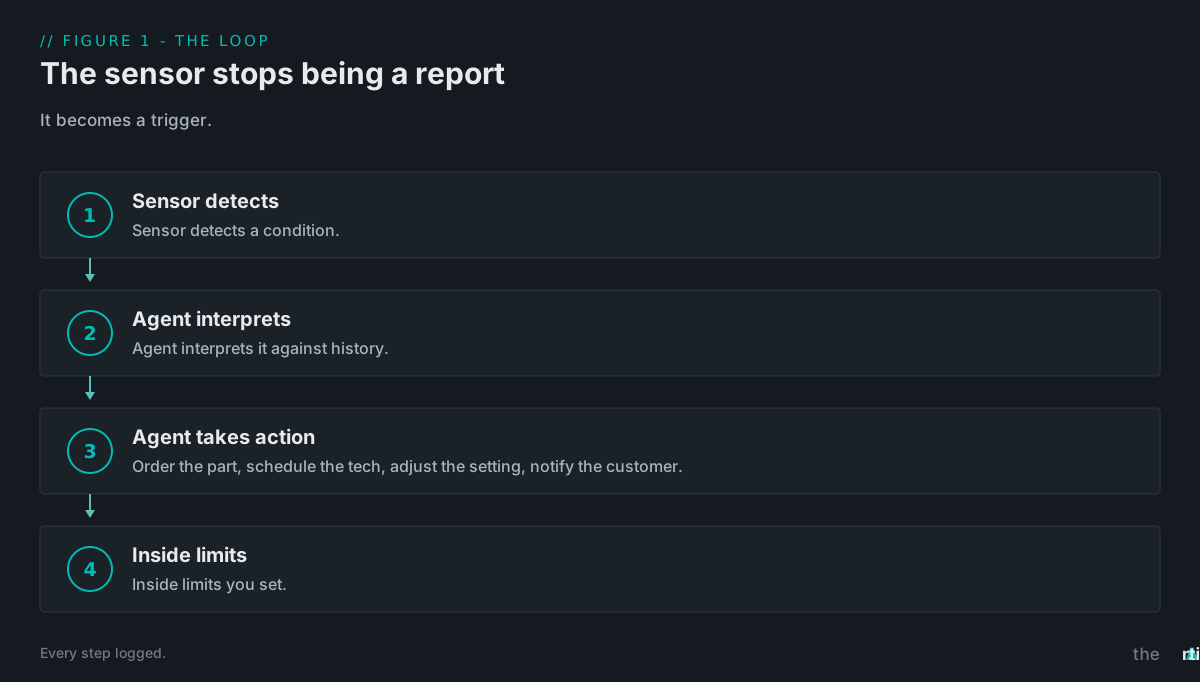
The loop
Sensor detects a condition. Agent interprets it against history. Agent takes the action — order the part, schedule the tech, adjust the setting, notify the customer — inside limits you set. Every step logged.
Concretely:
- A walk-in cooler's compressor draws 12% more current than its baseline. Failure pattern matches. The part is ordered overnight and a service window is booked before anything spoils.
- Fleet vehicle mileage crosses a service threshold. The appointment is booked at the shop with the best historical turnaround, on a day the route board shows slack.
- Shelf weight sensors show a SKU moving 30% faster than forecast. The reorder goes out at the current quantity break instead of an emergency rush order next week.
- A machine's runtime hours hit a consumables threshold and the supply ships automatically against a standing price agreement.
None of this is speculative technology. The sensors exist, the ordering rails exist, the models are more than capable. What's been missing is the part in the middle that connects a physical signal to a commercial action, at a scope tight enough that an owner will actually turn it on.
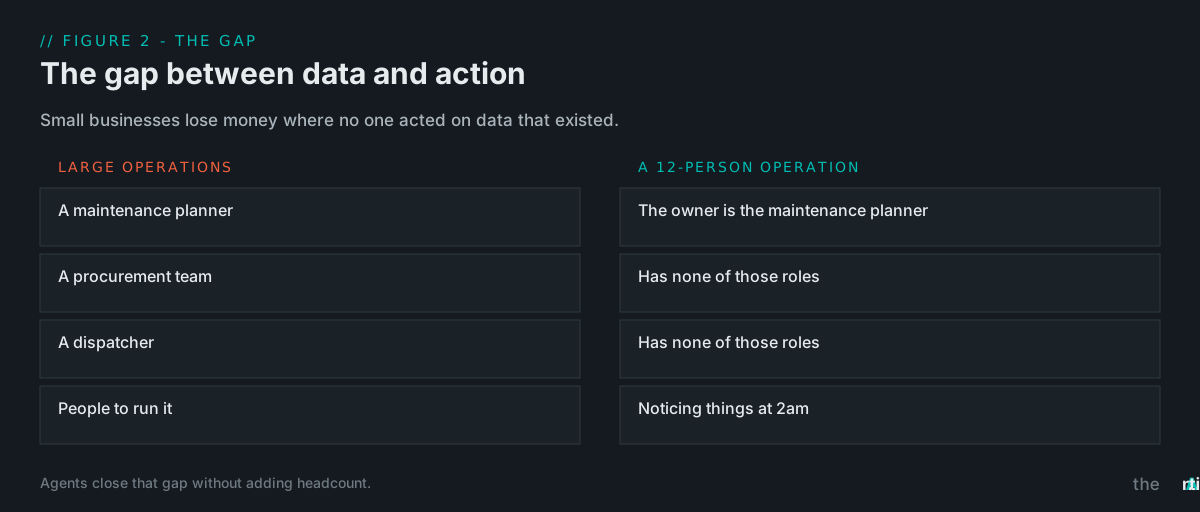
Why it matters more for small business than enterprise
Large operations already solved this with staff. They have a maintenance planner, a procurement team, a dispatcher. The software is expensive because it's priced for organizations with people to run it.
A 12-person operation has none of those roles. The owner is the maintenance planner, and they find out about the compressor when the product is warm. The gap between "the data existed" and "someone acted on it" is where small businesses lose money that they never see itemized anywhere.
Agents close that gap without adding headcount. That's the actual value — not futuristic autonomy, just noticing things at 2am that a human wasn't going to notice.
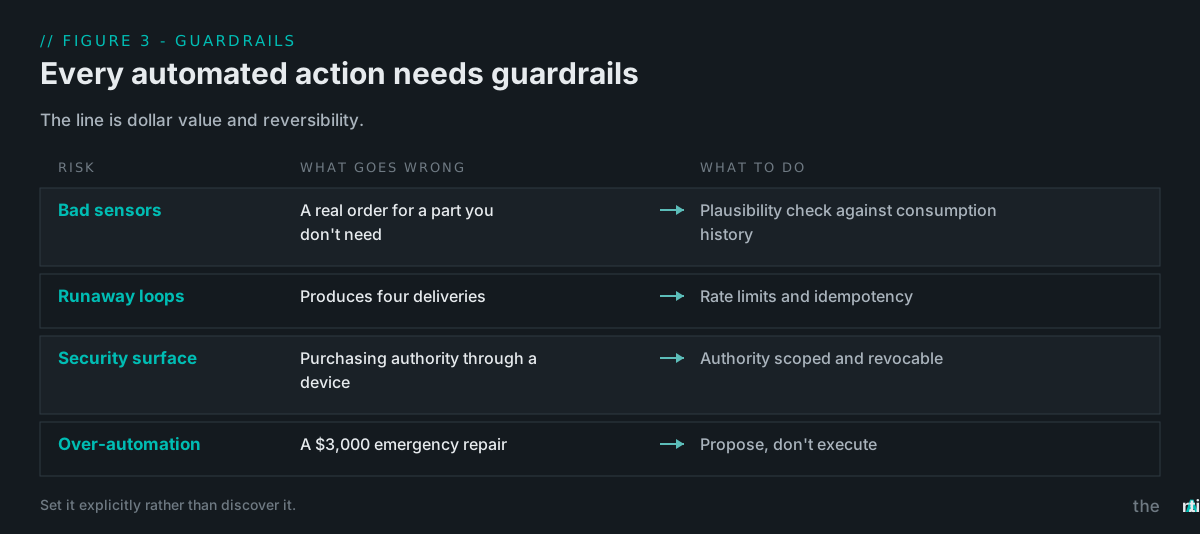
Where it goes wrong
Bad sensors, confident action. A drifting sensor generates a real order for a part you don't need. Every automated action needs a plausibility check against consumption history before it fires.
Runaway loops. An agent that reorders on a threshold, and a threshold that never clears, produces four deliveries. Rate limits and idempotency aren't optional.
Security surface. Connected equipment is famously under-patched. An agent with purchasing authority reachable through a device is a genuinely bad combination. Keep credentials out of devices, keep the agent's authority scoped and revocable, and put spend ceilings on everything.
Vendor lock through hardware. Equipment that only reorders through its manufacturer's portal isn't automation, it's a subscription with sensors. Insist on data you can route yourself.
Over-automation. Reordering a $40 consumable: automate freely. Dispatching a $3,000 emergency repair: propose, don't execute. The line is dollar value and reversibility, and you should set it explicitly rather than discover it.
How to start
Pick one thing that breaks predictably and costs real money when it does. One piece of equipment, one consumable, one route. Put the agent in propose-only mode for a few weeks — it recommends, you approve, and you see how often it would have been right. Then hand it authority within a ceiling for that one category.
That's a two-week project, not a transformation program. And it tells you more about whether this works in your business than any vendor demo will.
Where we sit
In the OS, equipment telemetry lands in the same place as your vendor records, purchase history, price agreements, and service calendar. An agent proposing a part order already knows the vendor, the negotiated price, the lead time, and last year's failure history — because those aren't four separate systems to integrate.
The physical world is the last surface most business software never touched. It's connected now. The question is only whether anything is listening.
— ImaginAItion