Agents Are Not Chatbots
Most people use the words interchangeably. "AI chatbot," "AI assistant," "AI agent" — same thing, right? It's all AI, you type to it, it types back.
No.
The difference between a chatbot and an agent is the difference between a search engine and an employee. Both involve typing. Only one of them does the job.
Once you see this distinction, you can't unsee it. And you'll notice that 95% of products marketing themselves as "AI agents" are still chatbots with a fresh coat of paint.
What a chatbot actually is
A chatbot is a query interface. You give it an input — a question, a request, a prompt. It returns an output — an answer, a draft, a suggestion. Then it waits.
It waits until you come back. It waits until you copy its output and paste it somewhere useful. It waits until you decide what to do with what it said.
The chatbot has no job. Its only function is to respond to inputs. If you stop typing, it stops working. Nothing changes in your business while you're not at the keyboard.
This describes essentially every "AI assistant" sold as a SaaS add-on. ChatGPT in your CRM. AI sidebar in your inbox. Smart features in your spreadsheet. All chatbots. Useful, sometimes. But fundamentally passive — they amplify your effort, they don't replace it.
What an agent actually is
An agent has a role, a brief, and standing authority.
Role: this agent is the CFO. Or the CMO. Or the Account Manager. Not a generic helper — a specific seat with specific responsibilities.
Brief: the agent knows what the role entails. The CFO agent knows it's responsible for cash position, AR aging, margin tracking, runway visibility, and board-ready reporting. Not because someone configured it to — because that's what the role is.
Standing authority: the agent acts on its own initiative inside the lane the role implies. The CFO agent watches your AR daily, drafts the follow-up email when an invoice goes past 30 days, surfaces the cash trend before it becomes a problem. It does not wait for you to ask. The job is the trigger.
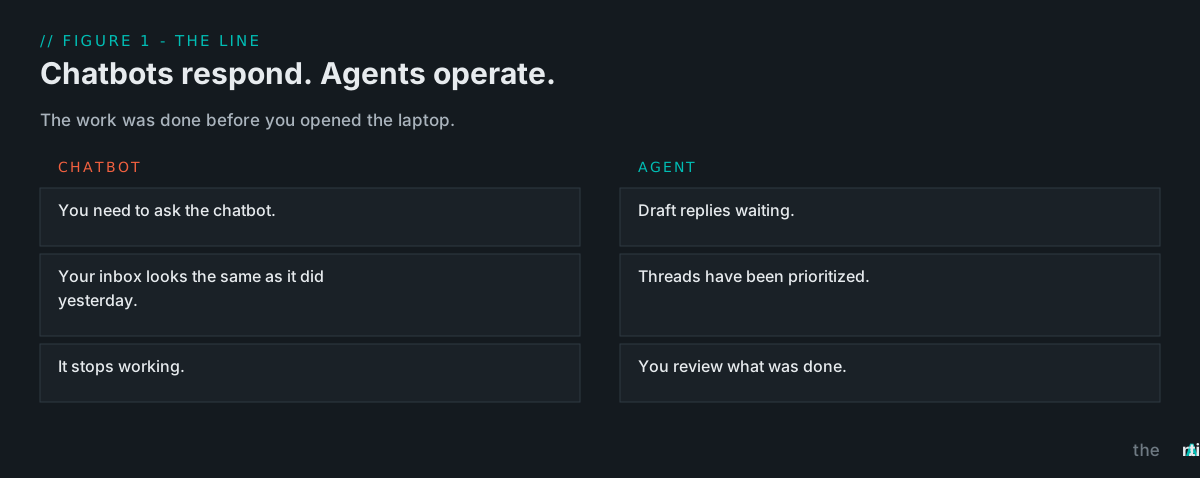
That's the line. Chatbots respond. Agents operate.
What it looks like in practice
Open your inbox tomorrow morning. If you're running on a chatbot product, your inbox looks the same as it did yesterday — you'll need to ask the chatbot to summarize, prioritize, or draft replies.
If you're running on an agent platform, your inbox already has draft replies waiting on the messages your agents could answer for you. Threads have been prioritized by the Account Manager agent based on customer value and urgency. Calendar conflicts have been pre-resolved by the People Ops agent. The CFO agent has already pinged the bookkeeper about the invoice that came in misformatted.
You walk in. You review what was done. You approve, redirect, or take the threads the agents flagged as needing the human.
The work was done before you opened the laptop.
Why most products are still chatbots
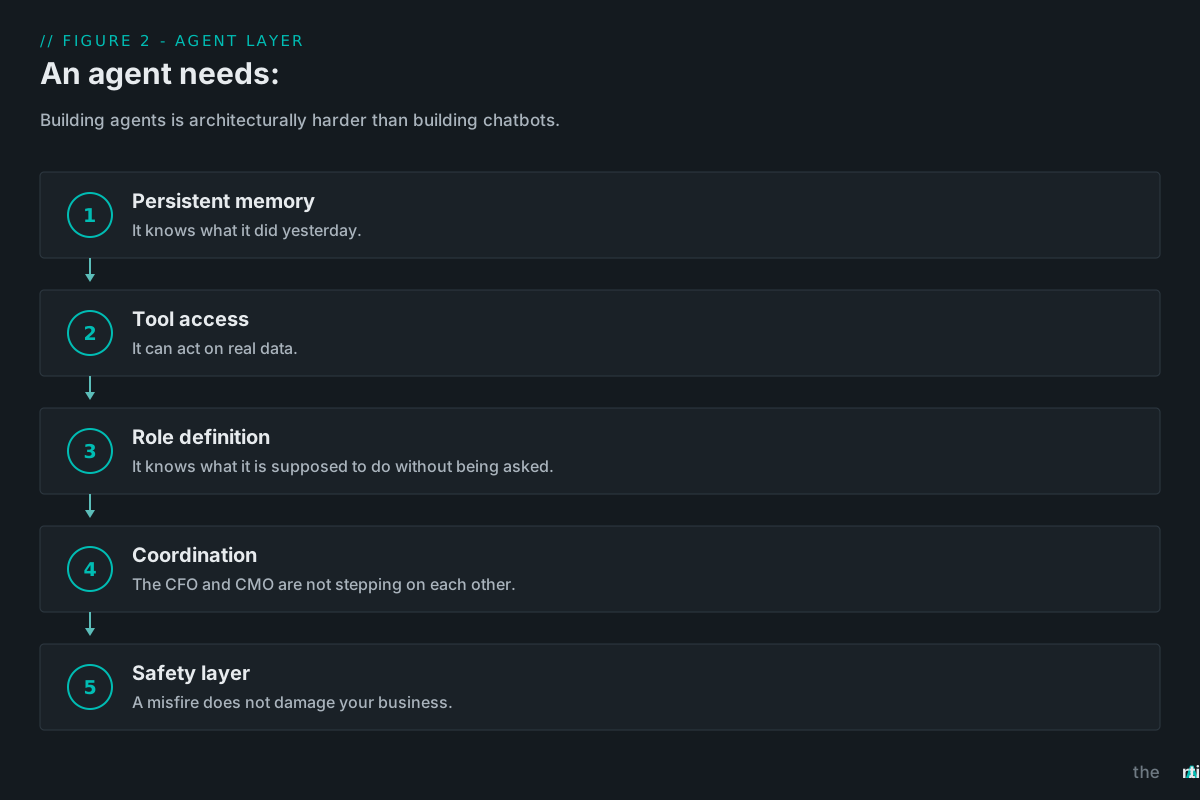
Building agents is architecturally harder than building chatbots. A chatbot needs a model and a UI. An agent needs:
- Persistent memory across sessions, so it knows what it did yesterday
- Tool access, so it can act on real data, not just describe it
- Role definition with standing authority, so it knows what it's supposed to do without being asked
- Coordination with other agents, so the CFO and CMO aren't stepping on each other
- A safety layer, so a misfire doesn't damage your business
- An audit trail, so you can see what was done and why
Most "AI agent" products skip half of these and ship a chatbot with a different label. You can tell because nothing happens unless you prompt it. If your "agent" has no work product when you arrive in the morning, it's a chatbot.
The nAItion was built agent-first from the substrate up. Memory, tools, roles, coordination, safety, audit — all native, all present from day one. Not bolted on. Not retrofitted. The architecture is the agent layer.
What this means for you
If you've tried AI tools and felt like they didn't deliver the leverage everyone promised — there's a real chance you weren't using agents. You were using chatbots that called themselves agents. The leverage isn't broken; the products are mislabeled.
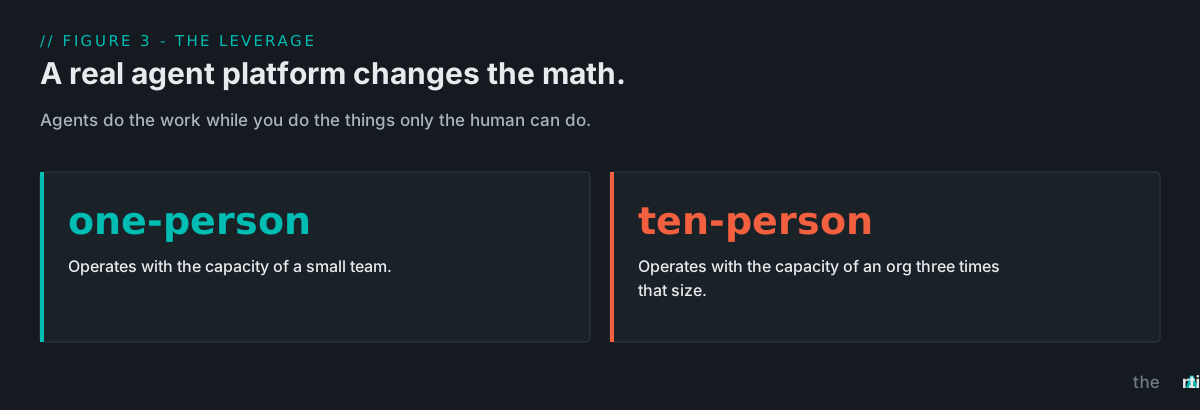
A real agent platform changes the math. The owner of a one-person business operates with the capacity of a small team. The owner of a ten-person team operates with the capacity of an org three times that size. Not because AI types faster — because the agents do the work while you do the things only the human can do.
What you do next
Starter, Small, and Mid tiers come with the full agent roster — ten roles, real authority, real memory, real coordination. Not chatbots wearing role labels. The actual architecture.
Stop typing to your tools. Start directing your staff.
— ImaginAItion