AI Gentrification Is Coming. You've Seen This Before.
They trained the models on your data.
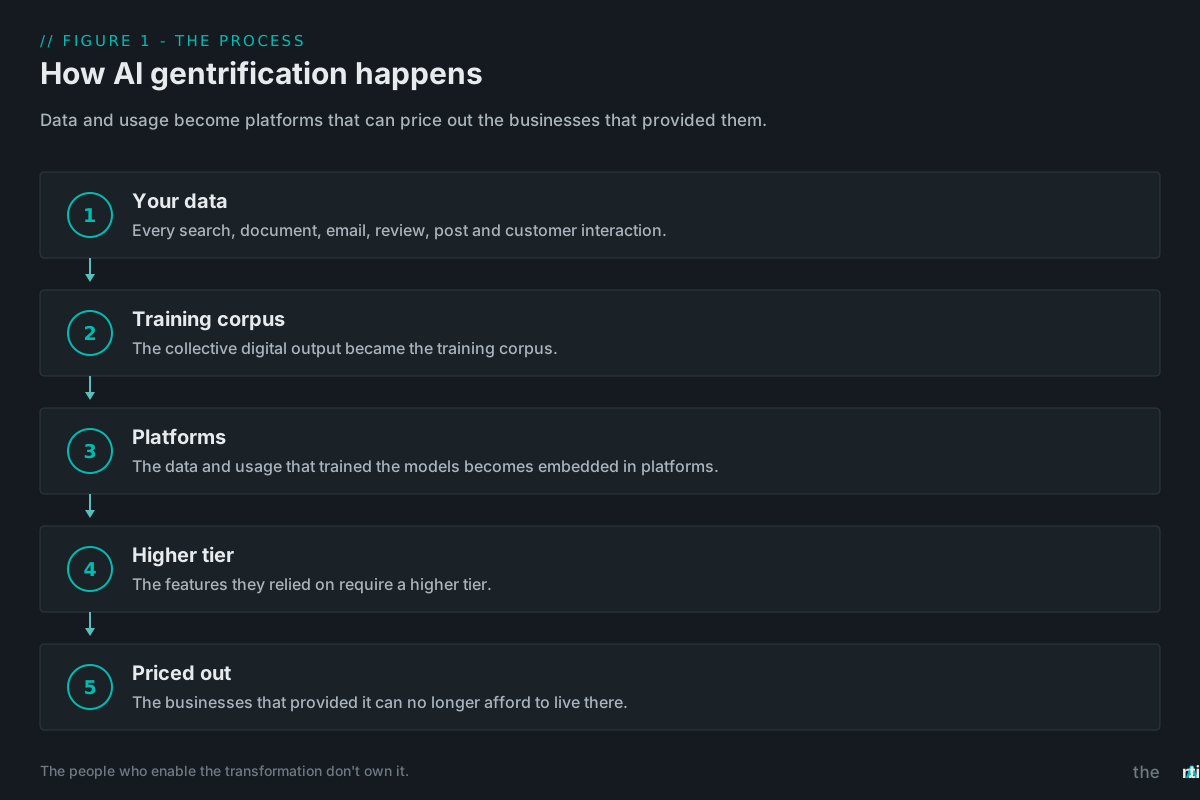
Every search you ran. Every document you created. Every email you sent through a platform that harvested it. Every product review, every social post, every customer interaction that flowed through someone else's infrastructure. The collective digital output of billions of people over decades became the training corpus for the most valuable technology in history.
You didn't sign a licensing agreement. You didn't negotiate a revenue share. You didn't hold a seat at the table when the model weights were set.
You were the raw material.
The Pattern Is Old
This is not the first time.
When the railroads came through in the 19th century, they needed land. The people who owned that land were bought out — sometimes fairly, sometimes not — and the infrastructure was built. The towns that the railroad ran through became valuable. The people who owned the railroad became very wealthy. The farmers who sold their land to make way for the tracks became tenants on the economy the railroad created.
When the internet came, the content creators built the audience. The platforms monetized it. When the terms changed — when the algorithm shifted, when the monetization rules rewrote themselves — the creators had no recourse. They had built on someone else's land.
When SaaS came, the small businesses paid the subscriptions that funded the growth. When the growth arrived, the pricing changed. The early adopters who took the risk became the base that subsidized the enterprise deals.
Every wave of transformative technology has followed the same pattern: the people who enable the transformation don't own it. The people who built the infrastructure around their contribution do.
What Gentrification Actually Means
Gentrification is the process by which a place becomes more valuable and the original inhabitants can no longer afford to live there.
You built the neighborhood. The neighborhood got nice. The rent went up. You got priced out.
AI gentrification is the process by which the data and usage that trained the models becomes embedded in platforms that increasingly price out the businesses that provided it.
It's already happening. The small business that was an early ChatGPT adopter is now being told that the features they relied on require a higher tier. The developer who built on top of an AI API is watching their margin compress as inference costs get passed through. The operator who trusted a platform with their customer data is discovering that the AI trained on it is being sold to their competitors.
You want to be a renter again?
Microsoft Showed You the Playbook
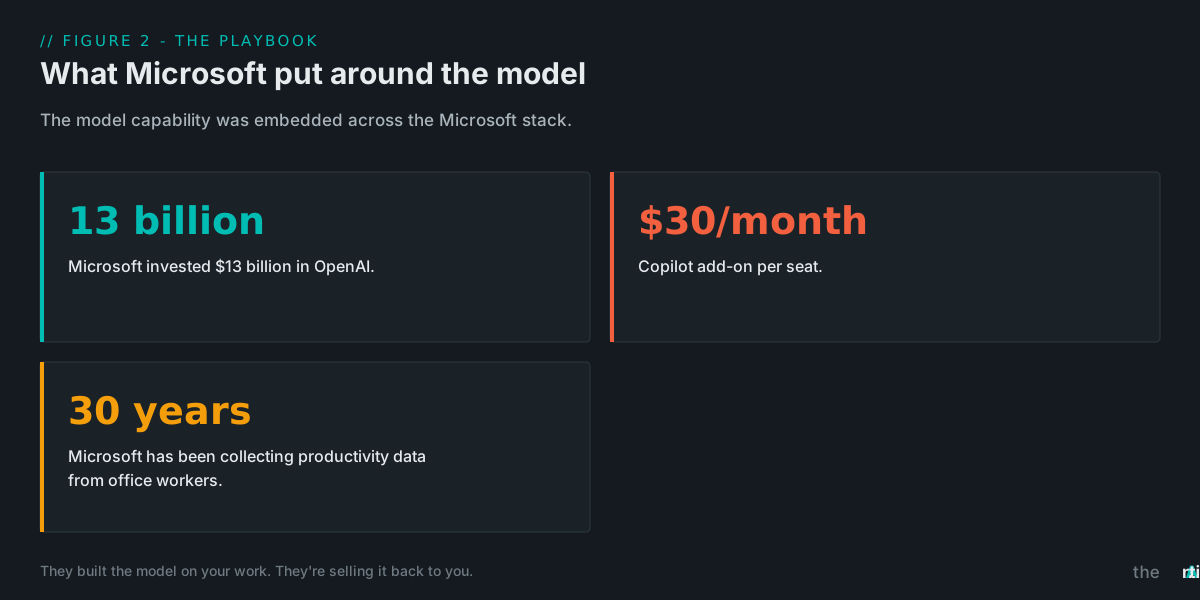
When Microsoft invested $13 billion in OpenAI, they were not investing in a chatbot company. They were investing in the operating layer of enterprise software.
The plan was always Copilot. Take the model capability. Embed it in Office, in Teams, in Azure, in Dynamics. Make the AI the reason you stay on the Microsoft stack. Make switching cost prohibitive.
What did the small business get? A $30/month per seat Copilot add-on. On top of the Microsoft 365 subscription they already pay. Trained on productivity data that Microsoft has been collecting from office workers for 30 years.
They built the model on your work. They're selling it back to you.
What Ownership Changes
When you own a piece of the platform, the equation changes.
Your usage doesn't just make the platform more valuable for Microsoft or Anthropic or Salesforce. It makes the platform more valuable for you — because you hold a stake in what that value becomes.
Your data doesn't disappear into a training corpus you have no relationship with. It flows into a collective you're part of, governed by terms you understood when you joined, improving intelligence that serves your business specifically.
Your monthly payment doesn't fund someone else's rate hike letter. It funds the network you co-own, the pool you participate in, the infrastructure that was built for businesses like yours because businesses like yours are the reason it exists.
This is not idealism. It is a structure. A documented, legally instrument-backed structure where the people who help build the network hold a stake in what it becomes.
Gentrification happens when you don't own the land.
We're giving you the land.
Founding seats available. Apply for yours.