Control vs. Relationship
There are two ways to keep a customer.
You can make leaving expensive. Or you can make staying worth it.
Most of the software industry chose the first one. It worked for a long time. It's about to stop working.
The control playbook
You know it even if you've never named it. The three-year contract with the auto-renewal buried on page nine. The price per seat that climbs every time you hire. The data you put in easily and can only get out as a spreadsheet nobody can use. The workflows so tangled into one vendor's screens that moving would mean retraining everyone.
None of that is an accident. It's a strategy: raise the cost of leaving until leaving isn't worth thinking about. The industry has a polite name for it — switching costs — and it has been one of the most reliable ways to build a durable software business.
Control produces a specific kind of customer: one who stays because the door is heavy.
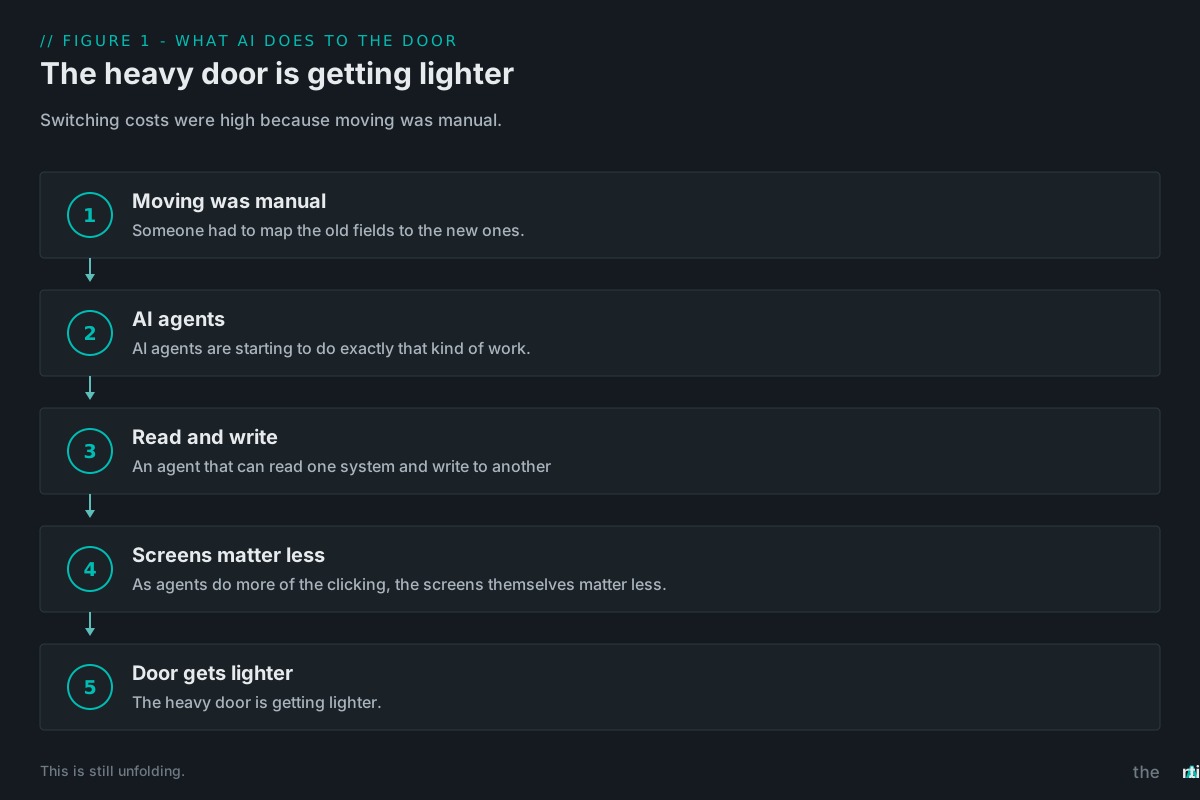
What AI does to the door
Switching costs were high because moving was manual. Someone had to map the old fields to the new ones, clean the records, rebuild the automations, and teach the team a new set of screens.
AI agents are starting to do exactly that kind of work. An agent that can read one system and write to another doesn't care much whose logo is on either one. And as agents do more of the clicking, the screens themselves matter less — the thing your team was trained on starts to disappear from their day.
This is still unfolding, and no one should pretend to know exactly how fast. But the direction is clear: the heavy door is getting lighter. And a business model built on the weight of the door has a problem when the door stops being heavy.
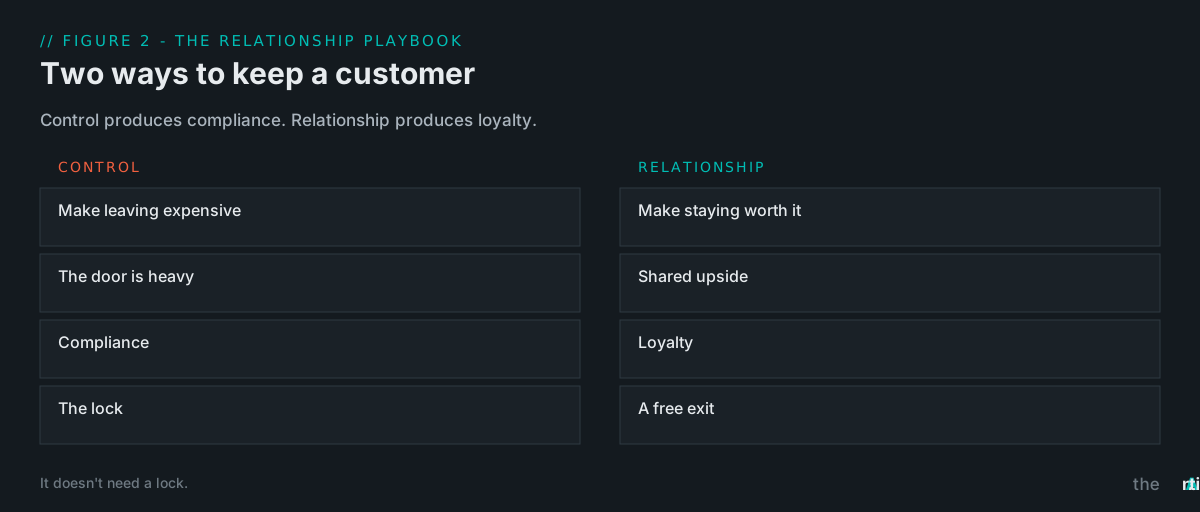
The relationship playbook
The other way to keep a customer is older than software.
It's the supplier who picks up the phone. The partner who tells you the hard number before it costs you. The arrangement where you do better when they do better — so neither side has to wonder whose interests the other is serving.
A relationship keeps people for reasons that survive a free exit: shared upside, a real voice in how things work, and results they can see. It doesn't need a lock.
Control produces compliance. Relationship produces loyalty. Compliance ends the day the lock breaks. Loyalty was never relying on the lock.
One question for every vendor — and for your own business
Ask it about every tool, platform and partner you pay:
If leaving were free tomorrow, would I stay?
If the honest answer is no, you're in a control relationship, and you should expect the terms to get worse as the door gets lighter — because the vendor will feel it too.
Then ask the same question about your own customers. The businesses that come through this shift strongest will be the ones whose customers would stay even with the door wide open.
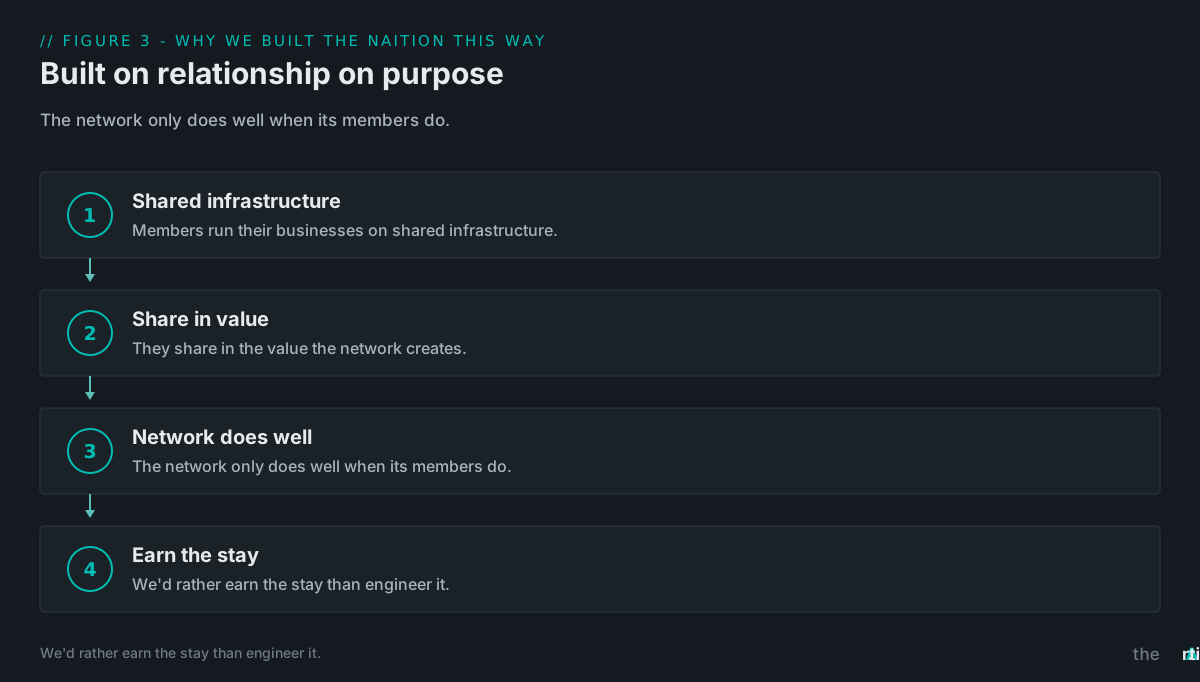
Why we built the nAItion this way
The nAItion is built on relationship on purpose. Members run their businesses on shared infrastructure, and they share in the value the network creates — so the network only does well when its members do. We think that's the only kind of arrangement that holds up once AI makes every door light.
We'd rather earn the stay than engineer it.