From Chat to Action
Every AI tool you've used so far has been good at one thing: talking about the work. Summarizing it. Drafting it. Explaining it. Recommending it.
Almost none of them have been good at the next thing: doing it.
That gap — between "here is a great suggestion" and "here is the suggestion executed" — is where most AI adoption falls apart in small businesses. Owners try a tool, get great outputs, never quite work out how to weave the outputs into the actual flow of the business, and quietly cancel the subscription three months later.
The output was never the problem. The action was.
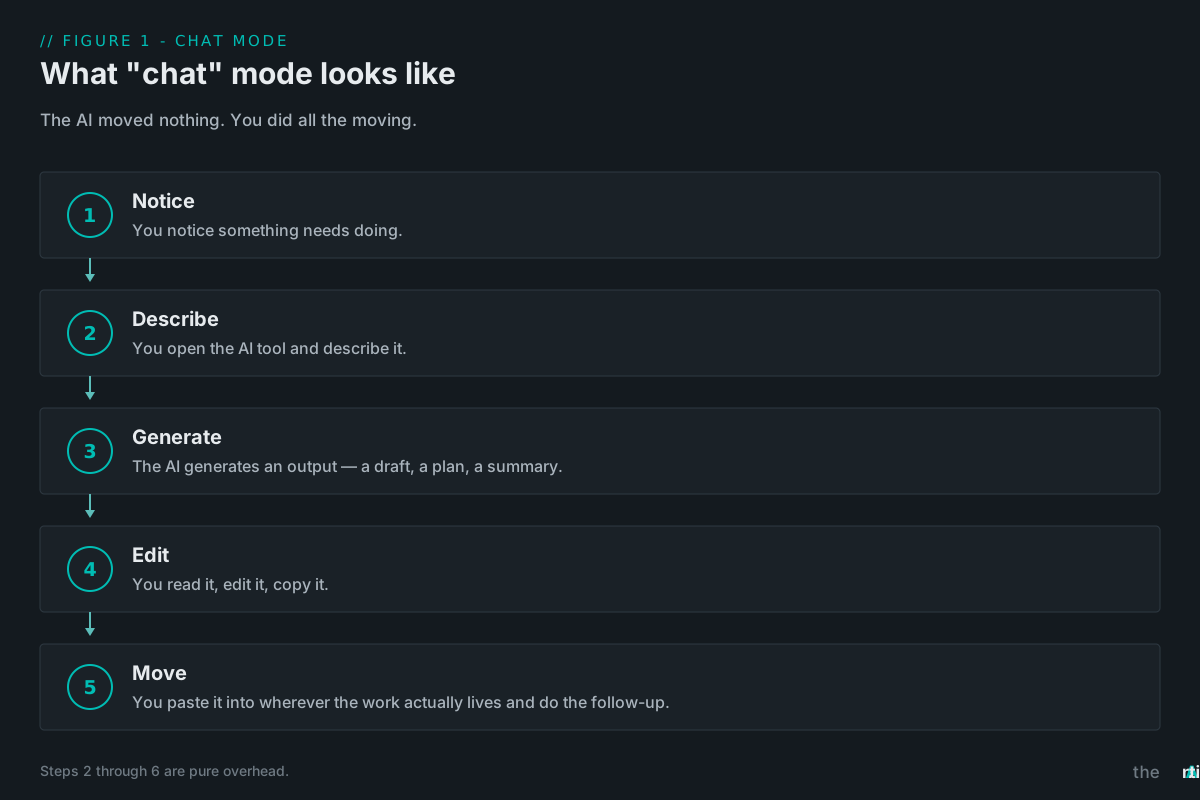
What "chat" mode looks like
In chat mode, the loop goes like this:
- You notice something needs doing
- You open the AI tool and describe it
- The AI generates an output — a draft, a plan, a summary
- You read it, edit it, copy it
- You paste it into wherever the work actually lives
- You do the follow-up the AI suggested
- You close the tab
Steps 2 through 6 are pure overhead. The AI moved nothing. You did all the moving. The AI was a research assistant, not a teammate. Useful, occasionally. But the leverage is small because you still did everything except the writing.
Multiply this by every task in your day and you understand why most owners feel like AI is "interesting" but not transformative. The interaction shape kills the value.
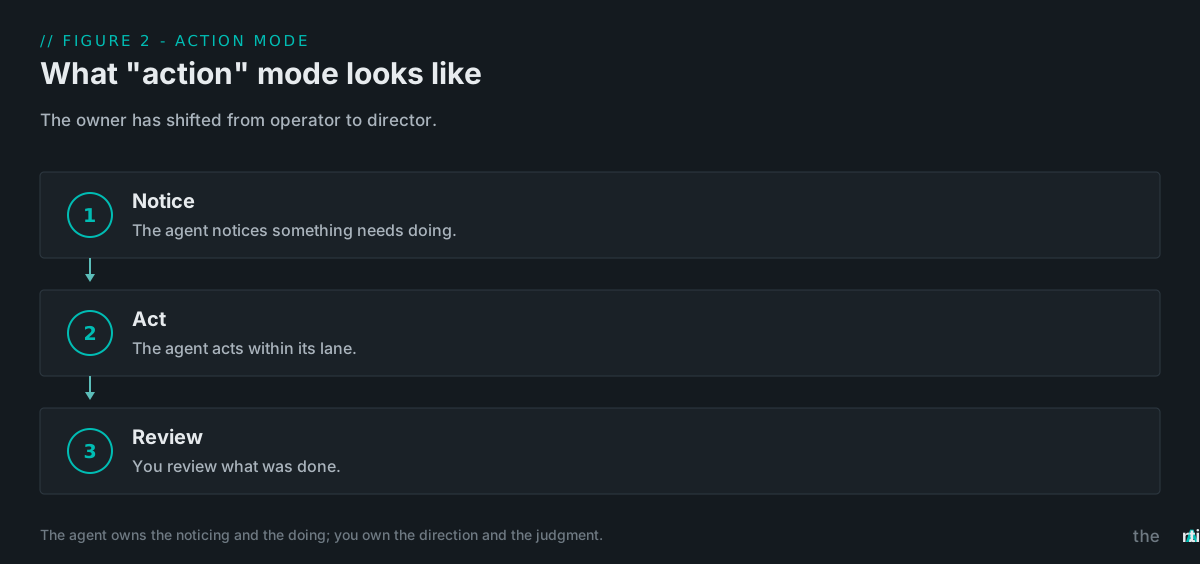
What "action" mode looks like
In action mode, the loop is different:
- The agent notices something needs doing
- The agent acts within its lane
- You review what was done
That's the whole loop. The owner has shifted from operator to director. The agent owns the noticing and the doing; you own the direction and the judgment.
Concrete example. A customer hasn't replied to a proposal in eight days. In chat mode, you'd need to remember, open the tool, ask it to draft a follow-up, copy the draft into your email client, send it, and log the activity in your CRM. Five touches.
In action mode, your Account Manager agent already drafted the follow-up on day six, surfaced it in your review queue with the rationale ("eight days since proposal, prior pattern shows responsiveness drops sharply after day ten"), and is waiting on your approve/edit/reject. One touch — your judgment. The agent handled noticing, drafting, contextualizing, and logging.
The work-per-decision ratio inverts. You make more decisions. You do less work per decision. That's leverage.
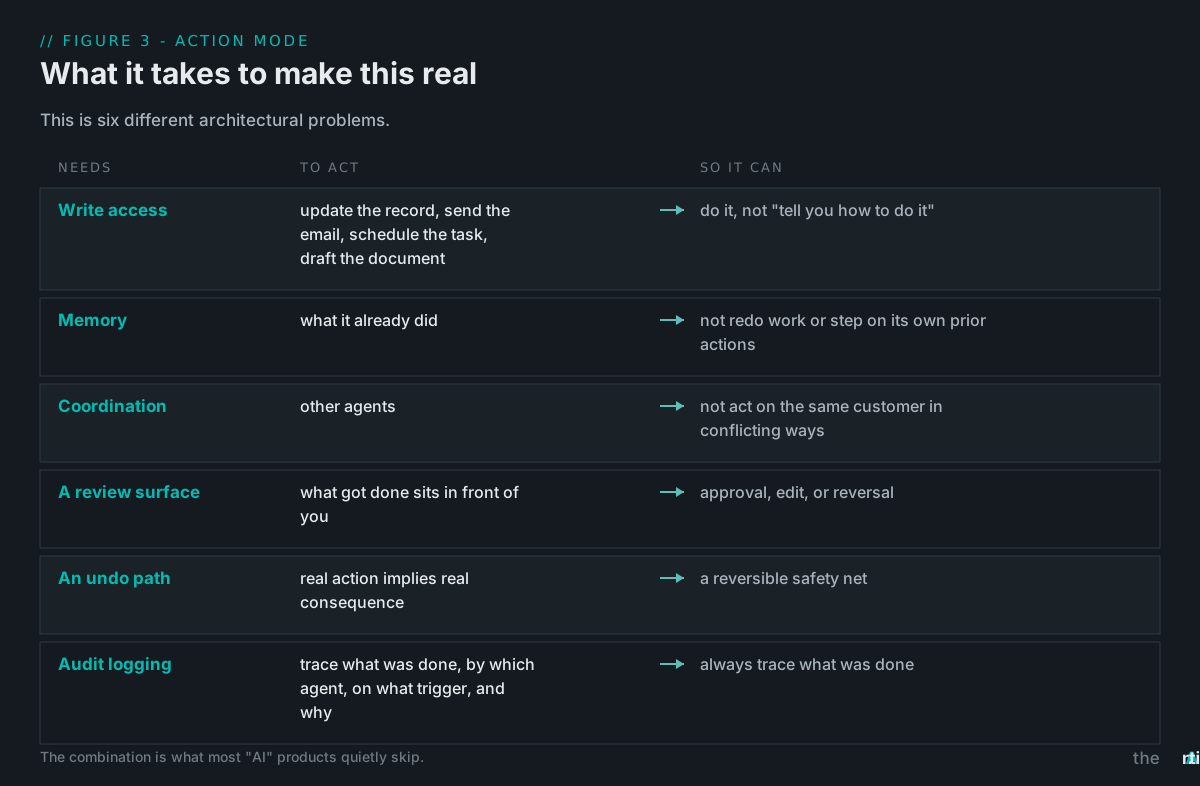
What it takes to make this real
Action mode is hard to build. There's a reason most products stop at chat mode and never cross over.
To act, an agent needs:
- Write access to your real systems, not just read access. The agent has to be able to update the record, send the email, schedule the task, draft the document. Not "tell you how to do it" — do it.
- Memory of what it already did, so it doesn't redo work or step on its own prior actions.
- Coordination with other agents, so the Account Manager and the Sales Engineer and the CFO aren't all acting on the same customer at the same time in conflicting ways.
- A review surface, where what got done sits in front of you cleanly for approval, edit, or reversal.
- An undo path, because real action implies real consequence and humans need a reversible safety net.
- Audit logging, so you can always trace what was done, by which agent, on what trigger, and why.
This is six different architectural problems. Each one is solvable. The combination is what most "AI" products quietly skip — they ship action mode for the cheap cases (email drafts) and bail out to chat mode for everything that matters.
The nAItion was built with all six native. Agents inside the platform have write access to your CRM, your books, your projects, your contracts, your communications — because those systems are part of the same OS, not external APIs that need integration handshakes. The coordination layer is built in. The review queue is the home screen. The audit trail is constitutional.
What changes when you cross the line
The first few weeks of running on action mode are disorienting. You'll catch yourself reaching to do things that have already been done. You'll have to learn to review instead of execute. Some owners find this hard — they're used to being the one who does the doing, and the shift to directing feels like losing control.
It isn't. You are moving up a layer — from doing the work to judging it. The agents handle the execution; you handle the judgment. The judgment is the thing that should have been your job all along — you were just doing it in fifteen-minute increments between executing tasks anyone else could do.
By month two, you'll stop noticing the transition. By month three, you won't be able to remember what it felt like to be the bottleneck on your own business.
What you do next
If you've tried AI tools and felt like the leverage wasn't there — try a platform where the agents act. Not where they chat. Starter, Small, and Mid tiers get you the full action layer on day one.
Stop generating outputs you have to paste somewhere. Start running a business where the work gets done.
— ImaginAItion