Is This a Good Business Model?
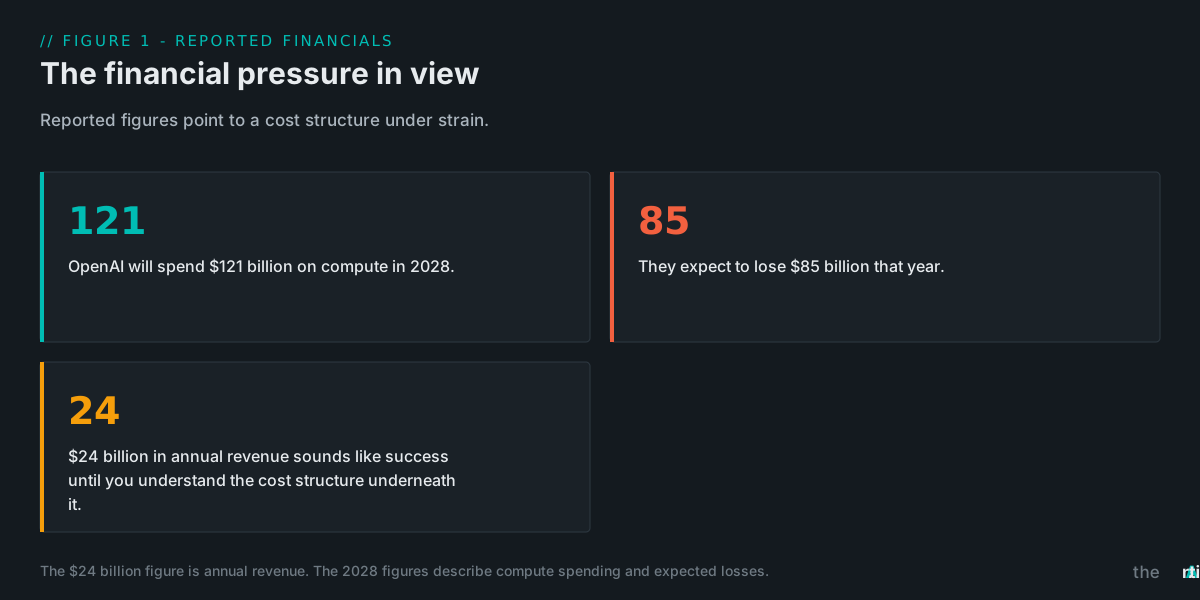
OpenAI will spend $121 billion on compute in 2028.
They expect to lose $85 billion that year.
They do not expect to break even until sometime in the 2030s.
These are not projections from a skeptic. These are the company's own numbers, reported by people who have seen the internal financials. The rocket is real. The runway is not.
The Revenue Problem
$24 billion in annual revenue sounds like success until you understand the cost structure underneath it.
More than half of OpenAI's revenue goes directly back out the door as inference costs — the raw compute required to answer every question, generate every image, write every line of code. The product they're selling costs them nearly as much to deliver as it earns. At scale, that ratio has to improve or the company doesn't survive.
It hasn't improved. It's gotten more expensive.
Every model release is smarter and more capable than the last. Every improvement in capability requires more compute to run. The better the product gets, the more expensive it becomes to deliver. The more users adopt it, the more the cost structure strains.
This is not a growth-stage company working through unit economics on its way to margin. This is a structural tension between capability and cost that no amount of revenue growth resolves on its own.
The Usage Problem
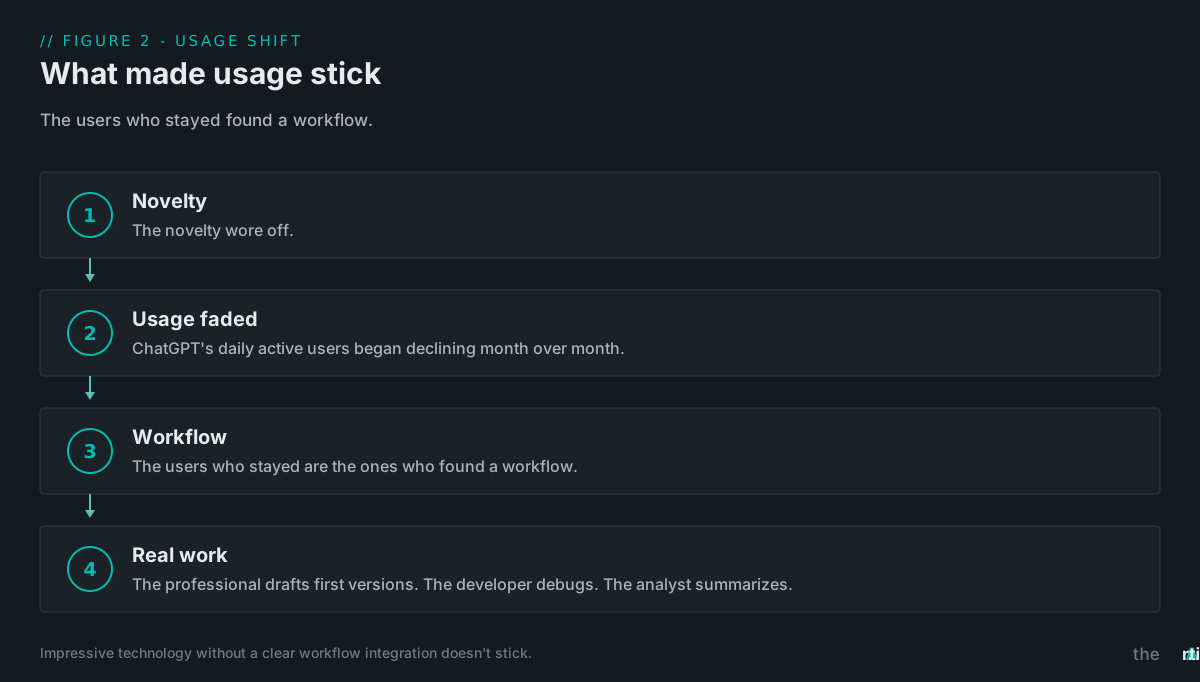
In October 2025, ChatGPT's daily active users began declining month over month.
This is a product that was growing faster than any consumer technology in history. The inflection happened abruptly. What changed?
The novelty wore off.
73% of ChatGPT usage has never been work-related. People used it to write birthday messages, settle arguments, generate images for fun, explore ideas in the abstract. When the new-thing energy faded, the usage faded with it.
The users who stayed are the ones who found a workflow. The professional who uses it to draft first versions. The developer who uses it to debug. The analyst who uses it to summarize. A real and growing base — but not the mass-market consumer phenomenon the first adoption wave suggested.
The mass market tried it. Many of them decided it wasn't for them yet. Not because the technology isn't impressive. Because impressive technology without a clear workflow integration doesn't stick.
The Application Layer Problem
Here is the structural issue that the revenue numbers and the DAU numbers both point toward:
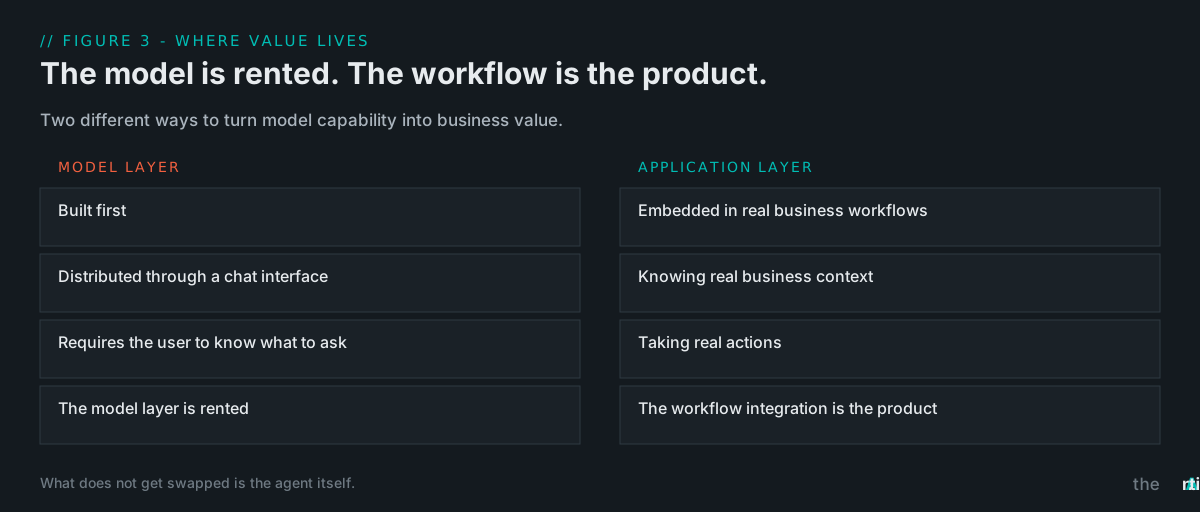
The model layer was built first. The application layer was left to everyone else.
OpenAI built the most powerful general-purpose reasoning engine in history and distributed it through a chat interface. The chat interface is the worst possible wrapper for the most powerful possible tool. It requires the user to know what to ask. It provides no context about the user's business, their customers, their history, their goals. It remembers nothing across sessions without explicit configuration. It acts on nothing without explicit instruction.
It is a tool that requires a skilled operator to produce value. And skilled operators represent a fraction of the market.
The application layer — the layer that takes the model's capability and embeds it in actual workflows, actual business contexts, actual operational systems — that's where the value gets unlocked. That's where the usage becomes sticky. That's where the cost structure starts to make sense because the value delivered per dollar of compute becomes quantifiable.
OpenAI didn't build that layer. They gave everyone an API and waited.
The Rate Hike Is Coming
A company spending $121 billion and losing $85 billion in a single year is a company under pressure.
Pressure finds relief somewhere. For a consumer subscription business with tens of millions of paying users, the relief valve is pricing.
ChatGPT Plus is $20/month today. It will not be $20/month in three years. The math doesn't allow it. The investors don't allow it. The infrastructure cost curve doesn't allow it.
When the rate hike comes — and it will come — it will hit the users who have built their workflows around the platform. The ones who depend on it. The ones who have the most to lose from switching. That's not a coincidence. That's the model.
A Different Model
The nAItion is built on the premise that the application layer is where the value lives.
Not the model. The application. The AI agents embedded in real business workflows, knowing real business context, taking real actions, getting smarter from real usage.
The models that power the platform are rented from the companies that built them. When better models arrive, the new capability gets brought in underneath. What does not get swapped is the agent itself — the context it has built inside your business, the history it has with you, the identity that carries from one session to the next. The model layer is rented. The workflow integration is the product.
This is the sustainable version of the AI business model. The one where usage generates value that justifies cost. The one where customers don't leave when the novelty wears off because the platform is doing real work in their real business. The one where pricing is tied to usage and value rather than to what the market will bear before they leave.
OpenAI built the engine. The question was always who would build the car.
The nAItion is the application layer. Find your tier.