Mixed Mesh Economics
Here is a fact most SaaS companies don't want you to think about.
When you pay $99 a month for a tool, you are not paying for what it costs them to run your account. You are paying for what it costs them to run your account, plus what it costs to acquire you, plus their sales team, plus their marketing budget, plus their VC's expected return, plus the margin their CFO has been told to hit. Your $99 covers maybe $4 of actual compute and storage. The other $95 is the rent layer.
That's fine when there's one of you. When there are ten thousand of you all paying the rent layer on top of the same shared infrastructure, the math gets interesting. And when the network is co-owned, the math becomes something SaaS has never let you see.
This is what we mean by mixed mesh economics. Let me show you.
What "mesh" means
A mesh is a network where every node benefits from every other node being there. The internet is a mesh — your connection is more useful because everyone else is also connected. A power grid is a mesh — load balances across the grid, redundancy comes from the grid, costs spread across the grid.
The nAItion is a mesh. Every member is a node. Every node consumes shared infrastructure — AI models, agents, modules, integrations, security, compliance, hosting, support — and every node contributes to the cost base that powers it.
The more members, the cheaper per-member it becomes to run the infrastructure. That part is intuitive. The non-intuitive part is what happens to the savings.
What "mixed" means
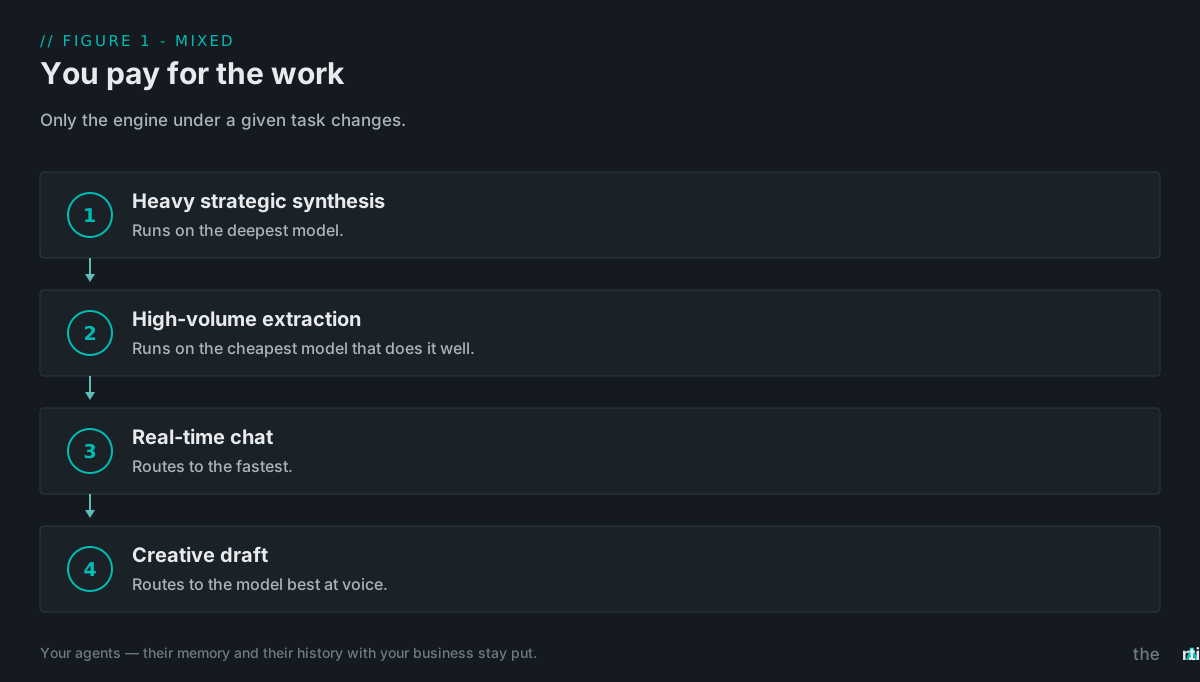
The infrastructure isn't homogeneous. We route across many AI providers — Anthropic, OpenAI, Google, xAI, Mistral, open-weight models — depending on what each task needs. A heavy strategic synthesis runs on the deepest model. A high-volume extraction runs on the cheapest model that does it well. A real-time chat routes to the fastest. A creative draft routes to the model best at voice.
This routing is invisible to you. You pay for the work, not for the model. We absorb the model arbitrage. What does not get swapped is your agents — their memory and their history with your business stay put; only the engine under a given task changes. When a new model arrives that does the same work at a tenth of the cost, the network captures that win immediately — you don't have to re-architect anything.
A single-vendor SaaS company can't do this. They picked their model years ago. They're locked into pricing. They can't shop the field every week.
We can. And we do.
What flows back
Here's where it stops looking like SaaS and starts looking like something new.
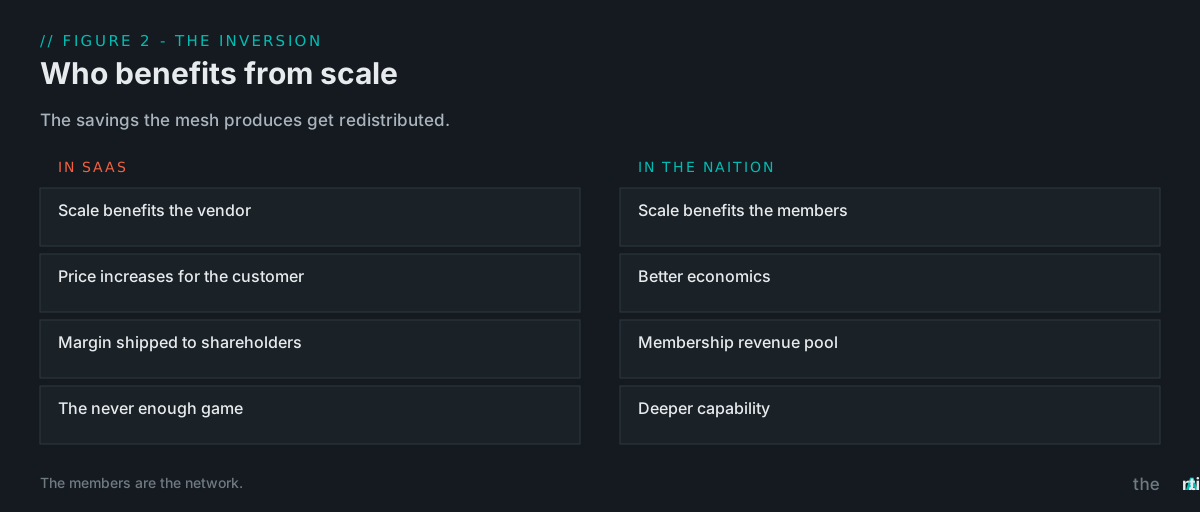
The savings the mesh produces don't get pocketed as margin and shipped to shareholders to feed the never enough game. They get redistributed — back to members through better economics, deeper capability, and the membership revenue pool that every paid member tier holds a share of, weighted primarily by tier. Founding Believers get an accelerated pro-rata share on top, reflecting their day-one status.
When the mesh runs leaner, members benefit. When the mesh gets a new capability, every member gets it. When the mesh wins a deal at the enterprise tier, that revenue flows into the same pool the SMB Starter member's invoice contributes to.
This is the inversion. In SaaS, scale benefits the vendor and gets repackaged as price increases for the customer. In the nAItion, scale benefits the members because the members are the network.
The economics in plain numbers
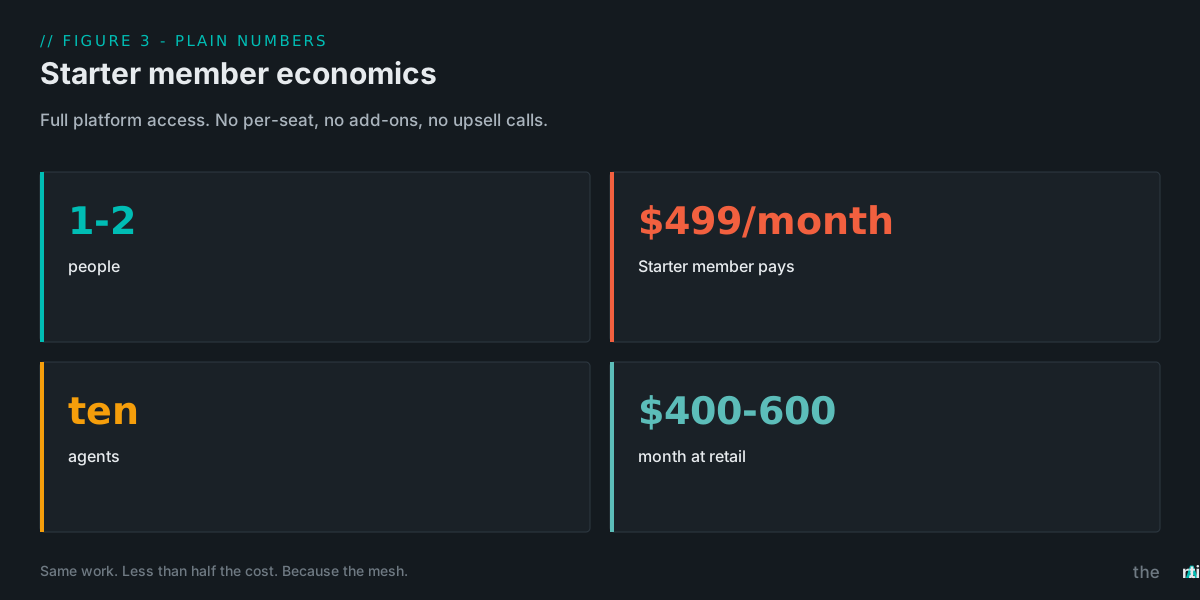
A Starter member (1-2 people) pays $499/month for full platform access — CRM, books, projects, contracts, ten agents, all integrations, all security, all support. No per-seat, no add-ons, no upsell calls.
To assemble the equivalent stack at retail: Salesforce ($150/seat) + QuickBooks ($90) + Asana ($25/seat) + DocuSign ($40) + an AI assistant subscription ($30) + the integration layer holding them together ($50+) — easily $400-600/month for a one-person operation that doesn't even include the agent layer because it doesn't exist at retail.
Same work. Less than half the cost. Because the mesh.
Where this goes
As the network grows, this gap widens. A 1,000-member mesh is more efficient than a 100-member mesh. A 10,000-member mesh is dramatically more efficient still. The marginal cost of adding member 10,001 is close to zero; the marginal benefit to the existing 10,000 is real.
That's a flywheel SaaS companies structurally cannot match, because their incentive is to charge the new member as much as the old one. Ours is the opposite.
What you do next
If you're on any paid tier, you already participate in this. Your monthly fee covers the infrastructure your work runs on, plus your share of the network's compounding capability.
Every paid tier already participates in the upside, not just the savings — your share of the revenue pool comes with the membership. If you want a day-one stake on top, there's Founding Believers: investment opportunities are available.
Update, 7 Oct 2026: the Founding Believer seat levels are retired. Investment opportunities are available: investors.imaginaitioninc.com.
The mesh is the math. Membership is the position.
— ImaginAItion