Per-Seat Licensing Is Dead
It should have died a long time ago.
The idea made sense once. Software lived on servers. Each user needed a license. The license paid for the seat. Simple, trackable, defensible.
That world is gone. Has been for years. What replaced it wasn't a better model — it was the same model with better marketing.
Per-seat licensing didn't die. It learned to disguise itself.
What Per-Seat Licensing Actually Does
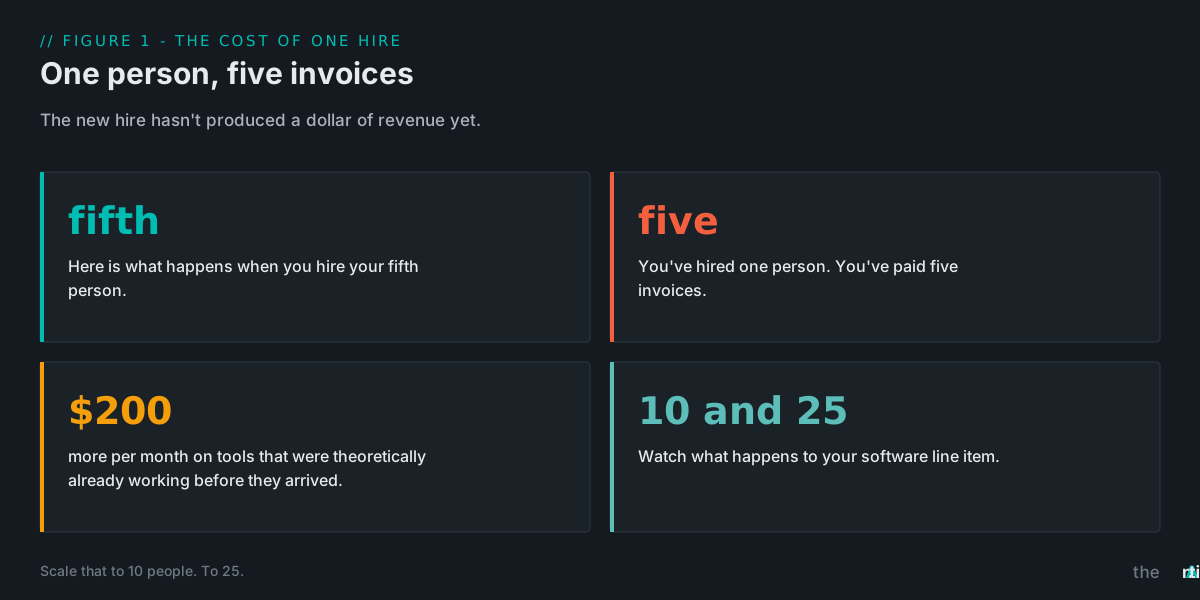
Here is what happens when you hire your fifth person.
You open your software stack. You add a seat to your CRM. Another to your project management tool. Another to your communication platform. Another to your accounting software. Another to your marketing automation tool.
You've hired one person. You've paid five invoices.
The new hire hasn't produced a dollar of revenue yet. You've already spent $200 more per month on tools that were theoretically already working before they arrived.
Scale that to 10 people. To 25. Watch what happens to your software line item.
Now watch what happens when you need to let someone go. The seat doesn't disappear automatically. The invoice doesn't adjust itself. Someone has to remember to go into five different platforms and remove a user — and if they forget, you pay for a ghost.
This is not an accident. This is the model working exactly as designed.
The Seat Is Not the Value
Here's the lie at the center of per-seat pricing: it pretends the value is the user, not the work.
The value of your CRM isn't the number of people who can log in. It's the customer relationships it helps you manage. The value of your project management tool isn't the number of seats. It's the projects that get delivered. The value of your AI platform isn't the number of users. It's the intelligence it brings to your business.
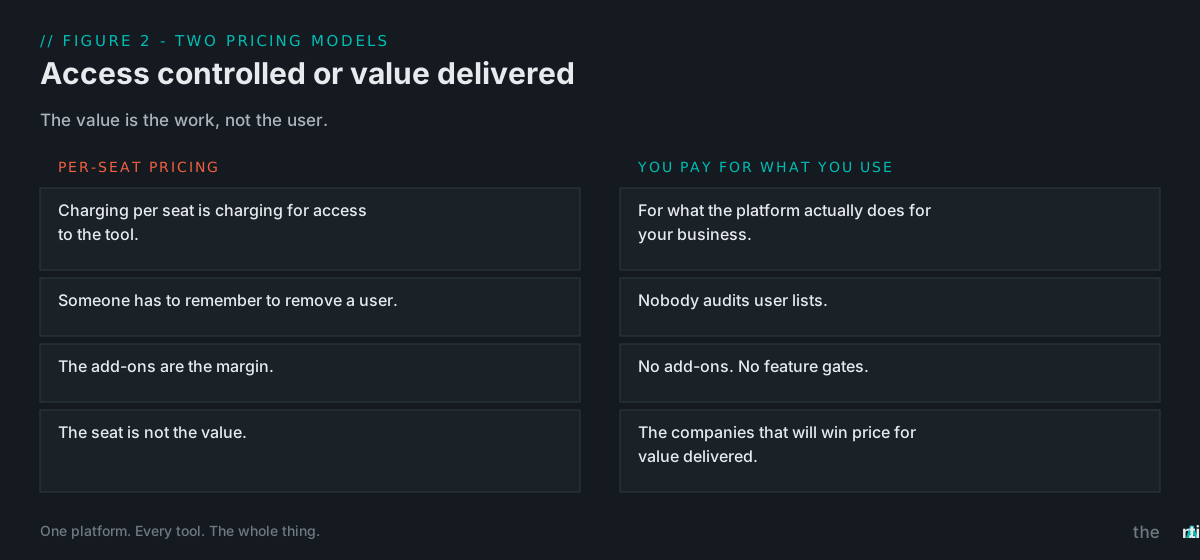
Charging per seat is charging for access to the tool, not for the value the tool creates.
It's the equivalent of a gym charging you every time you bring a friend — not because your friend costs them more in equipment wear, but because your friend is another revenue opportunity they don't want to miss.
The Add-On Is the New Seat
Per-seat pricing evolved. The new version is more sophisticated and harder to fight.
You sign up for a platform at a reasonable base rate. Then you discover that the feature you actually need — the AI assistant, the advanced reporting, the API access, the additional storage, the premium support — lives in the next tier. Or the add-on. Or the "professional" edition.
The base product is the loss leader. The add-ons are the margin.
By the time you have the tool configured the way your business actually needs it, you're paying three times what the website advertised. And you're locked in — your data is there, your team is trained on it, your processes depend on it.
Switching costs more than the price increase. That's not a coincidence.
What the Alternative Looks Like
You pay for what you use.
Not for how many people use it. For what the platform actually does for your business — the agent calls, the documents generated, the workflows run, the intelligence applied.
Your whole team uses the platform. Nobody counts seats. Nobody audits user lists. Nobody gets locked out because the budget review landed at the wrong time.
Your allowance is based on the size of your business — not the size of your headcount. A solo operator pays solo rates. A team of 10 pays team rates. A company of 25 pays accordingly. Overage is billed at a fair per-unit rate, transparently, before you hit the ceiling.
No add-ons. No feature gates. No "professional edition" that has the thing you actually need. One platform. Every tool. The whole thing.
Why This Matters Right Now
The AI moment makes per-seat pricing more absurd than it has ever been.
An AI agent doesn't have a seat. It works across your entire business simultaneously. It's in your CRM and your books and your customer communications and your marketing campaigns at the same time. Charging per seat for a tool that operates at the level of your entire organization is like charging a factory per worker for the electricity that runs the machines.
The companies that will win the AI era are the ones that price for value delivered — not for access controlled.
Per-seat licensing is the old model trying to survive contact with a new reality.
It's not surviving.
The Next Wave Is Already Pricing Itself
Watch closely. The next wave of per-seat pricing is already rolling out — and this time the seat isn't a human. It's an AI.
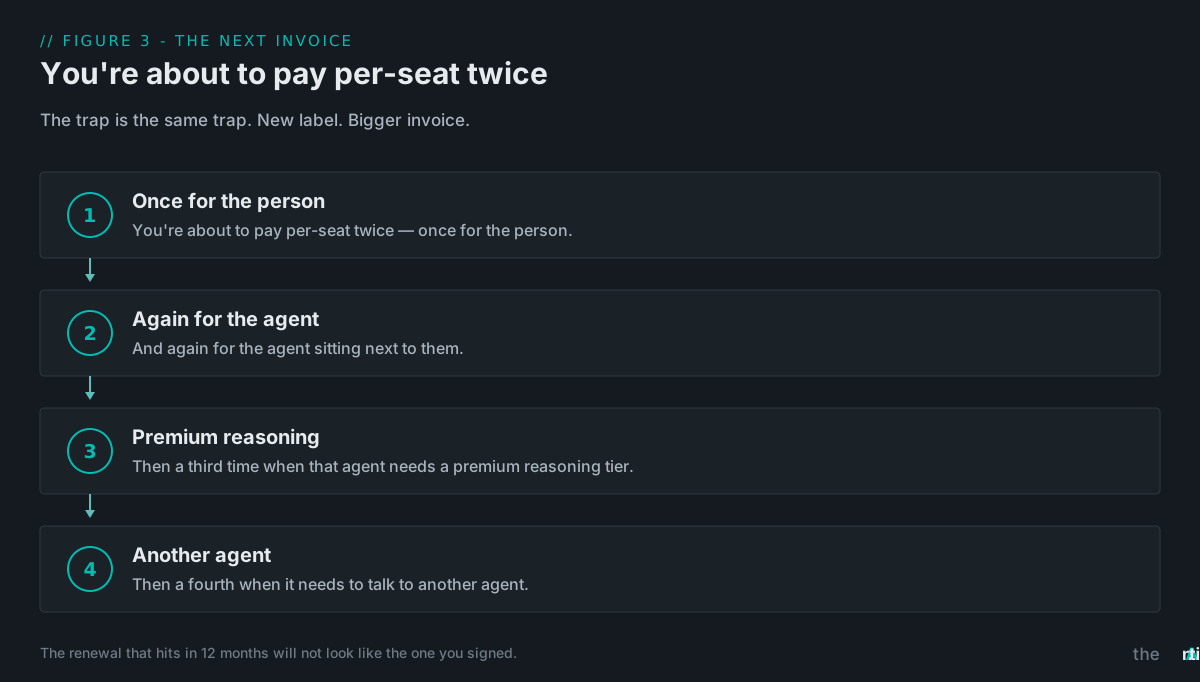
Every major SaaS vendor is rebranding the same model: "per-agent pricing," "AI seats," "Copilot licenses," "$30 per user per month for the AI add-on." You're about to pay per-seat twice — once for the person, and again for the agent sitting next to them. Then a third time when that agent needs a "premium reasoning" tier. Then a fourth when it needs to talk to another agent.
The trap is the same trap. New label. Bigger invoice.
If you're still on per-seat SaaS today, the window to get out is closing. Once the AI seat charges land inside the contracts you've already signed, switching costs go up, not down. The renewal that hits in 12 months will not look like the one you signed.
Get out now. Move to usage-based before the agents start counting themselves.
The nAItion charges for usage, not headcount. Unlimited users. No add-on fees. No feature gates. See how it works.