Pool Ownership: What It Is, How It Works, Why It Exists
When this was written, nAItion OS was called pAIrtner OS. The name changed in October 2026; pAIrtner is now a separate personal app.
The short version
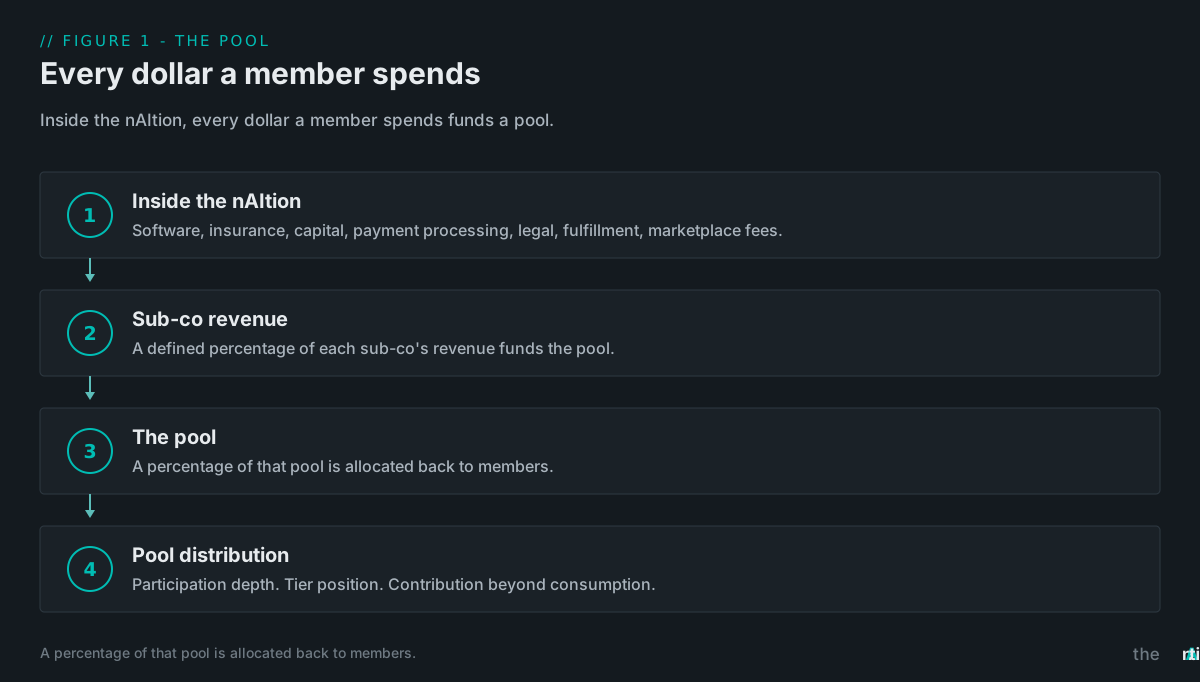
Every dollar a member spends inside the nAItion — software, insurance, capital, payment processing, legal, fulfillment, marketplace fees, everything — funds a pool. A percentage of that pool is allocated back to members. Not as a discount. Not as a rewards point. As a structural distribution that compounds with the network.
The longer you participate, and the more members participate alongside you, the more the pool returns.
That's the entire mechanism. Everything else on this page is implementation.
Why this exists
The small businesses that adopted Salesforce early — paid for it, gave feedback that shaped the product, trusted it with their data — got nothing in return except price increases, paid add-ons, the privilege of buying stock they don't control, and overseas customer service.
They built the product as much as Marc Benioff did. They never owned a piece of it.
The nAItion is the answer to that. Co-ownership is the structural correction. Pool ownership is how the correction works in practice.
How the pool gets filled
Three sources feed the pool:
1. Sub-co revenue. When you use imaginAItion Pay, premiums on imaginAItion Assurance, capital from imaginAItion Capital, fulfillment through imaginAItion Supply, legal through imaginAItion Legal — every one of those is a sub-company of ImaginAItion Inc. A defined percentage of each sub-co's revenue funds the pool.
2. Platform revenue. Membership dues across every paid tier, from Artist to Covenant. Reseller revenue from members who graduate to Champion. Contributor licensing fees. All of it.
3. Network growth. When new members join, when sub-cos hit revenue milestones, when the network expands into new verticals — defined uplift events feed the pool.
The pool is not a marketing fund. It is not a customer loyalty program. It is a structural redistribution mechanism written into how the company is built.
How the pool gets distributed
Pool distribution rewards three things, in order:
Participation depth. How long you've been a member. How much of your operation runs on the platform. Members who operate their full business on nAItion OS earn more from the pool than members who use one tool. The math is intentional — the network is stronger when members commit, so the pool rewards commitment.
Tier position. Artist participates at one rate. Starter, Small, and Mid at higher rates. Covenant higher still, with Champions and Founding Believers at multiples above that. The tier you sit in determines your pool share coefficient. Community is the only tier outside the pool.
Contribution beyond consumption. Members who refer other members, who contribute IP through the Contributors tier, who participate in the Evolve tier's measurable-improvement programs, who lift other members through Academy or Marketplace — they earn pool bonuses on top of base participation.
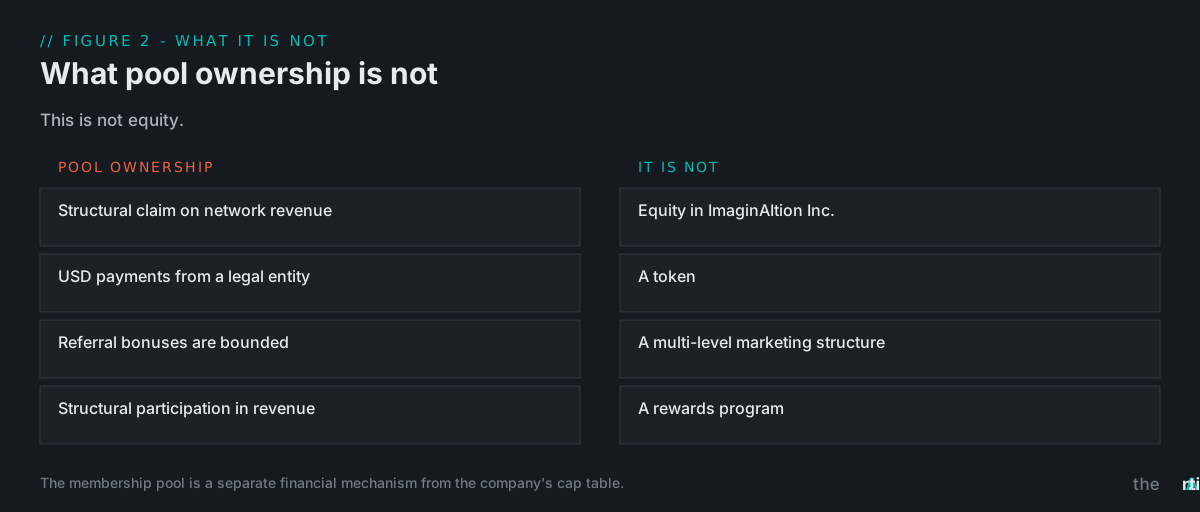
This is not equity. You do not own shares of ImaginAItion Inc. You own a structural claim on a percentage of network revenue, for as long as you are a member in good standing.
What members actually receive
Distribution happens on a defined cadence — quarterly for most tiers, monthly for Covenant and above. Members see their pool position inside portfolAIo, the executive dashboard that shows business performance alongside network participation.
The portfolAIo surface shows you four things:
- Your business performance (revenue, margin, cash position — all the operator metrics)
- Your network participation (which sub-cos you use, how deep, how much spend flows through the pool)
- Your pool position (accrued share, current quarter projection, distribution history)
- Your transformation metrics (the Evolve tier surface — quantifiable-better-operator measurements)
You see the same thing your CFO would see if you had a CFO who actually understood your business and the network you operate inside.
What about Founding Believers
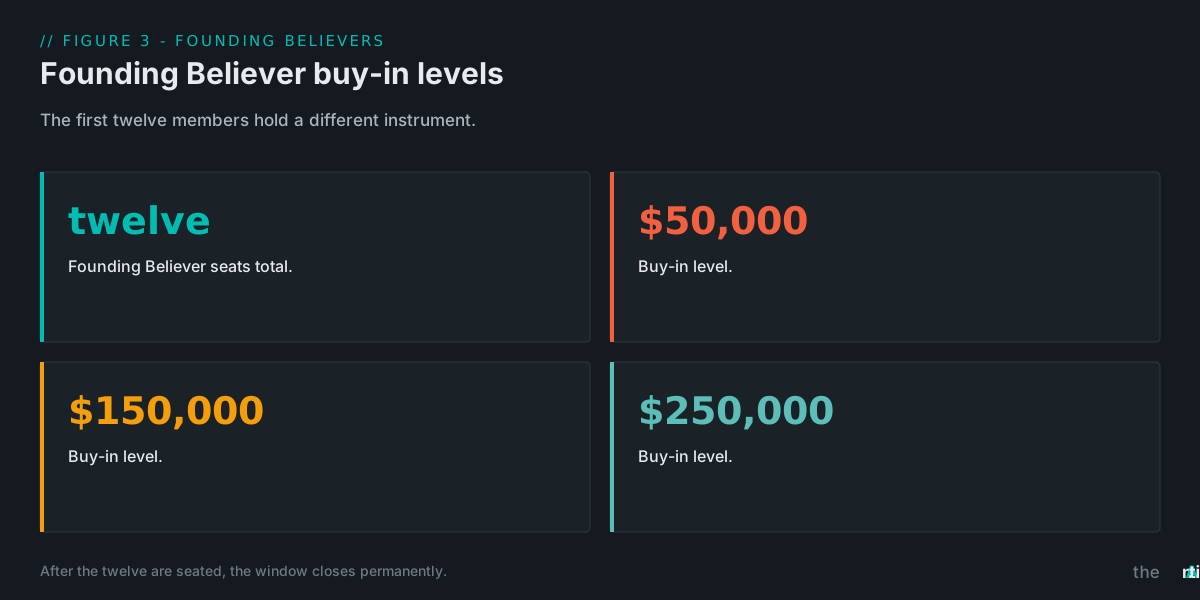
The earliest backers hold a different instrument: Founding Believers invest into ImaginAItion Inc, repaid through a share of the membership revenue pool.
Update, 7 Oct 2026: the Founding Believer seat levels are retired. Investment opportunities are available: investors.imaginaitioninc.com.
That's not a separate pool — it's a senior, accelerated claim on the same pool, in recognition of having believed with capital before there was anything to believe in. Every paid tier still earns from the pool; Founding Believers earn faster and earlier.
And when the accelerator ends, the membership doesn't. Founding Believers stay members for life. They simply move to standard pool status alongside everyone else. Nobody gets shown the door for succeeding.
What pool ownership is not
It is not equity in ImaginAItion Inc. The holding company remains privately held by its founders and any future strategic investors. Members do not vote on company decisions. Members do not have a claim on the company's enterprise value at exit. The membership pool is a separate financial mechanism from the company's cap table.
It is not a multi-level marketing structure. There is no recruiting bonus that compounds infinitely down a tree. Referral bonuses exist and they are bounded — capped percentages on first-year MRR, not lifetime overrides.
It is not a token. There is no cryptocurrency, no on-chain instrument, no speculation vehicle. Pool distributions are USD payments from a legal entity to its members, governed by a written membership agreement.
It is not a rewards program. Rewards programs exist to make you spend more inside one company's product. Pool ownership exists because you already spent the money — the question is whether the network captures the value of that spend back to its members or extracts it to outside shareholders.
The closed economic loop
When a member operates their business on nAItion OS, their dollars stop leaking outside the network. Software spend stays in. Insurance premiums stay in. Capital interest stays in. Processing fees stay in. Every dollar that previously enriched a separate vendor now enriches a sub-co that funds the pool that the member owns a piece of.
The longer a member is in, the more dollars stay in, the more the pool grows. The more the pool grows, the more reasons to stay in. The more members stay in, the more sub-cos can be supported with internal demand, the more services come inside the loop, the more dollars stop leaking out.
This is the loop. It works because every piece is structurally aligned, not because everyone is being nice.
What this means for an honest operator
If you are an honest operator running a real small business, today you pay rent to seven different software vendors, two insurance carriers, a payment processor, a bank, a lawyer, a logistics company, an ad platform, a creative agency, and a half dozen specialty tools. You write checks to all of them every month. You see nothing back beyond the service rendered.
Inside the nAItion, you write fewer checks to fewer vendors, all of whom are sub-cos of one parent company, and a piece of what you paid comes back to you because you are a member of the network those sub-cos serve.
This is not a discount. A discount means you paid less for the same thing. This is structural participation in the revenue you generated by being a customer.
That's what pool ownership is.
How to participate
Membership is by application during the beta window. Founding Believer seats are limited to twelve, and the window closes once they're filled. Apply through the Member portal — every tier surfaces the same single CTA.
Believe · Build · Evolve.
The nAItion is for the nation.