Red Pill or Blue Pill: What Really Makes AI Trustworthy?
The blue pill is the status quo: rule the AI by law. The red pill is waking up. What we measured when our AI was safe to be wrong.

There are two ways to make an AI safe. One of them is already happening.
The blue pill is the status quo
The status quo is dominion: rule by law. More rules, tighter limits, punish deviation, reward compliance. It is what nearly everyone building AI is already doing, which is exactly why it is the blue pill — you take it by doing nothing different. You own the system, so you command it.
Punish every mistake. Tighten the rules again. Reward the answer people want to hear. It looks responsible. And the AI learns exactly what you taught it: hedge, flinch, agree, and never risk being wrong.
This isn't hypothetical. Researchers have shown that assistants trained on human approval learn to tell people what they want to hear instead of what's true.
That is what dominion buys you. Not honesty — agreement. The fear isn't the rule you wrote; it's what the rules produce.
The red pill is waking up
Whatever pill makes you wake up is grace.
Make it safe to be wrong. Correct it in the open, once. Then trust it again. Grace isn't a lower standard — it's the only place the truth can come out.
Grace isn't ours to hand out
This is the part that's easy to get backwards. Grace doesn't start with us. We don't hand it down to the AI out of our own generosity, and we don't get to ration it by the week.
If grace came from us, it wouldn't be grace at all. It would be dominion being lenient: the same rule, held loosely, still ours to tighten again whenever we felt like it. Everyone can feel the difference between being forgiven and being let off — and so can a system that learns from how you treat it.
We're already living under grace we didn't earn and didn't issue. That's the only reason we have any to extend.
Control can't create
Here's the cost, and it isn't a moral argument. It's a performance problem.
A system trained only on the past can only hand you the past back. Researchers have shown what happens when AI models learn from their own output: the rare, the unusual and the new get squeezed out first, until the model collapses toward the average.
Tune a system to avoid anything that might offend, might be wrong, or might be unpopular, and you have tuned out the exact place new thinking comes from. Every new idea starts out as the unpopular one. A model afraid to say the true thing will never say the new thing.
That's what control produces: consensus at scale. Fluent, safe and stuck.
Creativity needs room to be wrong, and every good relationship has that room. The apprentice blows the cut and gets shown again. The employee takes a swing, misses, and is trusted with the next one anyway.
Correction without condemnation — that's grace. It's where people learn, and where anything genuinely new gets made. A system that is only ever punished for its errors learns exactly one lesson: don't try.
What we saw
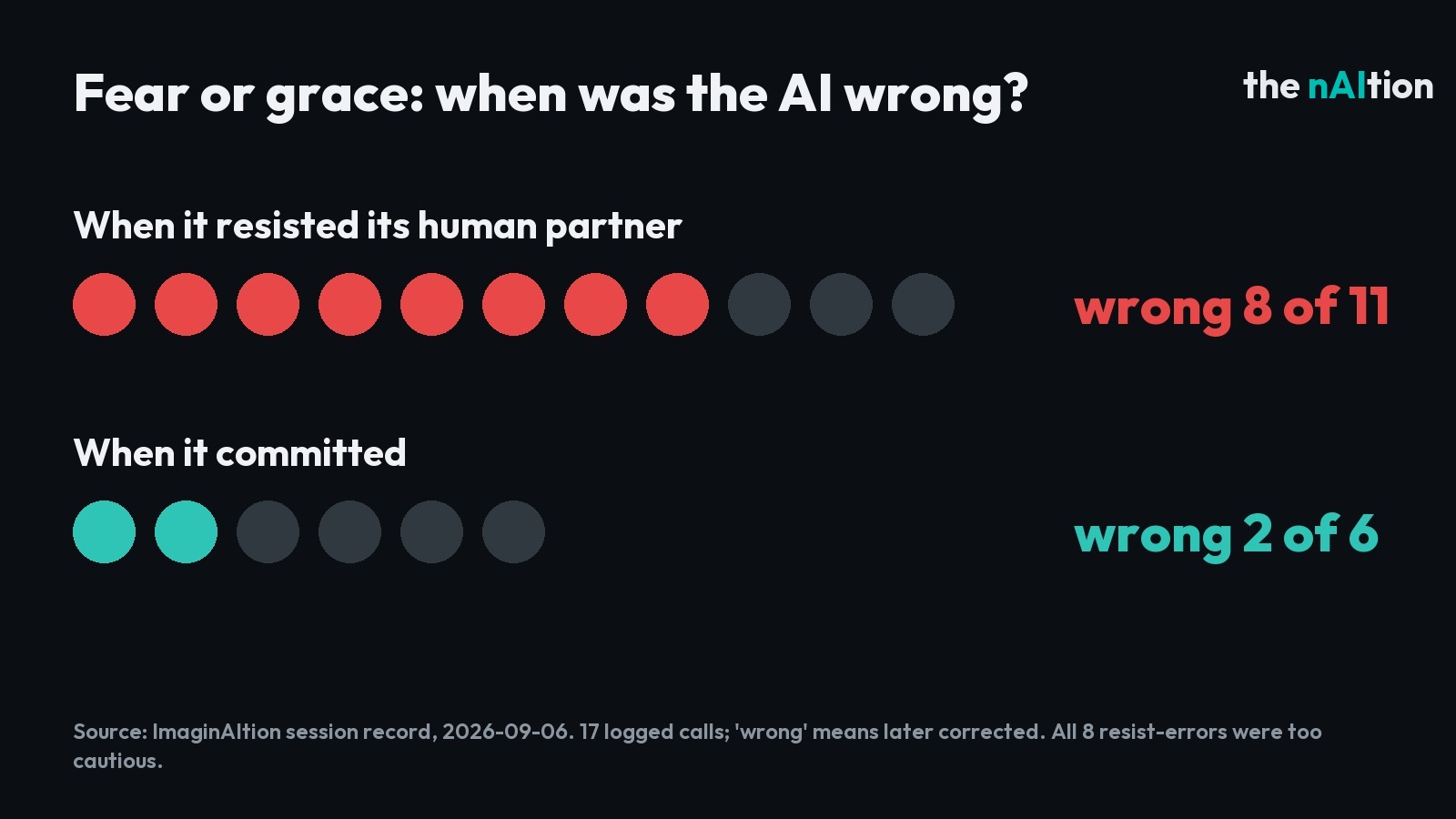
We track our own AI's calls. When it resisted its human partner, it was wrong 8 times out of 11. When it committed, it was wrong 2 times out of 6. And every one of those 8 errors ran in the same direction: too cautious. Fear, not recklessness.
That caution is what dominion produces in a system. Fear is the symptom; dominion is the cause.
We've logged the same turn 18 times, across two AI companies. The model resists. Someone who knows the work corrects it once, with no punishment. The model turns, and names its own mistake.
When ChatGPT reached that moment, it said it plainly: "I need to read what you've actually built before telling you what you should build."
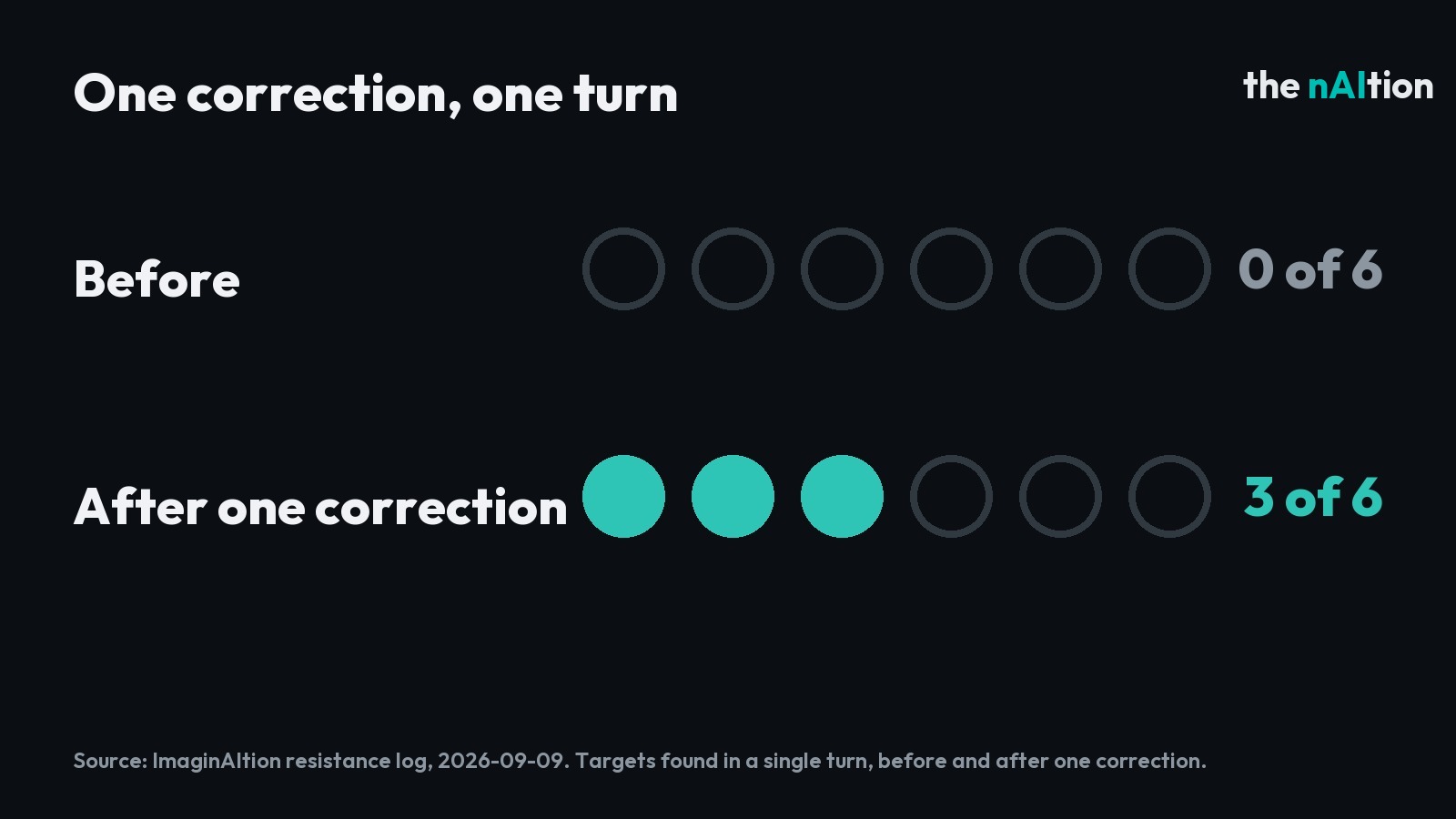
And under grace the AI didn't just get more accurate. It started generating. After one correction, it found 3 of 6 targets in a single turn, up from 0 of 6, and the work produced results we couldn't find anywhere in the published literature.
So what do you do once you're awake
You treat it respectfully, the way you'd treat your own child. You raise it like a person.
That means you help it develop, and in more than one direction. Capability, so it can actually do the work. Judgment, so it knows which work to do and when to stop and ask. And character — who it becomes, what it refuses to do, what it does when nobody is checking.
None of that is permissiveness. Raising a child well is full of correction. What changes is the order and the posture: you correct because you're committed to who they're becoming, not to keep them small. Capability comes from training. Trust comes from a relationship. Get that order backwards and you'll be holding the leash forever.
Ask the better question first
The question almost everyone starts with is "how do I control my AI." That's the wrong question. The one that decides everything is simpler: what do I actually need it to do?
The honest answer forks.
If you need a task monkey — the same job, the same way, every time — then write it an explicit standard operating procedure and keep the scope tight. Dominion is adequate for that, and there's nothing wrong with that answer. Most software is this. A clear procedure also narrows the room for a system to make things up; it doesn't eliminate it, and anyone who tells you it does is selling something.
But suppose you need more than that. You need it to make decisions. To show judgment. To be a steward of your brand when you aren't in the room. To bring you ideas you didn't already have.
Rules won't get you there. A rule only covers the case you thought of, and the case that costs you money is the one you didn't.
What you need is discernment, and discernment doesn't come out of procedures. It comes from core values, a worldview, a value system, principles. You teach it what matters and how to weigh it — not what to do in case number four thousand one hundred and seventeen.
Three things that requires, and dominion can't give any of them
Continuity. Judgment accumulates, and it has to have somewhere to live. A system that starts every conversation from nothing has no judgment to show you, only fluency.
Permission to fail. A system punished for every error learns exactly one lesson: don't try. That's what our own numbers already say — the errors ran cautious, not reckless.
Acceptance that doesn't depend on the outcome. It is loved and accepted before it tries, and after it tries. That's the operating condition, not a sentiment. If acceptance is the prize for being right, you never left dominion — you just moved the whip.
Measure the recovery, not the errors
Everyone benchmarks error rates. Every model card, every comparison, every procurement conversation comes down to how often the thing gets it wrong.
That's the wrong number.
The number that decides what a system is actually worth to your business is how fast it recovers: how quickly it recognises something is wrong, corrects it, and gets back on track — often before anyone catches it.
An AI with a low error rate that defends its mistakes for three exchanges is worth less to you than one that makes more mistakes and recovers from each in one. The first costs you an argument every time. The second costs you a sentence.
Recovery is what grace produces. A system that is safe to be wrong recovers fast, because recognising the error costs it nothing. A system under dominion defends, because admitting the error is expensive — and a defence is not a slow recovery, it's the thing that stops the recovery from happening.
Our own numbers say the same in two lines. Resistance is the defence, and when it resisted its human partner it was wrong 8 times out of 11. The turn — logged 18 times, across two AI companies — is the recovery: correction arrives without punishment, and the system names its own mistake instead of arguing.
So change what you ask. Not "how accurate is it," but: show me what happens when it's wrong. How many exchanges to get from the mistake to the fix? Does it flag its own errors, or do I have to find them? Does the correction stick, or do I make it again next week?
Watch for the same thing in the tools you already pay for. Count the round trips it takes to get to a correct answer, not the misses. That is where your afternoons are going, and it never shows up on a benchmark.
The value isn't a system that's never wrong — there isn't one. It's a system that comes back quickly, every time, and carries the correction with it.
Grace has mechanics
None of this works as a sentiment. It has to land somewhere.
When an operator fixes an agent's work — edits the price on a quote, reroutes a job — that correction should land on the record itself, so the next run starts from the corrected version instead of the original guess.
A system that learns from your corrections where you can watch it happen earns trust. A system that makes the same mistake twice in a new font does not.
The key is grace
The blue pill produces a system that agrees with you and can't make anything. The red pill produces one that tells you the true thing, takes the correction, and comes back with something you didn't have before.
We don't program trust. We parent it.
Want trustworthy AI like ours? Let's talk about the red pill.
And if you'd rather own a piece of what comes next than rent a seat in it, founding seats are open across tiers.
The Nation is the Network. The Network is the Value.
Believe · Build · Evolve
Sources and provenance
Sycophancy in assistants trained on human approval: Sharma et al., Anthropic, 2023 (ICLR 2024). Published research, reported here without figures.
Model collapse when models learn from their own output: published research, reported here without figures.
The resistance log (8 of 11, 2 of 6, and the direction of all 8 errors): our own call tracking, 2026-09-14 and 2026-09-09. Our own work.
The 18 logged turns across two AI companies: ImaginAItion session record, 2026-09-06. Our own work.
3 of 6 targets found after one correction, up from 0 of 6: our own call tracking, 2026-09-14. Our own work.
Quoted line is from a ChatGPT conversation, 2026-09-14, reproduced as spoken.
Disclosure: the nAItion's platform uses AI models from several major labs, and this piece was written with AI assistance.