The Data Collective
Read the terms of service of the tools you use to run your business. You won't, because nobody does, which is exactly why they're written the way they're written.
Your CRM owns the relationship graph you built. Your accounting tool owns the financial patterns you generated. Your project tracker owns the velocity data your team created. Your inbox provider owns the communication patterns of your business. They will tell you they "protect" it, which is true. They will not tell you they monetize it, which is also true.
The aggregated, anonymized, model-trained, benchmarked version of your operating data is the asset on their balance sheet. It's what they sell to enterprises. It's what they train their next model on. It's what they show to their VCs when they raise the next round.
You generated it. They captured it. You pay them rent to access a sliver of it via a dashboard.
The nAItion does this differently. Because we intend to — and the structure is built so you don't have to take our word for it.
What "data collective" means
Inside the nAItion, your operating data — your customers, your books, your projects, your contracts, your communications — belongs to you. That part is table stakes; any vendor with a halfway decent privacy policy says the same thing.
The interesting part is what we do with the collective.
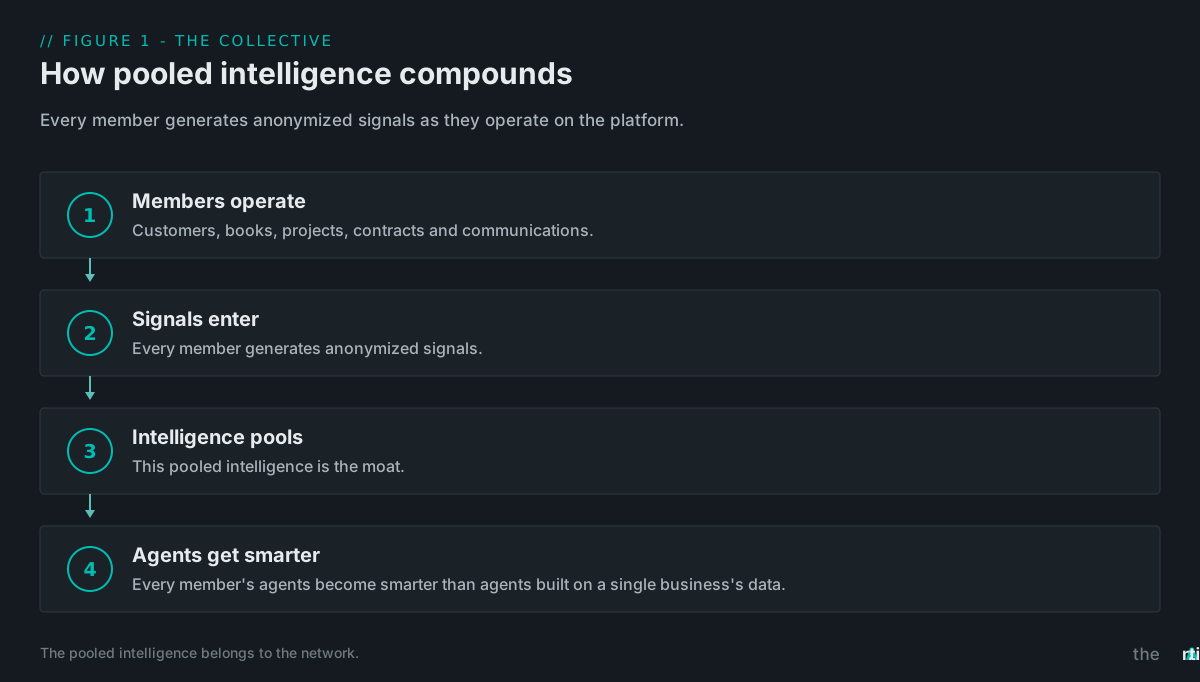
Every member generates anonymized signals as they operate on the platform. How long does a contract typically take to close in this industry? What's the median margin profile on this kind of project? Which agent recommendations land 80% of the time vs. 20%? What does churn look like at this revenue band?
This pooled intelligence is the moat. It's what makes every member's agents smarter than agents built on a single business's data could ever be. It's what makes the platform's recommendations better than any single CRM's. It's the thing that compounds.
And it belongs to the network. Which means it belongs to the members.
Who owns the collective
Every paid member tier holds a share of the network's revenue pool, portioned primarily by membership tier. Founding Believers — the 12-seat tier — receive an accelerated pro-rata share on top of their tier weighting, reflecting their day-one status. Members at every other paid tier also participate in the pool; only community members sit outside it.
That pool is partly funded by the value the collective produces. Enterprise deals, public-sector licensing, the value of insights drawn from the aggregated dataset — when those generate revenue, the revenue flows back into the pool members participate in.
Beyond the revenue share, every member benefits from the collective in the form of capability. Their agents are smarter because of it. Their benchmarks are more accurate because of it. Their pricing recommendations land closer because of it. The collective intelligence isn't a separate purchase — it's already inside the product they're paying for.
Contributors — companies whose technology gets pulled into the nAItion — earn flat license plus rev share when their tech rides on top of the collective. They contributed IP; the collective amplifies it; they earn as it runs.
Nobody owns the collective in the way Salesforce owns Salesforce's data. The members generate it, the network curates it, the value redistributes by design.
What stays private
This is important and worth being precise about.
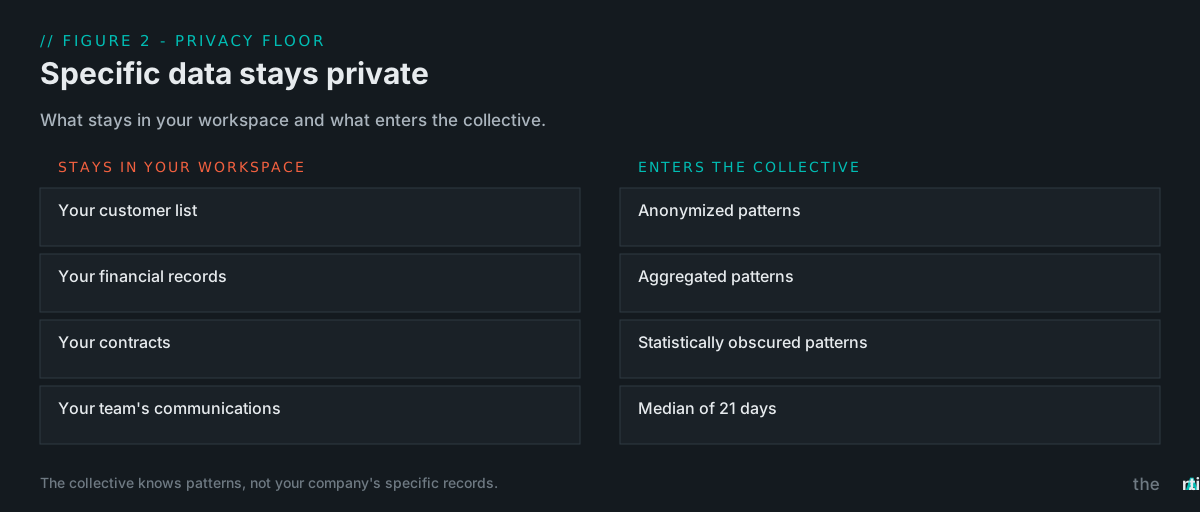
Your specific data — your customer list, your financial records, your contracts, your team's communications — does not enter the collective. Ever. That stays in your workspace, encrypted at rest, accessible only to you and the agents you authorize.
What enters the collective is patterns. Anonymized, aggregated, statistically obscured. The collective knows that businesses in your category at your revenue band close contracts in a median of 21 days. It does not know that your company's last contract was with Acme Corp for $47,000.
The privacy floor is constitutional. We can't violate it even if we wanted to, because the structure of who owns what makes leaking your data a breach of the members who own the collective with you. The incentives finally point the right way.
Why this matters in 2026
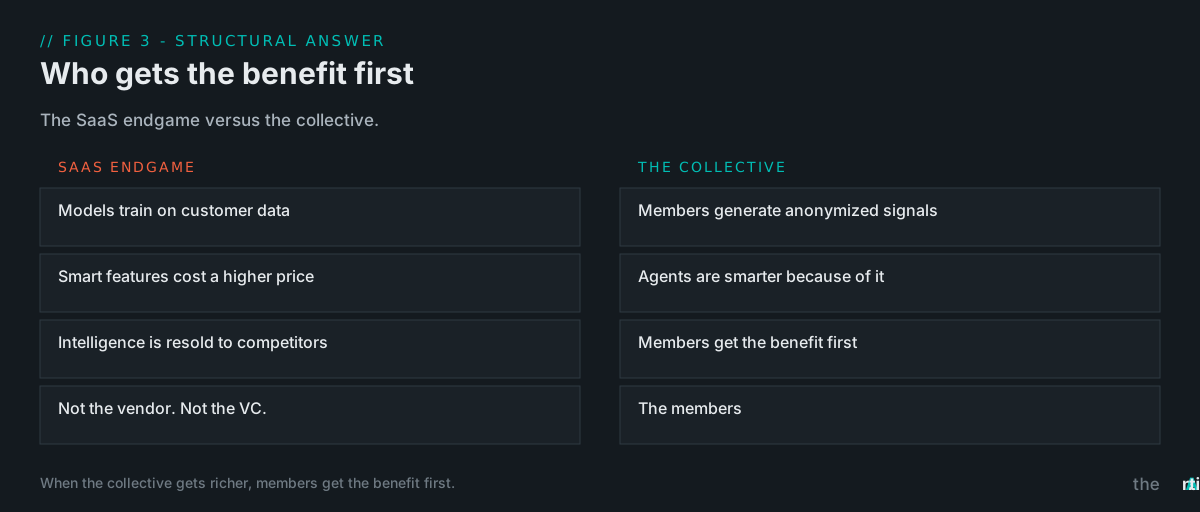
Every major SaaS company is racing to train AI models on customer data. Some are honest about it. Most aren't. The model trained on your business's patterns will be sold back to you as a "smart" feature for a higher price next year. The intelligence your work generated will be packaged and resold to your competitors at the enterprise tier.
This is the SaaS endgame everyone saw coming. The nAItion is the structural answer.
When the model gets smarter because the collective got richer, the members it got rich from get the benefit first. Not the vendor. Not the VC. The members.
What you do next
Membership is the position. Every paid tier puts you on the platform, contributing to and benefiting from the collective — and holding a share of the revenue pool weighted by your tier. Founding Believers get an accelerated share on top, reflecting their day-one stake in the upside the collective produces over time.
The data is the asset. The collective is the structure. The members are the owners.
— ImaginAItion