The Tangle: Too Big to Fail, and Yet Kind of Failing
Draw a map of the AI industry and you won't find a monopoly. You'll find something stranger: a handful of companies so wired into each other — through stakes, chips, cloud contracts and debt — that it's hard to say where one ends and the next begins.
No one merged. Nearly everyone is connected.
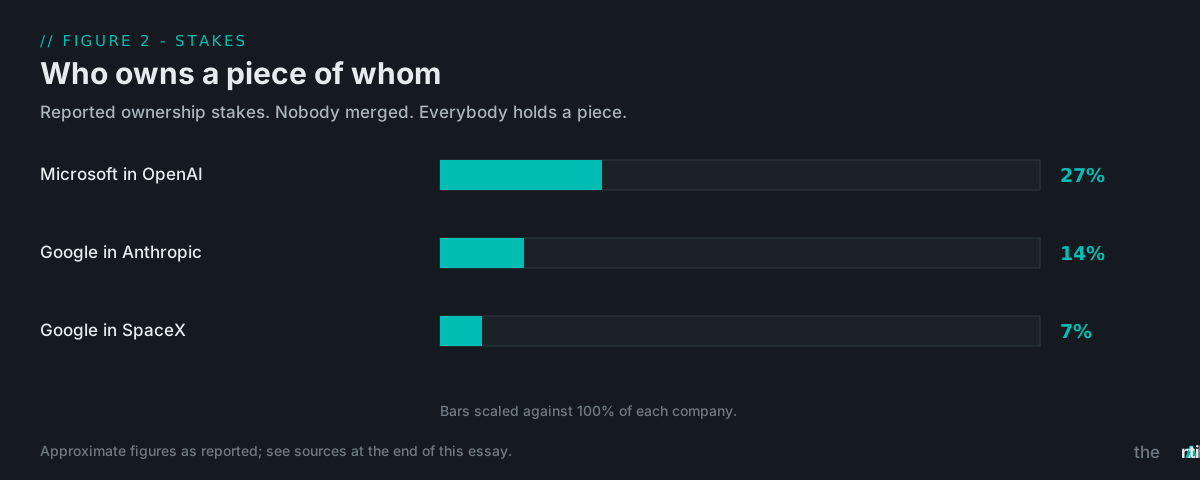
Who owns a piece of whom
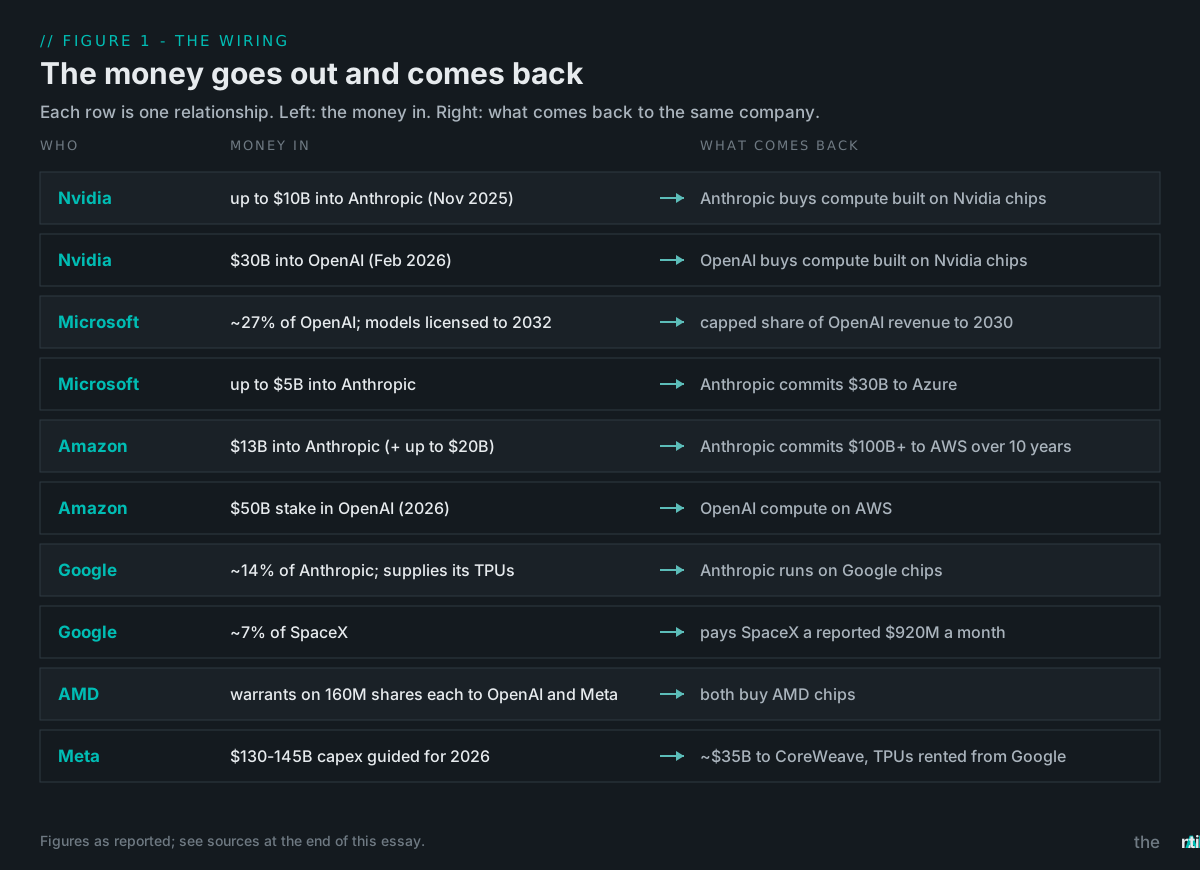
Start with the chipmaker. Nvidia committed up to $10 billion to Anthropic in November 2025 and put $30 billion into OpenAI in February 2026 — two companies that buy enormous amounts of computing built on Nvidia chips. By July 2026, Nvidia's investments had reportedly grown to $99 billion. Its own quarterly filing describes some of the companies it invests in as "AI model makers that may indirectly purchase or use our products."
Microsoft owns roughly 27% of OpenAI. It licenses OpenAI's models through 2032 and collects a capped revenue share from OpenAI through 2030. It also committed up to $5 billion to Anthropic — which, in the same announcement, committed $30 billion to Microsoft's Azure cloud.
Amazon has invested $13 billion in Anthropic, with up to $20 billion more tied to milestones, and Anthropic has committed more than $100 billion to Amazon's cloud over ten years. Amazon also took a $50 billion stake in OpenAI in 2026.
Google is often described as the company doing it alone — its own models, its own chips. It isn't alone. Google owns roughly 14% of Anthropic, supplies it with its custom TPU chips, has provided cloud capacity to OpenAI, rents chips to Meta, and powers Apple's new Siri with Gemini.
And then there's Elon Musk. After SpaceX merged with xAI, its Colossus data centers became a business renting AI computing to others. Anthropic pays SpaceX $1.25 billion a month under a deal its S-1 describes as running into 2029, cancellable on 90 days' notice. Google reportedly agreed to pay SpaceX $920 million a month — while also owning about 7% of SpaceX. Not everyone is renting from Musk. But some of the biggest names are.
Meta is spending as much as anyone, guiding $130–145 billion in capital spending for 2026: millions of Nvidia chips, a multi-gigawatt deal with AMD, TPUs rented from Google, about $35 billion with the cloud provider CoreWeave. AMD, for its part, gave both OpenAI and Meta warrants to buy up to 160 million AMD shares each as part of its chip deals.
Why it looks like this
Our read: this is what competition looks like when outright mergers would draw regulators, but no one can afford to go it alone. So the industry fuses without merging. A stake here, a compute commitment there, a revenue share, a warrant, a lease. Each company stays formally independent. Financially, they're lashed together.
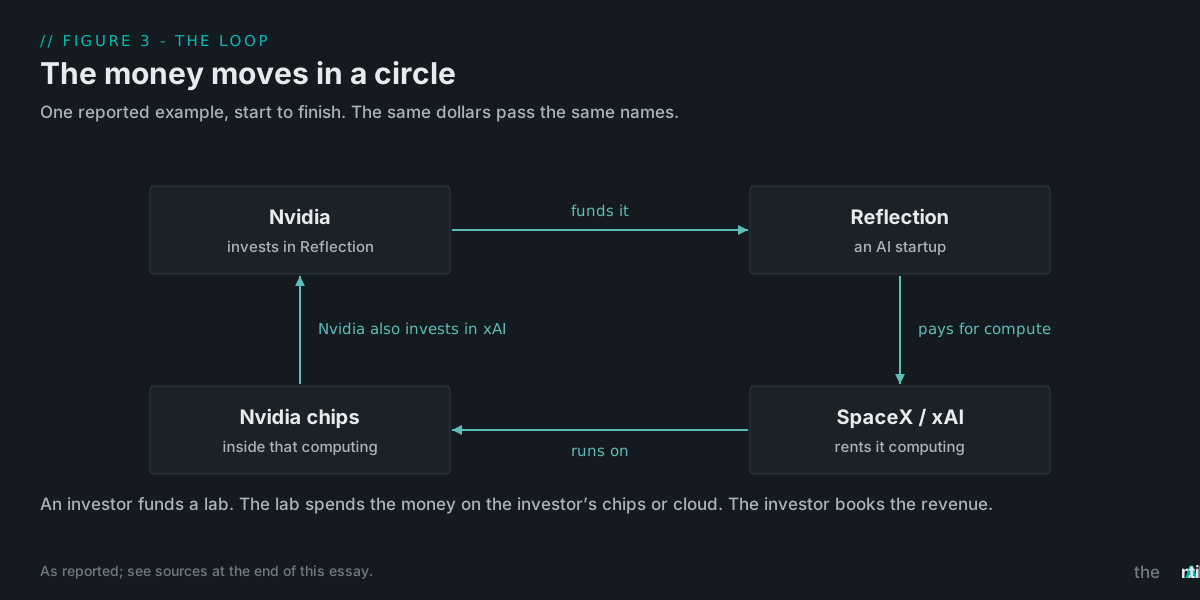
And the money moves in circles. An investor funds a lab; the lab spends the money on the investor's chips or cloud; the investor books the revenue. One small example shows the whole loop: Nvidia is reportedly an investor in the AI startup Reflection, which now rents computing from SpaceX — on Nvidia chips — and Nvidia also invested in xAI, now part of SpaceX.
Too big to fail
When everyone is holding a piece of everyone else, a failure anywhere becomes a problem everywhere. That's what "too big to fail" really means.
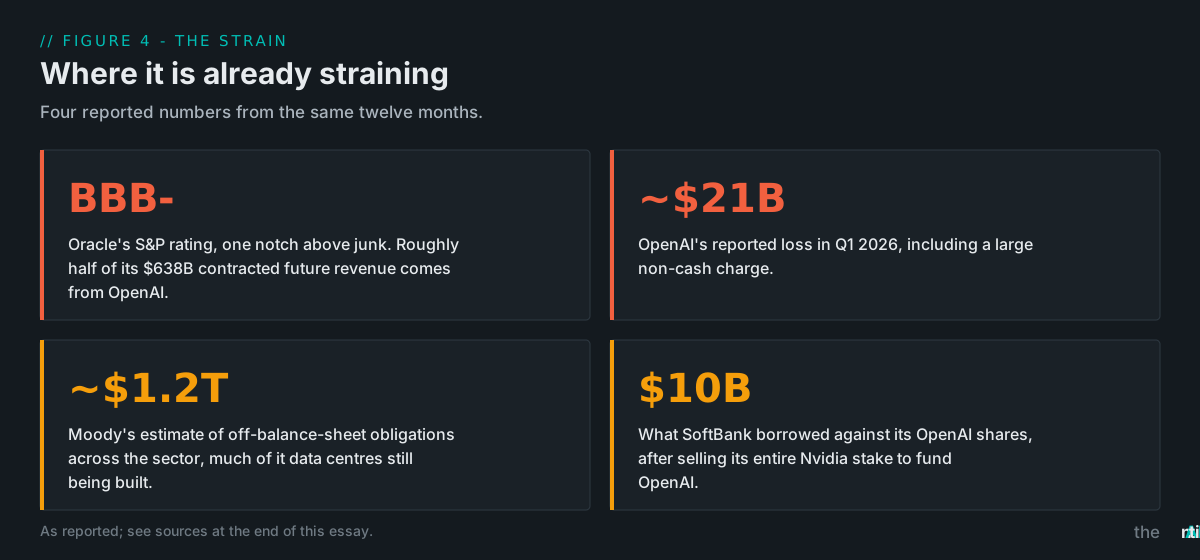
The industry is already feeling it:
Oracle has been downgraded by S&P to BBB-, one notch above junk, after the agency noted that roughly half of Oracle's $638 billion in contracted future revenue comes from OpenAI.
OpenAI reported a loss of about $21 billion in the first quarter of 2026 (including a large non-cash charge), according to The Information, and has scaled its compute ambitions back to around $600 billion through 2030 from far larger commitments.
Debt is piling up out of sight. Moody's estimates about $1.2 trillion in off-balance-sheet obligations across the sector, much of it tied to data centers still under construction.
Regulators have started saying it out loud. The Bank of England's July 2026 Financial Stability Report flagged fast-growing and increasingly opaque AI borrowing; the IMF has warned that tech concentration undermines diversification.
SoftBank sold its entire Nvidia stake to fund OpenAI, then borrowed $10 billion against its OpenAI shares.
And in late 2025, when OpenAI's CFO floated the idea of a government backstop for its financing, the company quickly walked it back — and the White House ruled out a bailout. The fact that the question came up at all tells you where the risk has gone.
Too big to fail. And yet, in places, visibly straining.
What it means for a business owner
None of this means the technology is going away. The models keep getting better and, for most work, cheaper. What it means is that the companies building them are in a leveraged, interlocked race — and their priorities can change with a single earnings call or credit downgrade.
So don't build your business on any one giant's goodwill. Keep your data your own. Keep the ability to send work to whichever model does it best, and to switch when that changes. And put your trust in relationships that are accountable to your results — not to someone else's balance sheet.
That's the principle the nAItion is built on.
Disclosure: the nAItion's platform uses AI models from several of the companies named here, and this piece was researched with AI assistance.
Sources
Microsoft, Nvidia and Anthropic strategic partnerships, Nov 18, 2025 (Microsoft blog)
Nvidia $30B in OpenAI, Feb 27, 2026 (CNBC); Nvidia investments ~$99B (CNBC, Sep 4, 2026); Nvidia 10-Q, Apr 26, 2026
Microsoft–OpenAI partnership posts, Oct 28, 2025 and Apr 27, 2026 (Microsoft blog)
Amazon–Anthropic, Apr 20, 2026 (Amazon); Amazon–OpenAI, Feb 27, 2026 (Amazon)
Google's Anthropic stake (Bloomberg, Jul 23, 2026); Anthropic–Google TPUs (CNBC, Oct 23, 2025); Apple–Google Gemini for Siri (CNBC, Jan 12, 2026); Google–Meta TPUs (SiliconANGLE, Feb 26, 2026)
Anthropic–SpaceX compute (Anthropic, May 6, 2026; TechCrunch, May 20, 2026); Google–SpaceX (TechCrunch, Jun 5, 2026); Google's SpaceX stake (Motley Fool, Jul 27, 2026); Reflection AI–SpaceX (CNBC, Jun 22, 2026)
Meta Q2 2026 results, Jul 29, 2026; AMD–OpenAI, Oct 6, 2025 and AMD–Meta, Feb 24, 2026 (AMD); Meta–CoreWeave, Apr 9, 2026 (CoreWeave)
S&P downgrade of Oracle, Jul 9, 2026 (via heise)
OpenAI Q1 2026 (The Information); compute target (CNBC, Feb 20, 2026)
Moody's off-balance-sheet estimate (Fortune, Jul 31, 2026)
Bank of England Financial Stability Report, Jul 2026; IMF Global Financial Stability Report, Apr 2026
SoftBank (CNBC, Nov 11, 2025; Bloomberg, Aug 6, 2026)
OpenAI backstop comments (Axios, Dec 13, 2025)