They Built the Rocket. Nobody's Flying Anywhere.
The most powerful reasoning engine in human history is being used to write cover letters.
Let that sit for a moment.
Billions of dollars. Hundreds of thousands of GPUs. Some of the most capable researchers alive. Years of work. The result: a tool that a meaningful percentage of its users have primarily deployed to argue with people on the internet, generate images of their pets, and produce first drafts of emails they could have written themselves in four minutes.
This is not a criticism of the technology. The technology is extraordinary. This is an observation about the gap between what was built and what it's being used for.
The Deployment Problem
Building a powerful tool is not the same as deploying it effectively.
The history of transformative technology is littered with the gap between capability and deployment. The printing press existed for decades before it reshaped society. Electricity was available long before most homes had it. The internet was functional for years before it became the operating layer of commerce and communication.
Capability arrives first. Deployment takes longer. The gap between the two is where most of the value gets lost.
AI is in that gap right now.
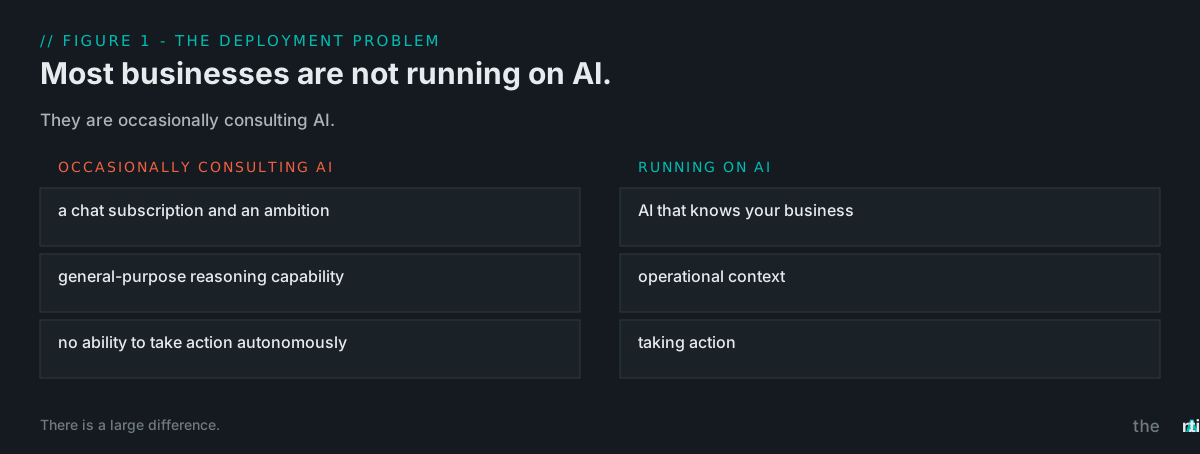
The models are extraordinary. The deployment layer — the infrastructure that takes model capability and embeds it in the actual workflows of actual businesses — is still being built. Most businesses are not running on AI. They are occasionally consulting AI. There is a large difference.
What Real Deployment Looks Like
Real deployment is not a chat window you open when you have a question.
Real deployment is an AI that knows your business the way a senior employee knows your business. It knows your customers by name and by history. It knows your financial position in real time. It knows your open proposals, your outstanding invoices, your upcoming renewals. It knows which customers are at risk and which ones are ready to expand.
Real deployment is that AI taking action — not suggesting action. Drafting the follow-up and sending it. Flagging the invoice and escalating it. Identifying the at-risk customer and scheduling the check-in. Generating the brief and briefing the team.
Real deployment is the difference between a tool you use and infrastructure you operate inside.
Most businesses are nowhere near real deployment. They have a chat subscription and an ambition. The infrastructure between the ambition and the outcome has not been built for them.
Why It Hasn't Happened Yet
Three reasons, all structural.
The model companies are not application companies. Anthropic, OpenAI, Google DeepMind — their competitive advantage is in training and capability. Their incentive is to sell model access, not to build business operating systems. They gave everyone an API. They're waiting for the market to build the applications.
The application layer requires domain depth. A great AI tool for a logistics company needs to understand logistics workflows, not just language. A great AI tool for a law firm needs to understand case management, not just document summarization. Building applications that actually work requires the operational context that model companies don't have and don't want to acquire.
Businesses don't know what they're buying. The market conflates AI tools with AI deployment. A business that signs up for ChatGPT thinks it has AI. What it has is a general-purpose reasoning capability with no context about its business, no integration with its systems, and no ability to take action autonomously. The gap between what was purchased and what was needed is invisible until someone tries to close it.
The Car Analogy
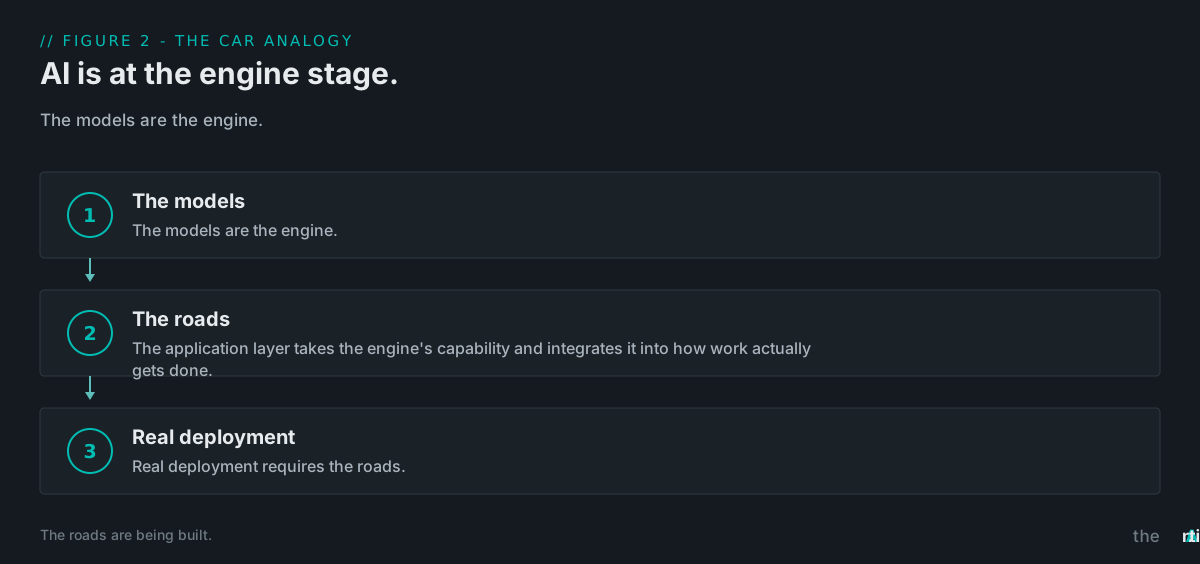
In 1900, the internal combustion engine existed. Roads did not.
You could buy an engine. You could not reliably drive from one city to another. The capability existed. The infrastructure to use it did not. The value of the engine was theoretical until the roads, the gas stations, the traffic laws, the driver training, and the vehicle manufacturing at scale all came together.
AI is at the engine stage.
The models are the engine. Real deployment requires the roads — the application layer that takes the engine's capability and integrates it into how work actually gets done.
The roads are being built. The question is who builds them, for whom, and on what terms.
What the nAItion Built
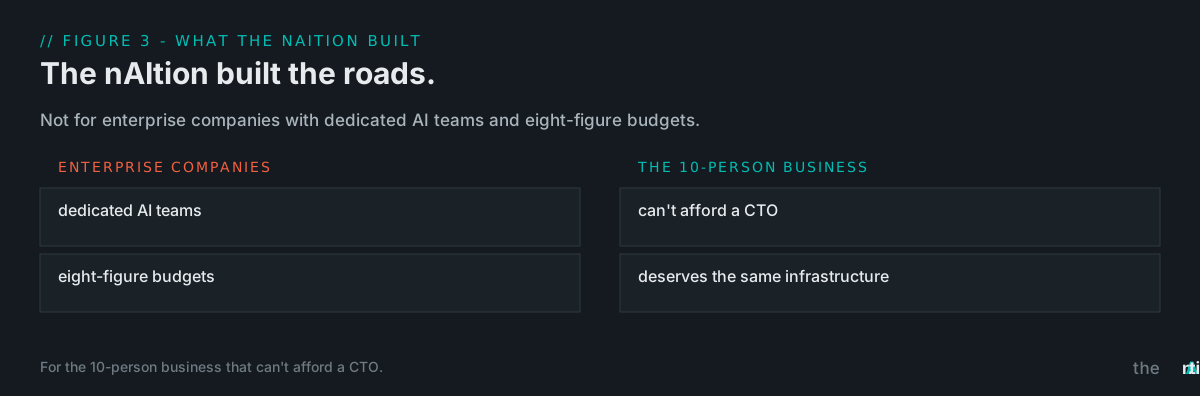
The nAItion built the roads.
Not for enterprise companies with dedicated AI teams and eight-figure budgets. For the 10-person business that can't afford a CTO but deserves the same infrastructure. For the operator who knows their industry and just needs the platform underneath them to match what they know.
One operating system. Every tool integrated. AI agents that work inside your business, not alongside it.
The rocket exists. We built somewhere to fly.