What It Actually Costs to Run a Small Business on Software Right Now
Let's do the math nobody wants to do.
Not the math that ends with "but it's worth it." Not the math that compares you to enterprise companies with IT departments and negotiated contracts. The real math. The monthly invoice math. The "where did all the money go" math.
The Average Small Business Software Stack
Here's what a real 10-person business pays every month just to operate:
Customer Relationship Management Salesforce Essentials or HubSpot Starter: $50–$90 per seat 10 seats: $500–$900/mo
Project Management Monday.com or Asana Business: $16–$25 per seat 10 seats: $160–$250/mo
Communication Slack Pro: $8.75 per seat 10 seats: $87.50/mo
Accounting QuickBooks Online Plus: $90/mo flat Add payroll: $80/mo plus $6 per employee = $140/mo
Email Marketing Mailchimp or ActiveCampaign: $100–$300/mo depending on list size
Document Signing DocuSign Business Pro: $40 per seat Even 3 seats: $120/mo
File Storage Google Workspace Business Starter: $6 per seat 10 seats: $60/mo
Video Conferencing Zoom Pro: $15.99 per seat 10 seats: $159.90/mo
HR and Hiring Gusto or Rippling: $80/mo base plus $12 per employee = $200/mo
Customer Support Zendesk Suite: $55 per seat Even 3 support staff: $165/mo
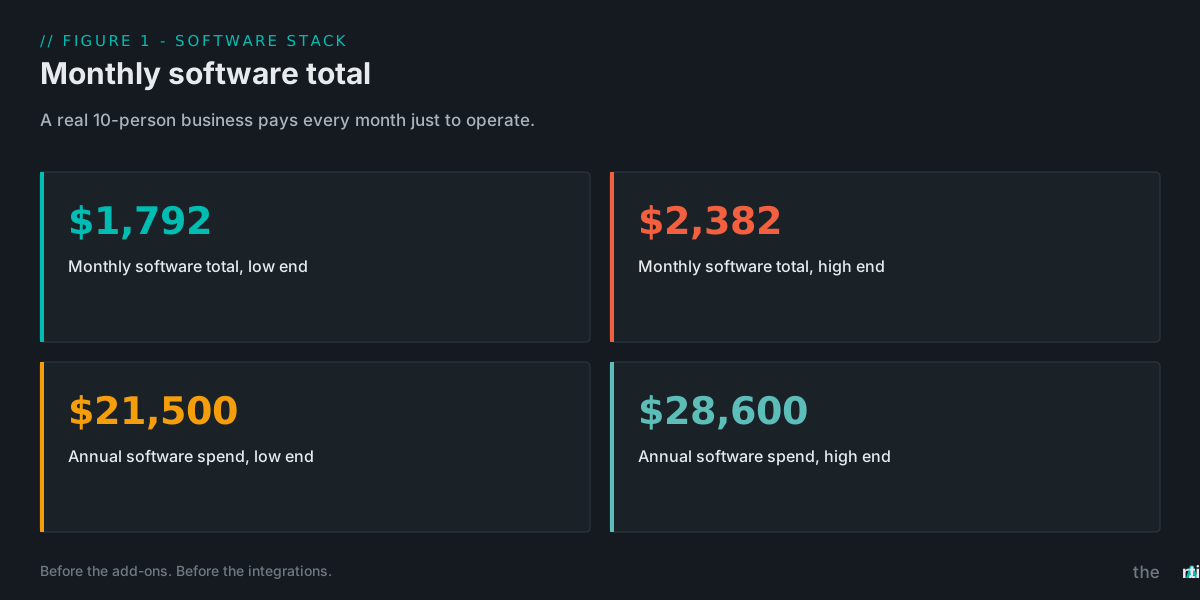
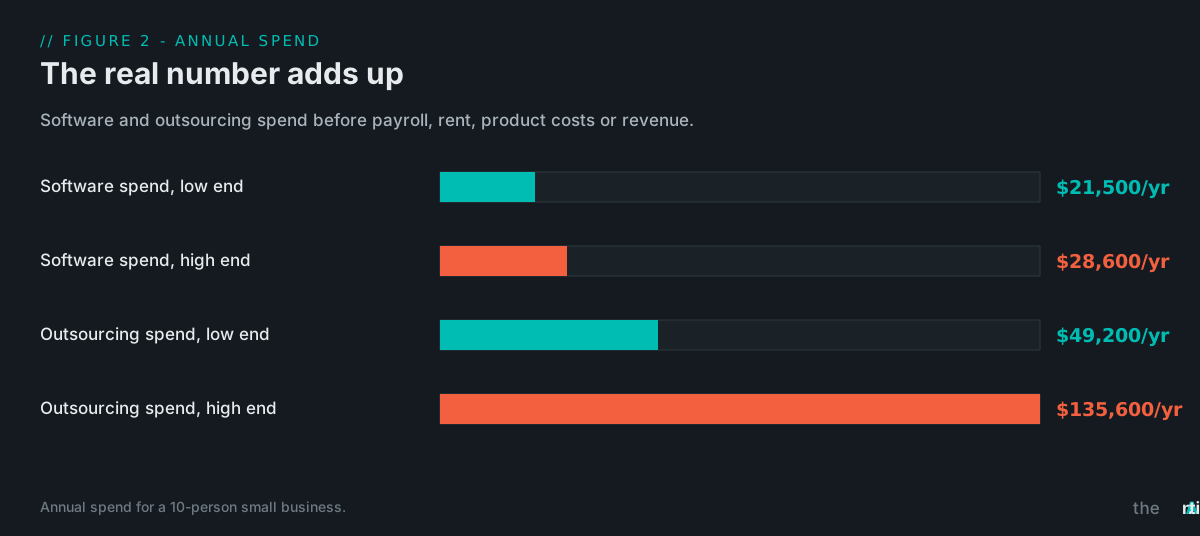
Monthly software total: $1,792–$2,382/mo Annual software spend: $21,500–$28,600/yr
And that's before the add-ons. Before the integrations. Before someone realizes the plan you're on doesn't include the feature you actually need.
Now Add the Outsourcing
Software is only part of the bill. The other part is everything your software doesn't actually do — so you pay someone else to do it.
Bookkeeping and accounting CPA or bookkeeper: $300–$800/mo for a small business Annual tax prep: $1,500–$3,000/yr
IT support Managed IT services for a 10-person company: $500–$1,500/mo Or the cost of the one person who knows how to fix things when they break
Marketing Freelance or agency retainer: $1,500–$5,000/mo Social media management: $500–$2,000/mo
HR and compliance HR consultant or PEO services: $100–$200 per employee per month 10 employees: $1,000–$2,000/mo
Legal Business attorney retainer or on-demand: $200–$500/mo minimum
Monthly outsourcing total: $4,100–$11,300/mo Annual outsourcing spend: $49,200–$135,600/yr
The Real Number
Add it together.
A 10-person small business spends between $70,000 and $164,000 per year just to keep the lights on — before payroll, before rent, before product costs, before anything that actually generates revenue.
Most of that money goes to vendors who don't talk to each other, tools that require manual reconciliation, and outsourced experts who have to be briefed from scratch every time you have a question.
None of it compounds. None of it gets smarter the longer you use it. None of it gives you anything back when it grows more valuable because of your usage.
You pay. They grow. You pay more.
What Changes With AI
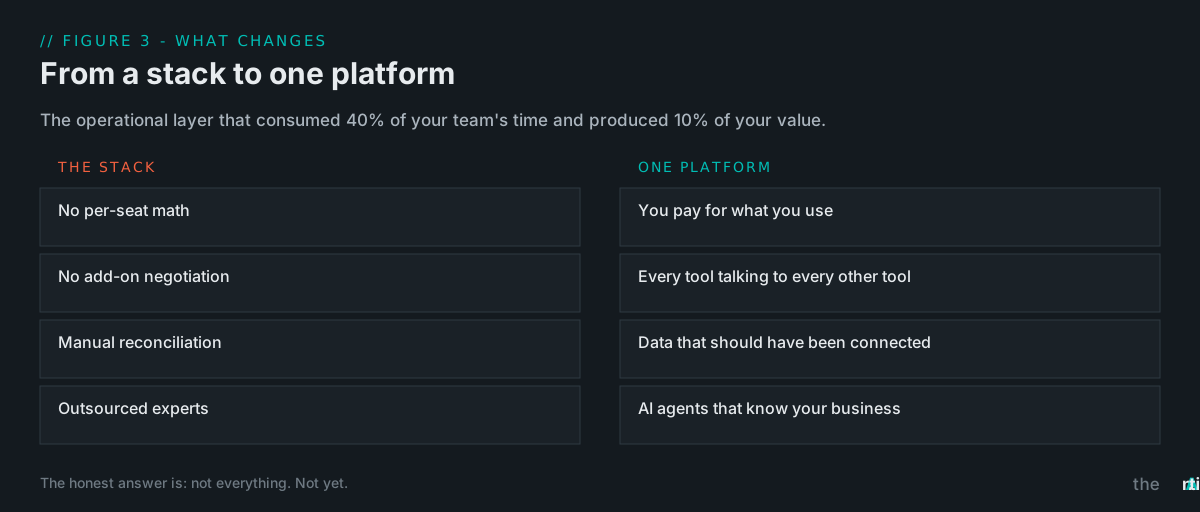
The honest answer is: not everything. Not yet.
AI doesn't eliminate your need for a good accountant when things get complicated. It doesn't replace a lawyer when you're signing a real contract with real stakes. It doesn't make bad hiring decisions irrelevant.
What it does: it eliminates the $2,000/mo software stack that wasn't doing the job anyway. It replaces the bookkeeper who was manually reconciling data that should have been connected. It handles the marketing briefs, the customer follow-ups, the report generation, the CRM updates — the operational layer that consumed 40% of your team's time and produced 10% of your value.
One platform. Every tool talking to every other tool. AI agents that actually know your business because they've been working inside it since day one.
No per-seat math. No add-on negotiation. No annual price increase letter.
You pay for what you use.
The Question Worth Asking
The question isn't whether you can afford AI.
The question is whether you can afford to keep paying for a stack that doesn't work, outsourcing the things that should be automated, and watching your software vendors get richer every time they add a feature gate.
The math already answers it.
The nAItion replaces the stack. One platform, every tool, pay for what you use. See the membership tiers.