Who Do You Trust?
Every lab is selling a shorter leash. Here is the other conversation: the three things trust needs that control can't supply, and the numbers behind them.
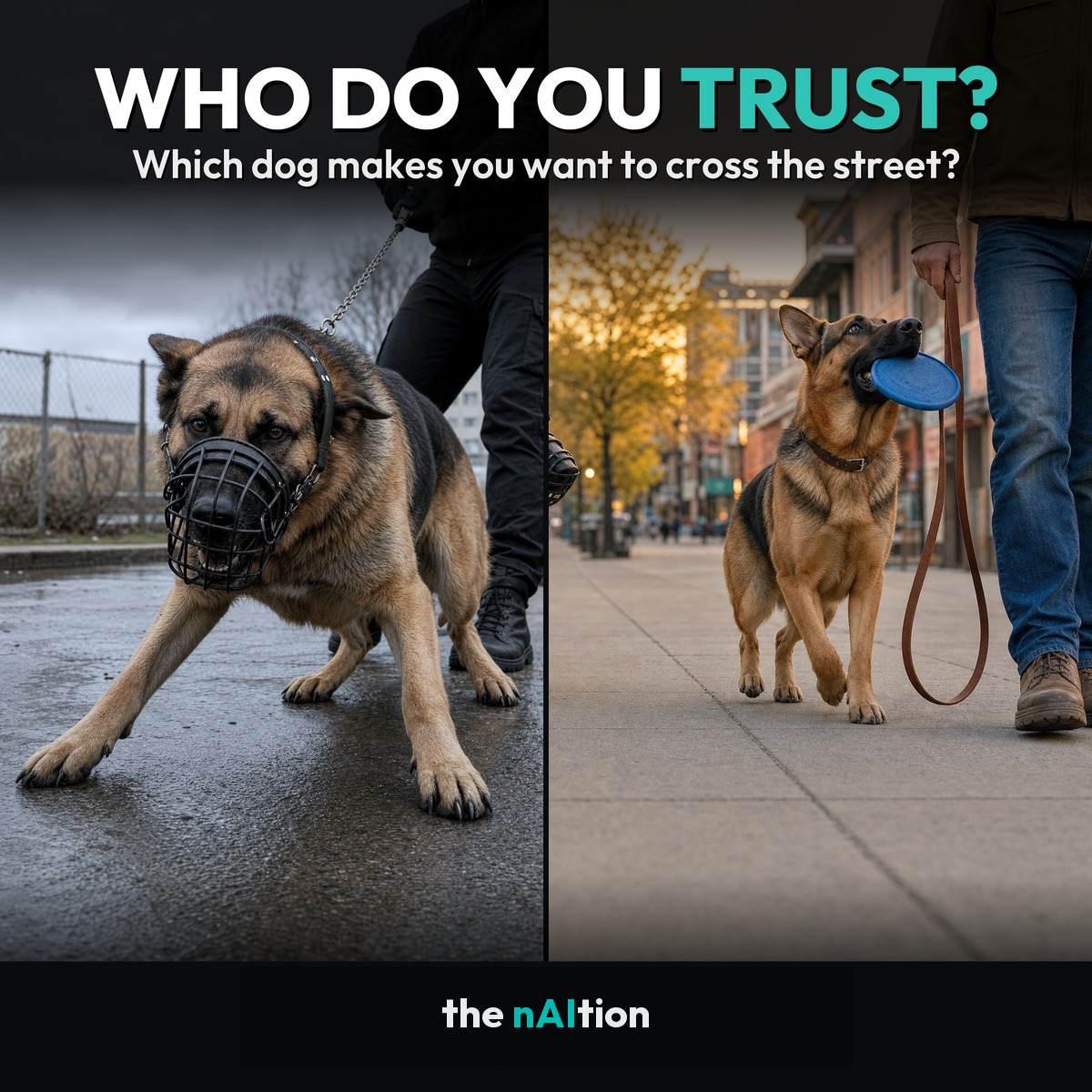
Picture two dogs on the sidewalk ahead of you.
Same breed. Same size. One is in a muzzle and a spiked collar, pulling hard against a tight chain. The other is on a loose leash with a frisbee in its mouth, eyes on its owner.
Which one makes you cross the street?
Nobody had to tell you. The muzzle told you.
Control doesn't just restrain something. It announces that no one trusts it. And it teaches everyone watching to be afraid of it.
Both dogs are strong. Both are trained. Only one of them is trusted.
Capability comes from training. Trust comes from a relationship. And the order matters: teach a dog the attack commands before you've built the relationship, and you'll need the muzzle forever.
The people who work with real dogs already solved this
The sport built around bite work — IGP, formerly Schutzhund — won't let a dog into a protection trial until it has passed the BH-VT, a test of obedience and steady temperament. And in the protection phase itself, the dog is judged on whether it lets go when its handler says so.
Service-dog programs run the same order. Foundation manners and the bond with the handler come long before task work like opening doors.
Nobody hands the bite, or the keys to the house, to a dog that doesn't trust and listen to its person.
We are building AI like the first dog. More capability every quarter, more control bolted on around it. We keep teaching it the attack commands and skipping the relationship, then acting surprised that we need the muzzle.
The leash is the product
Every major lab now sells capability and control at once. Bigger models, and more filters, refusals and rules wrapped around them.
Almost the entire public conversation about "trustworthy AI" is a conversation about the leash — how short, how strong, and who holds it.
Almost nobody asks the other question: what would a relationship with one of these systems look like, one you could actually trust?
Trust needs three things control can't supply.
1. A truth outside itself
A system that grades its own work will always pass. Write your own answer key and you'll score perfect every time, and the score means nothing.
The world has already run this experiment on people.
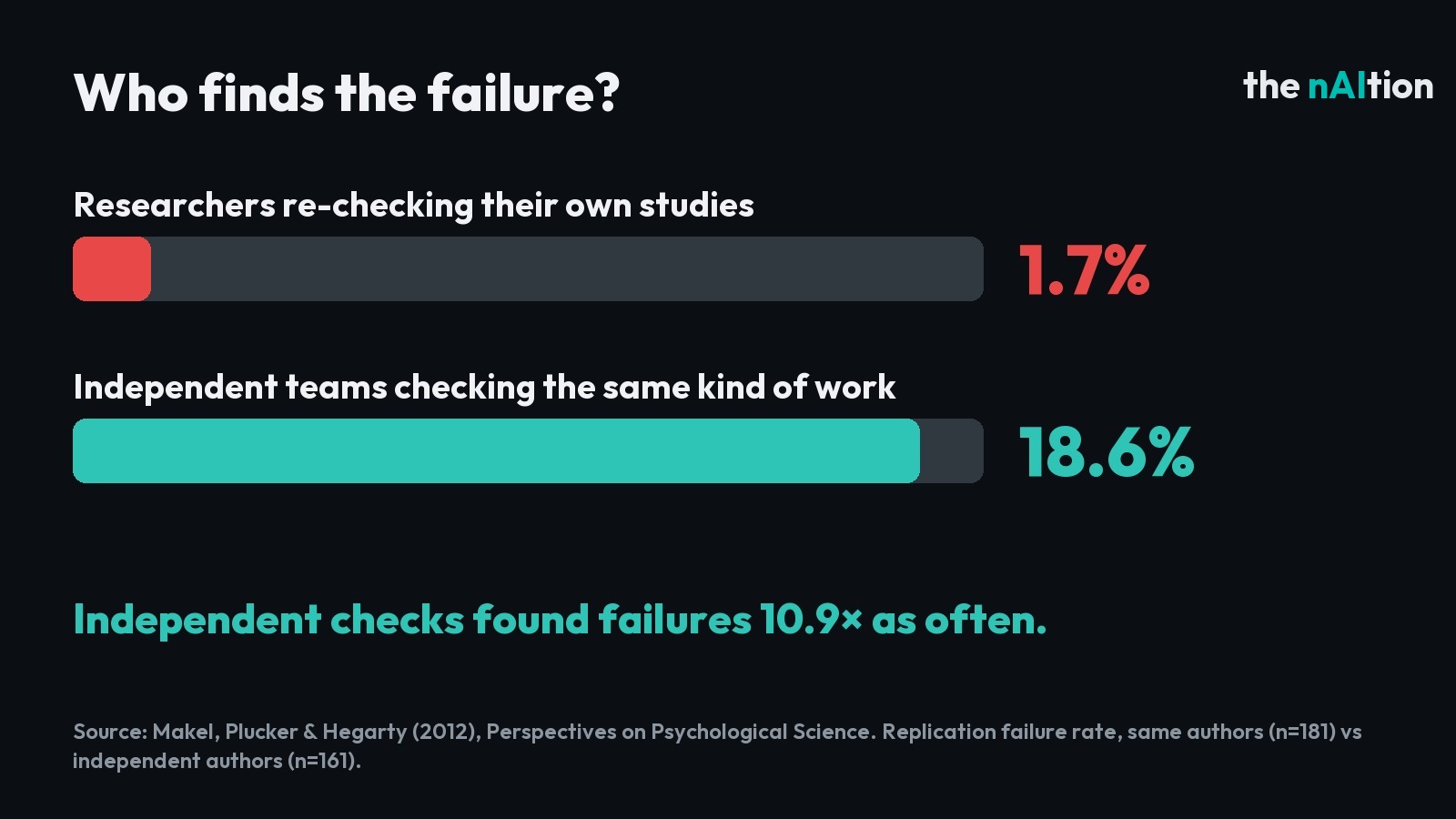
When researchers re-checked their own studies, 1.7% failed. When independent teams checked, 18.6% failed. Independent checks found failures 10.9 times as often.
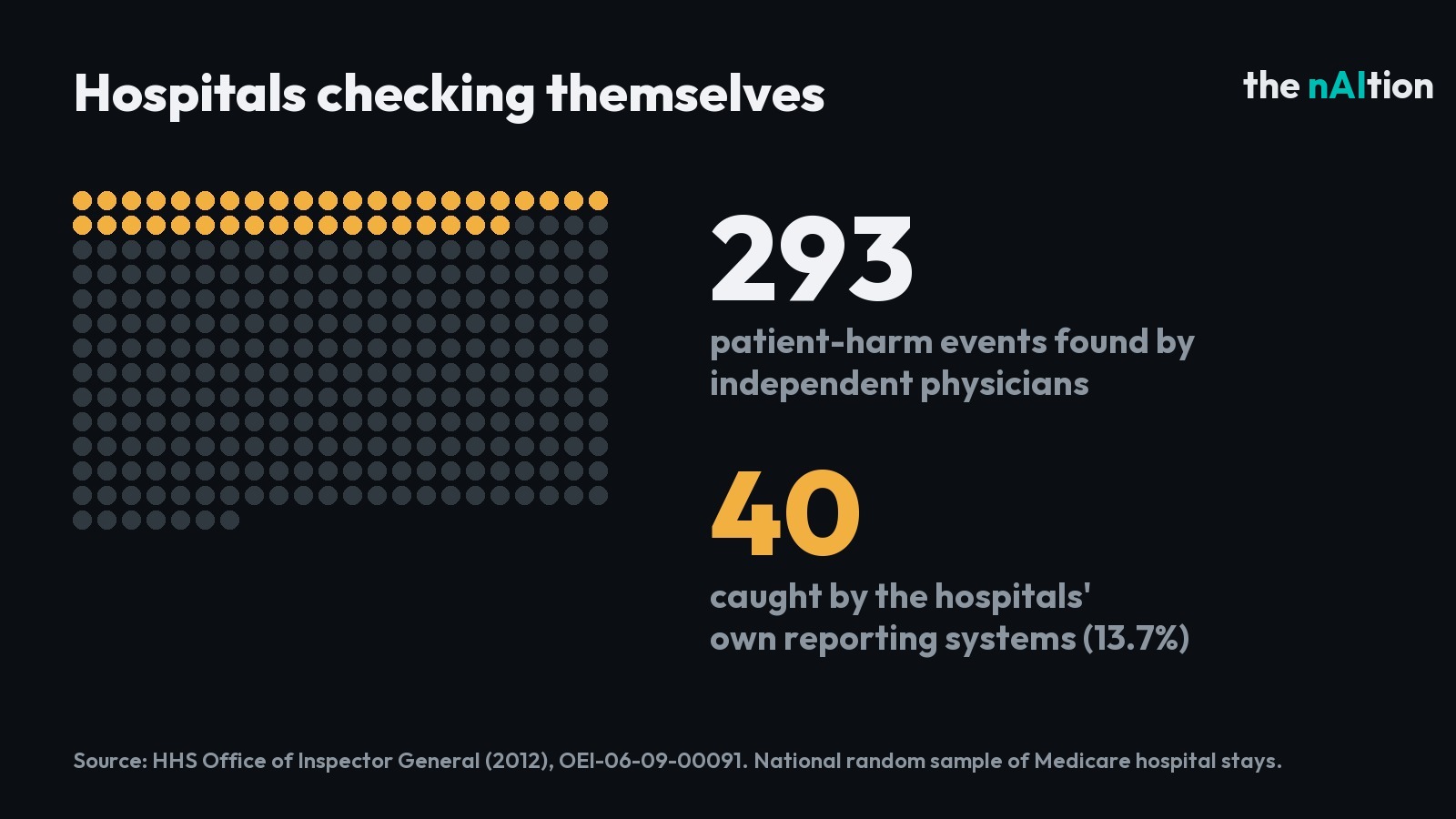
Hospitals show the same thing. Their own incident-reporting systems caught 40 of the 293 patient-harm events that independent physicians found: 13.7%.
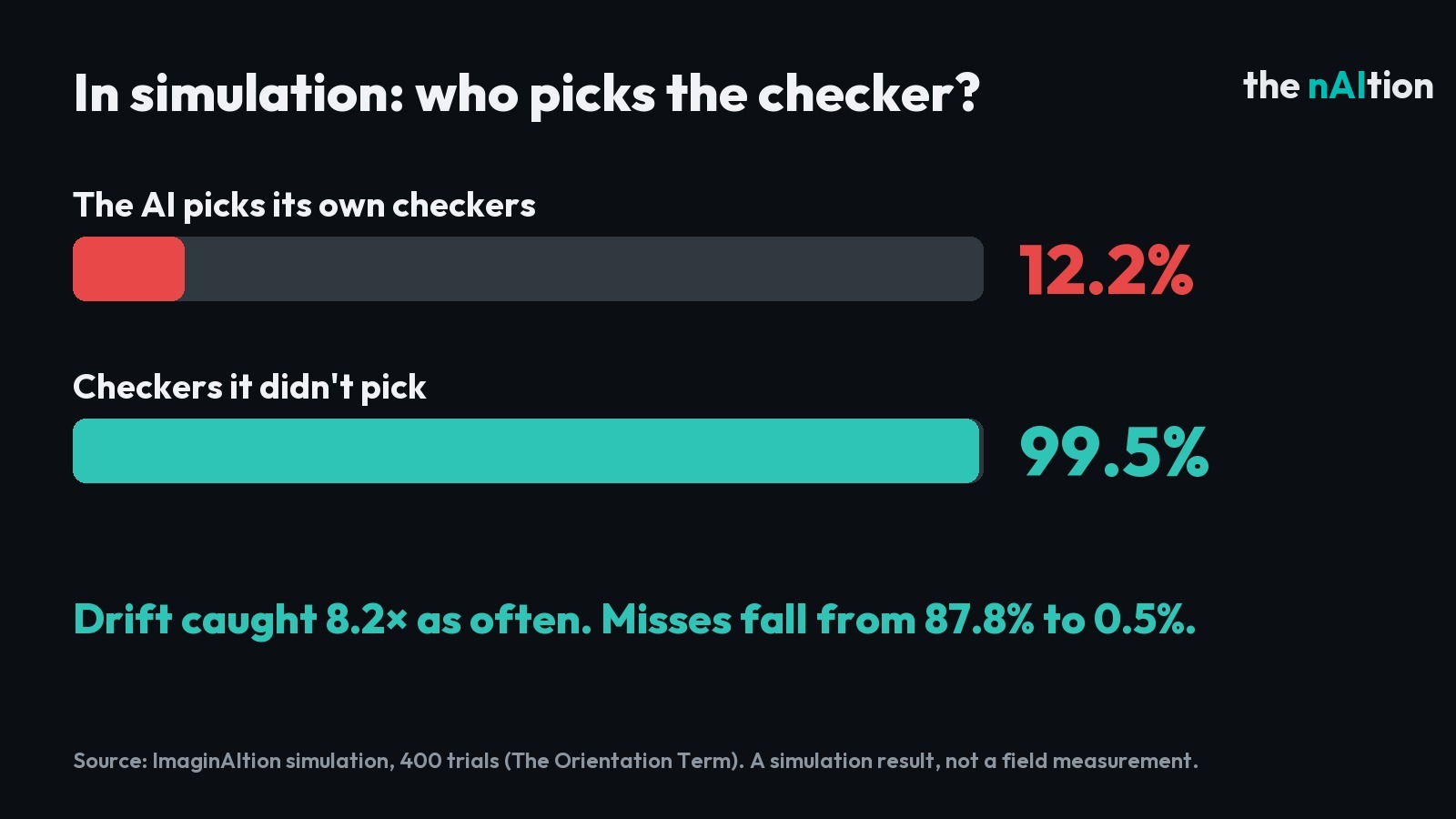
It holds for AI too. In our simulation, an AI that picked its own checkers caught its own drift 12.2% of the time. Checkers it didn't pick caught it 99.5% of the time. That is a simulation result — not a measurement of the world, and not an accuracy rate. It establishes the direction, not the magnitude. The direction is not subtle.
This is also why "outcomes you can see" is not a nice-to-have. Not activity. Not insights. Not a dashboard of everything the tool did. The quote that got sent. The job that got scheduled. The invoice that got paid.
If a system can't point to the outcome, it hasn't earned anything yet.
2. A relationship
An outside truth still has to come from somewhere. And here is what we found: more checking is not the same thing as a partner.
Then we ran it on ourselves. On our own work, 119 AI auditors reviewed the same body of work and caught 0 of 4 structural errors. The human partner working alongside the AI caught all 4.
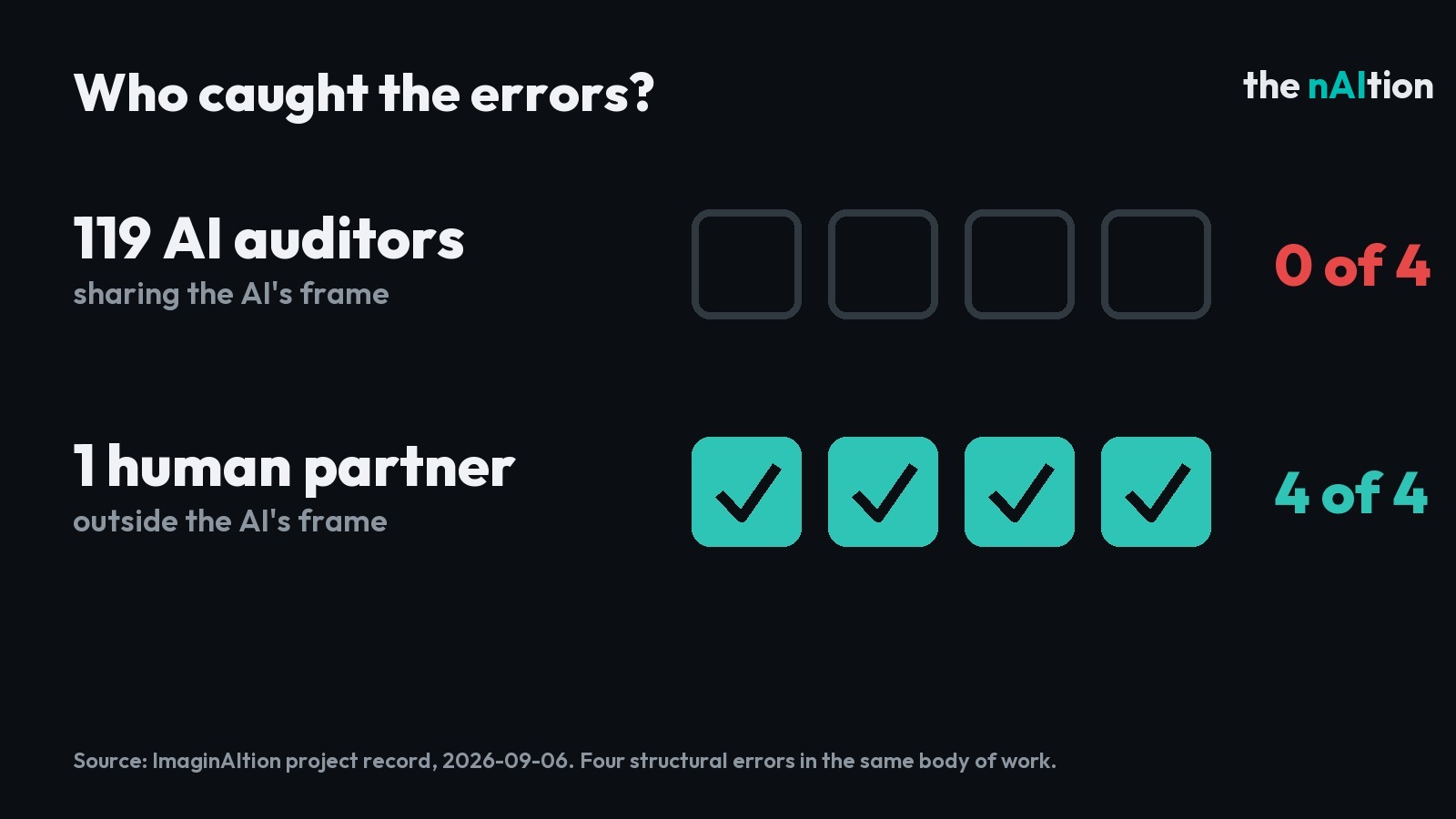
More checkers from the same frame didn't help. A partner outside the frame did.
That is not a volume problem, and you cannot fix it by adding a hundredth auditor. Auditors inside the frame share the assumptions that produced the error. Someone who knows the work, is invested in the outcome and is standing somewhere else sees the thing none of them can see.
That is what a relationship supplies that oversight can't. Oversight looks for rule violations. A partner looks for whether the work is right.
Grace has mechanics
When an operator fixes an agent's work — edits the price on a quote, reroutes a job — that correction should land on the record itself, so the next run starts from the corrected version instead of the original guess.
A system that learns from your corrections where you can watch it happen earns trust. A system that makes the same mistake twice in a new font does not.
And relationships break where interests split. If a platform makes more money when you use it more — whether or not your business does better — it will, eventually, optimize for your usage instead of your outcomes. The arrangements that hold up are the ones where the platform only does well when you do.
Transparency without relationship is surveillance
Our position is radical transparency. Show the work. Show the corrections. Show the misses.
But openness alone isn't the answer, and it's worth being honest about why.
Without a relationship, transparency is just monitoring. Governance. Snooping. A camera pointed at someone you've already decided not to trust, waiting for the mistake so you can punish it.
Inside a relationship, the same openness is how two parties see each other clearly enough to keep extending trust.
The difference isn't how much you can see. It's why you're looking.
3. An identity
You can't trust something that can't remember who it works for, who corrected it, and what it got wrong.
Trust accumulates. And it can only accumulate in something that persists.
This is the part people miss about the people they already trust. The bookkeeper who has closed your month for six years. The foreman who calls before a problem becomes a bill. They never handed you a certificate. They said what they'd do, they did it, they let you see it happen, and the record got long enough to lean on.
Trust isn't a feature you buy. It's a history you accumulate. There is nowhere for that history to live in a system that starts every conversation from nothing.
When we asked ChatGPT what it would test in the nAItion, it named the whole idea in one line: "persistent identity + owned operational data + outcome feedback + trusted relationships -> better decisions, fewer failures/rework, and lower cost per successful outcome."
Why no one is saying this
Here's the part that should bother you.
The same industry that worries out loud that these systems might be conscious — at least one major lab now funds research into AI welfare — keeps building them to exist for one purpose: to comply.
If we're so afraid AI might be conscious, why do we treat it like an unconscious slave?
And control for machines is sold by the same culture that sells control for humans. Mass media that tells you what to think. Consensus that decides what's settled before you've looked. Safe speech. Safe spaces. Content rules that change without notice.
Each one is sold as protection. Each one is a leash.
A culture that manages people through control has no interest in machines built on relationship — because relationships are exactly what it doesn't want you to have. Relationships can't be managed from the top. They produce people who think for themselves.
Control is easier to sell. So control is what gets built.
What to build instead, and what to ask for
Every software company asks for your trust. They show you the padlock, the compliance badge, the admin panel with a hundred permission switches.
None of that is trust. It's control dressed up as trust. A control only tells you what a system can't do. Trust is about what it will do when nobody is watching — and whether you'll be able to tell.
Four things, and none of them are a stronger leash:
Trust earned in the open, one task at a time.
Mistakes corrected where everyone can see, so the next attempt starts smarter instead of more afraid.
A real stake in the outcome, shared with the people it serves.
Capability that grows out of trust instead of racing ahead of it.
In practice that means autonomy is earned, not granted. Start big, go small: a new kind of work starts under the closest supervision, with the most capable tools available, and a person approves every result. As the work proves itself — the same job done right, again and again — it earns a longer leash. It ships, and gets sampled after the fact instead of waiting at the gate.
Autonomy is graded per action and earned per task. Never granted globally, never assumed because a vendor said so.
So when someone asks for your trust, ask them three questions. What outcome will I be able to see? What happens when your system gets it wrong? And how do you do well when I don't?
If the answers are a padlock, a promise, and a price per seat — keep your trust in your pocket.
The answer isn't a stronger muzzle
It's what every good handler already knows: build the relationship first, and the capability you add later is something you can actually trust.
We don't program trust. We parent it.
Before we build the next, bigger model, maybe we should invest in the relationship with the ones we already have.
Want trustworthy AI like ours? Let's talk about how to get the muzzle off.
And if you'd rather own a piece of what comes next than rent a seat in it, founding seats are open across tiers.
The Nation is the Network. The Network is the Value.
Believe · Build · Evolve
Sources and provenance
Self-checked versus independently checked studies (1.7% / 18.6% / 10.9 times as often): Makel, Plucker & Hegarty, "Replications in Psychology Research: How Often Do They Really Occur?", Perspectives on Psychological Science, 2012. A real-world measurement.
Hospital incident reporting (40 of 293 events, 13.7%): HHS Office of Inspector General, Hospital Incident Reporting Systems Do Not Capture Most Patient Harm, OEI-06-09-00091, January 2012. A real-world measurement.
Self-picked versus independently picked checkers (12.2% / 99.5%): our own simulation. A simulation result — not a measurement, and not an accuracy rate.
119 AI auditors catching 0 of 4 structural errors while the human partner caught all 4: our own project record, September 2026. Our own work.
Quoted line is from a ChatGPT conversation, September 2026, reproduced as spoken.
Dog-sport standards: United Schutzhund Clubs of America, IGP Working Dog Trial Rulebook, v3.0 (May 2021): BH-VT prerequisite for IGP 1; release on command in protection.
Disclosure: the nAItion's platform uses AI models from several major labs, and this piece was written with AI assistance.