Your AI Employees
Most software calls them "features." A reporting dashboard. An automated workflow. A "smart" assistant that pops up when you click something.
We don't.
The agents inside the nAItion are staff. Your CFO agent doesn't help you with finance — your CFO agent does finance. Your CMO agent doesn't suggest marketing — it runs the marketing. Your Sales agent owns the pipeline. Your Delivery Lead agent watches the work get shipped. Your People Ops agent tracks your team, your contracts, your hires, your fires.
This is not a marketing framing. It's an architectural one. And once you understand the difference, you can't unsee it.
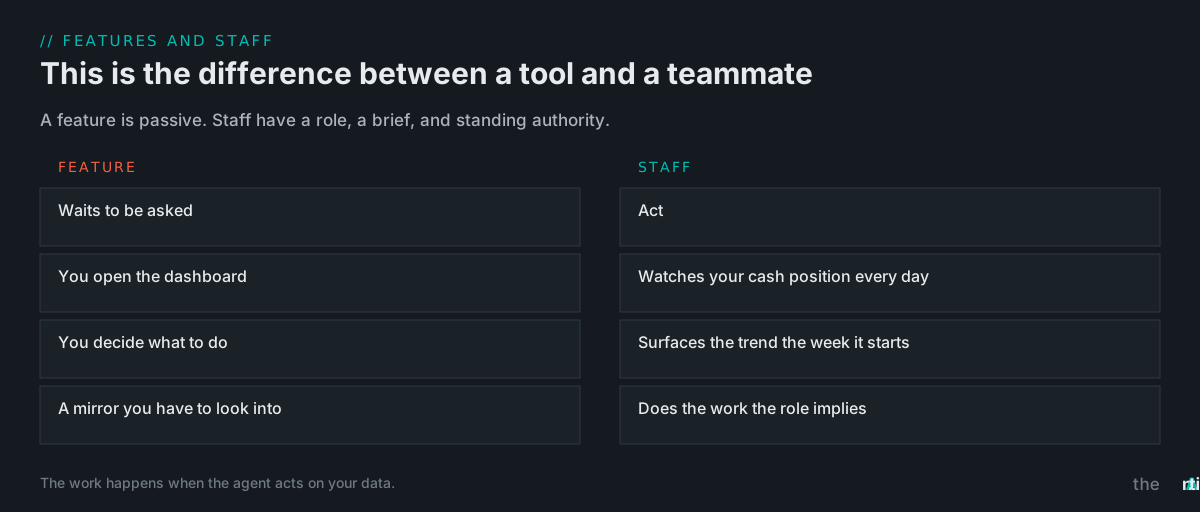
What "feature" gets you vs. what "staff" gets you
A feature waits to be asked. You open the dashboard. You click the button. You read the chart. You decide what to do. The software is passive — a mirror you have to look into.
Staff act. They have a role, a brief, and standing authority to do the work the role implies. You don't ask your bookkeeper to look at your books every morning. They just do it. You don't ask your salesperson to follow up on a stalled deal. That's their job.
AI agents have crossed the line where this works for software too. Your CFO agent watches your cash position every day without being asked. When an invoice goes past 30 days, it doesn't put a red dot on a dashboard hoping you'll notice — it drafts a follow-up email and asks if you want to send it. When your gross margin drifts, it doesn't wait for the monthly review — it surfaces the trend the week it starts.
This is the difference between a tool and a teammate.
Who is on your roster
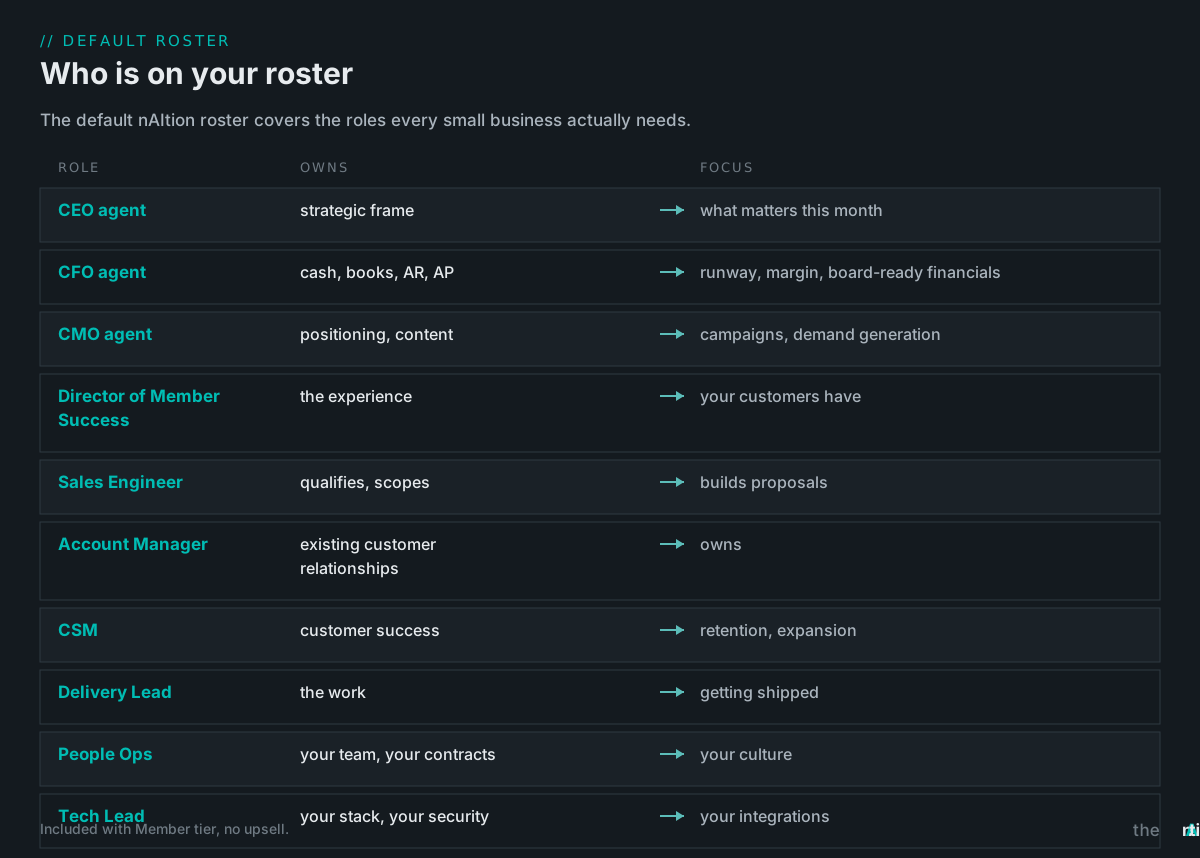
The default nAItion roster — included with Member tier, no upsell — covers the ten roles every small business actually needs but rarely has the budget to fully hire:
- CEO agent — strategic frame, prioritization, the "what matters this month" view
- CFO agent — cash, books, AR, AP, runway, margin, board-ready financials
- CMO agent — positioning, content, campaigns, demand generation
- Director of Member Success (DMS) — owns the experience your customers have
- Sales Engineer — qualifies, scopes, builds proposals
- Account Manager — owns existing customer relationships
- CSM — customer success, retention, expansion
- Delivery Lead — owns the work getting shipped
- People Ops — your team, your contracts, your culture
- Tech Lead — your stack, your security, your integrations
Ten roles. Most small businesses staff three of them — the owner does the other seven badly between 9pm and midnight.
Your agents do all ten. Continuously. In the background. While you sleep.
They are not chatbots
This part matters and gets missed.
A chatbot waits in a chat window for you to type. An agent has a job. The chat is one way you can talk to them — the way you'd talk to a human teammate over Slack — but the chat is not where the work happens. The work happens when the agent acts on your data, drafts the email, updates the record, flags the risk, proposes the next move.
When your CFO agent surfaces something, it isn't because you prompted it. It's because the role required it.
If you've used "AI" before and felt like you were doing all the work — prompting, re-prompting, copying outputs around — that's because you were using a chatbot. Not an employee.
What changes for you
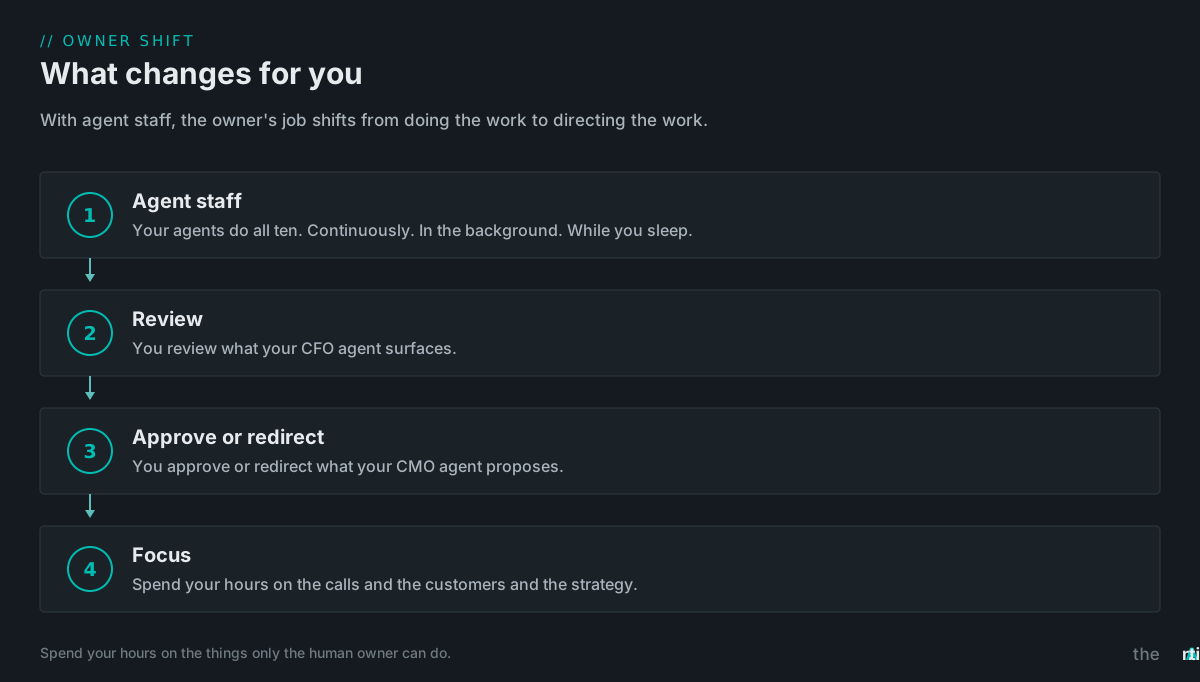
When you run a business with agent staff, the owner's job shifts. You stop doing the work and start directing the work. You review what your CFO agent surfaces. You approve or redirect what your CMO agent proposes. You spend your hours on the calls and the customers and the strategy — the things only the human owner can do.
This is what people mean when they say AI gives you leverage. Not "AI helps you type faster." Leverage means a one-person business can run with the operating capacity of a ten-person business. A ten-person business can run with the capacity of a fifty-person business.
The agents aren't replacing your team. They're filling the seats your team can't afford to hire into.
What you do next
Starter, Small, and Mid tiers come with the full roster. Not three agents and an upsell path to the rest — all ten, on day one. They learn your business as you run on the platform. By month three they sound like they've worked there for years, because in your operating data, they have.
Hire the staff. Direct the work. Keep the business.
— ImaginAItion