You're Paying 14 Companies to Not Talk to Each Other
There's a specific kind of frustration that every small business owner knows.
You pull a report from your accounting software. You cross-reference it with your CRM. You export a spreadsheet. You paste it into your project management tool. You send a summary over Slack. Someone asks a question you already answered three tools ago.
You've just spent 45 minutes moving information between systems that should have been talking to each other automatically. You do this multiple times a week. You have been doing this for years.
You are paying for this experience. Monthly. Per seat.
Count Your Stack
Take a minute and actually count.
CRM. Accounting. Project management. Email marketing. Communication. Document signing. File storage. Video calls. HR and payroll. Customer support. Scheduling. Social media. Analytics. Proposal software.
Most small businesses have between 8 and 16 active software subscriptions. They were each purchased to solve a specific problem. They solved that problem. They created a new one: none of them know what the others know.
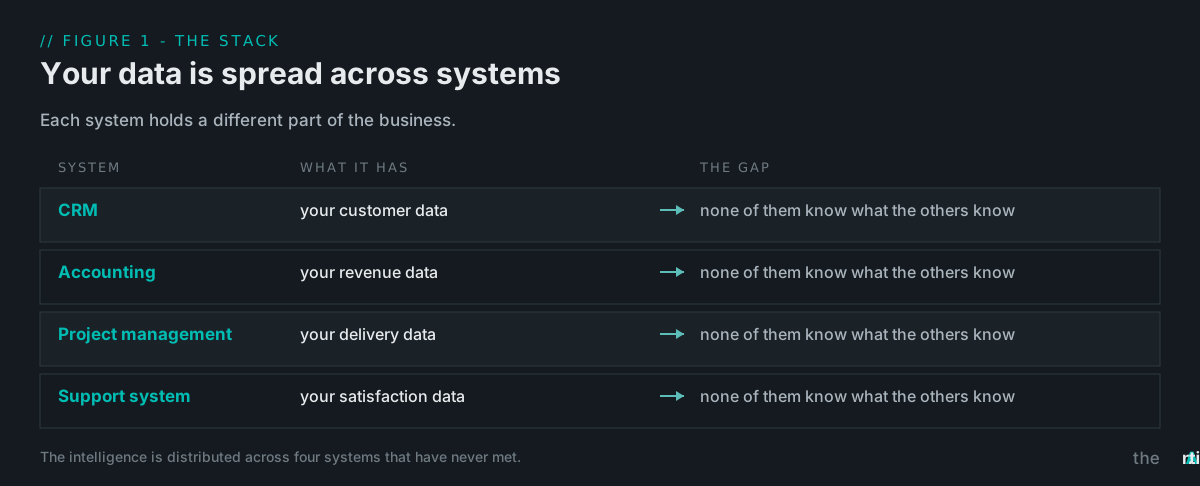
Your CRM has your customer data. Your accounting software has your revenue data. Your project management tool has your delivery data. Your support system has your satisfaction data. The intelligence that could tell you which customers are most valuable, most at risk, most ready to expand — that intelligence is distributed across four systems that have never met.
You don't have a data problem. You have a fragmentation problem.
The Integration Tax
Every disconnected system in your stack charges you twice.
Once for the subscription. Once for the time your team spends being the integration layer between systems that should talk to each other automatically.
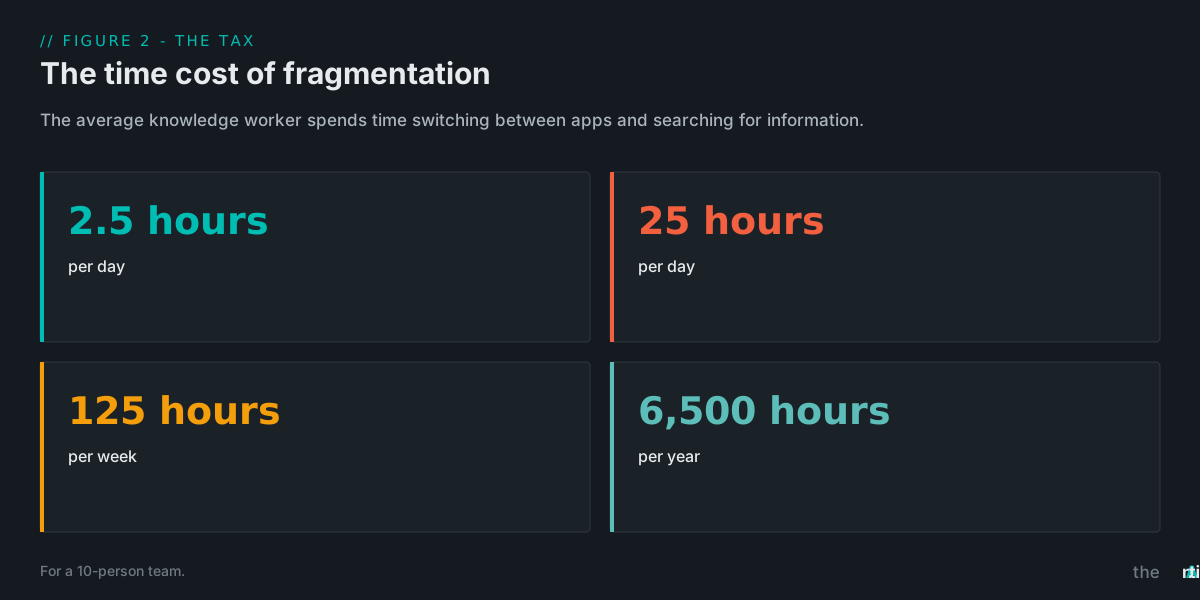
The average knowledge worker spends 2.5 hours per day switching between apps and searching for information. For a 10-person team, that's 25 hours per day. 125 hours per week. 6,500 hours per year.
At $25/hour fully loaded, that's $162,500 per year in productivity lost to fragmentation. In a 10-person business. Before you count the decisions made with incomplete information because the right data lived in the wrong system.
The Connector Is Not the Solution
Here's the current "solution" the industry is selling you: connectors.
Zapier. Make. Workato. HubSpot integrations. Salesforce AppExchange. And now, AI-assisted connectors that sit on top of your existing stack and help the tools talk to each other through a chat interface.
The connector is better than nothing. It is not a solution.
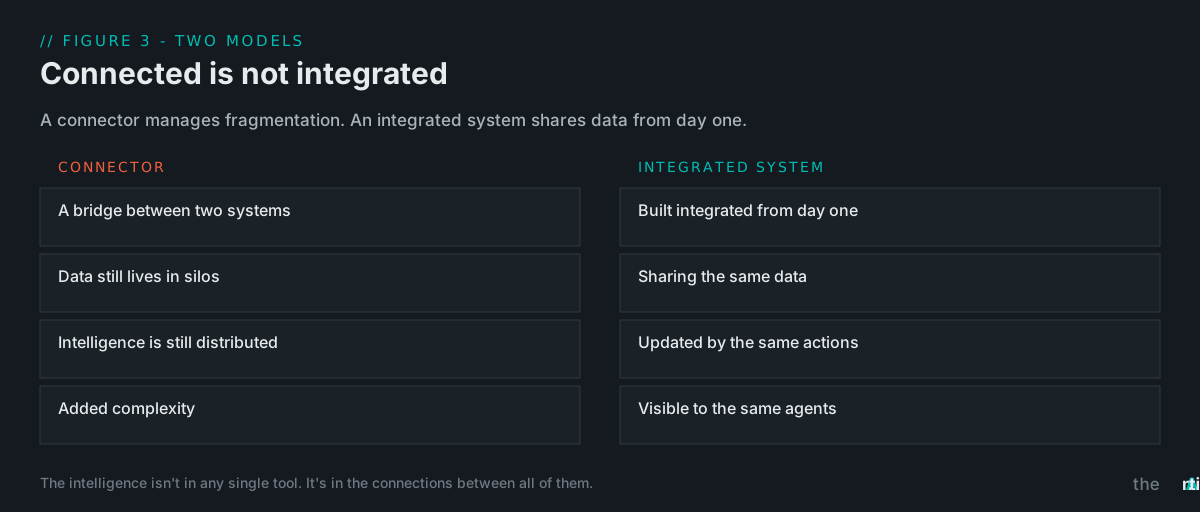
A connector is a bridge between two systems that should never have been separate. You're paying a third company to manage the relationship between two other companies you're already paying. The underlying fragmentation remains. The data still lives in silos. The intelligence is still distributed. You've added complexity to manage the complexity.
The only real solution is a system that was built integrated from day one. Not connected. Integrated. Where the CRM and the accounting and the project management and the customer support are the same system, sharing the same data, updated by the same actions, visible to the same agents.
What Integrated Actually Means
When your AI CFO runs your books, it sees every invoice, every payment, every outstanding receivable in real time. When your AI CMO plans your next campaign, it sees which customers are most likely to respond based on transaction history. When your AI CSM flags a customer at risk, it's working from support ticket data, payment history, product usage, and communication frequency — not from the CRM field your sales rep remembered to update.
This is not a vision. This is what a genuinely integrated platform does. The intelligence isn't in any single tool. It's in the connections between all of them.
The 14 companies you're paying to not talk to each other have a collective interest in staying separate. Integration threatens their individual subscription revenue. Fragmentation is their business model.
It is not yours.
One platform. Every tool connected. One bill that fits your size. See how it works.