AI for the Overwhelmed
You opened seventeen tabs this morning. You closed three. You have four CRMs because each one was the right answer at the time. Your bookkeeper sends spreadsheets. Your dispatcher uses a different tool than your sales team. Somebody on LinkedIn is telling you to add an AI agent to your stack.
Add it where, exactly.
This post is for the owner who is not anti-AI. You're not skeptical. You've tried things. You've watched the demos. You believe the technology is real. The problem is that every solution arrives as another login, another integration, another vendor pitch, another monthly bill, and another thing that doesn't talk to the other things.
You're not behind on AI. You're behind on consolidation.
What "overwhelmed" actually means
Overwhelm in a small business is rarely a workload problem. It's a surface count problem.
A surface is anywhere your work lives. Your inbox is a surface. Your CRM is a surface. Your accounting tool is a surface. Your project tracker is a surface. Each surface has its own login, its own search, its own notification fatigue, its own version of the truth.
The math is brutal. Five surfaces means five places to check, five places where something can fall through, five contexts you have to swap between, and five subscription line items. The cognitive cost isn't the work — it's the switching.
AI doesn't fix this by becoming the sixth surface. AI fixes this by eating the surfaces.
The wrong answer: another app
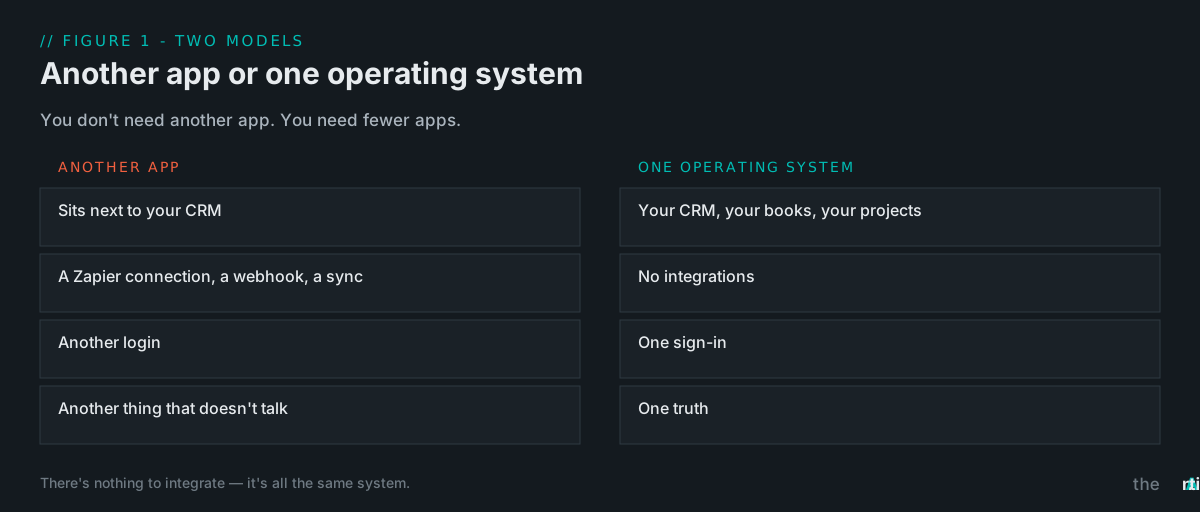
Most "AI for small business" products are bolt-ons. They sit next to your CRM. They sit next to your books. They sit next to your inbox. They promise to "integrate" — which means a Zapier connection, a webhook, a sync that breaks once a quarter, and a support ticket you have to file in someone else's portal.
Each bolt-on adds a surface. The thing supposed to reduce your load is increasing it.
This is the Salesforce pattern dressed in new clothes. The pitch is that you'll save time. The reality is that you'll spend three weekends configuring it, your team will half-adopt it, and in six months you'll be paying for it and barely using it.
You don't need another app. You need fewer apps.
The right answer: one operating system
The nAItion is built around a single thesis. You should run your business on one AI-native operating system. Not five tools with AI sprinkled on top. Not a chatbot that lives next to your work. The OS itself.
Inside one workspace:
- Your CRM, your books, your projects, your contracts, your inbox — all native
- Your AI agents (CFO, CMO, CEO, Sales, Delivery, People, Tech) sitting in the same context as your data
- One sign-in, one search, one truth, one bill
- No "integrations" because there's nothing to integrate — it's all the same system
When an agent flags an overdue invoice, it's looking at the same record your bookkeeper is looking at. When your CMO agent proposes a campaign, it's reading the actual pipeline your sales agent is updating. There's no sync. There's no lag. There's no "let me check the other system."
That's what consolidation feels like.
What you give up
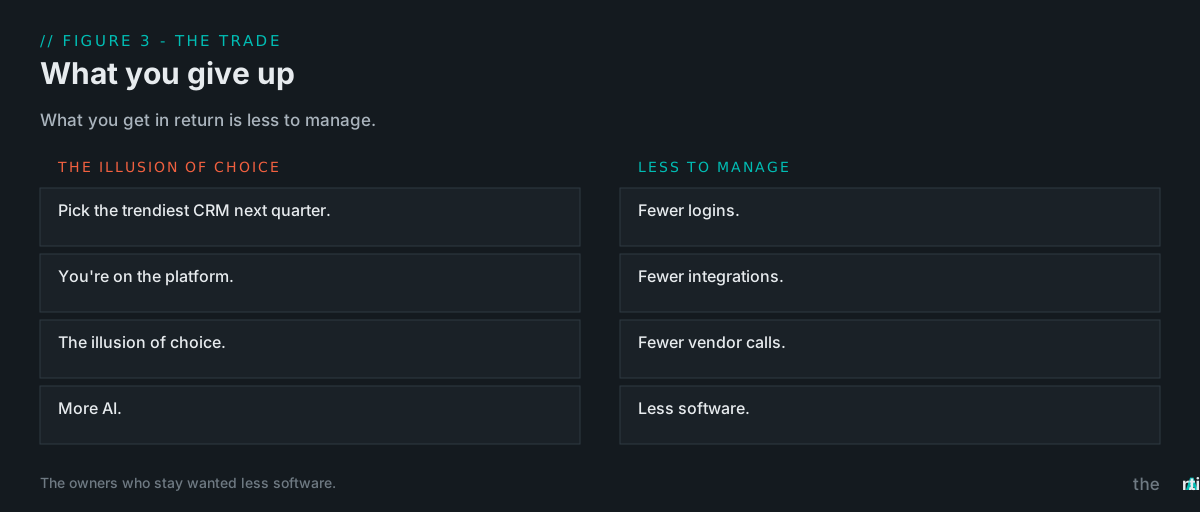
Honesty: you give up the illusion of choice. When you run on a unified OS, you can't go pick the trendiest CRM next quarter. You're on the platform.
What you get in return is the thing every overwhelmed owner actually wants — less to manage. Fewer logins. Fewer integrations. Fewer vendor calls. Fewer reasons to context-switch at 9pm because something didn't sync.
The owners who try the nAItion and stay are not the ones who wanted more AI. They're the ones who wanted less software.
What you do next
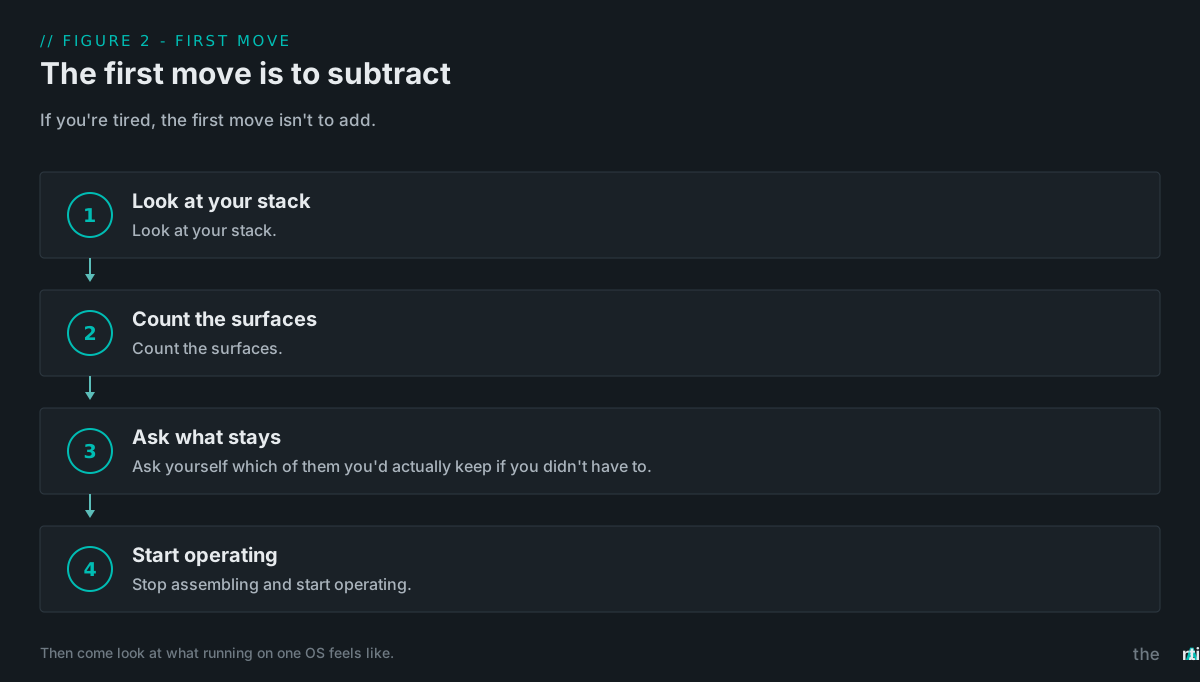
If you're tired, the first move isn't to add. The first move is to subtract. Look at your stack. Count the surfaces. Ask yourself which of them you'd actually keep if you didn't have to.
Then come look at what running on one OS feels like.
The Starter, Small, and Mid tiers exist for owners who are ready to stop assembling and start operating. We size your tier from how many people you have in each department — not from how many seats you buy. No bolt-ons, no add-on modules, no upsell calls. How pricing works.
You don't need more tools. You need the one that makes the others unnecessary.
— ImaginAItion