A Major AI–CRM Merger Is Coming
This is a forecast, not a report. No deal has been announced.
Editor's update
Since this was written, Salesforce launched AIforce. Their CEO's line: "Here, the UI is the AI."
That is a concession. He is telling you Salesforce becomes infrastructure — the plumbing behind someone else's interface. It is not a bad business. It is just not Salesforce.
We took it apart here: When Claude De-Interfaces Salesforce, Who Will Customers Choose?
But the pressures on both sides of this trade have been pointing the same direction for two years, and it's worth thinking about before the press release rather than after.
The setup
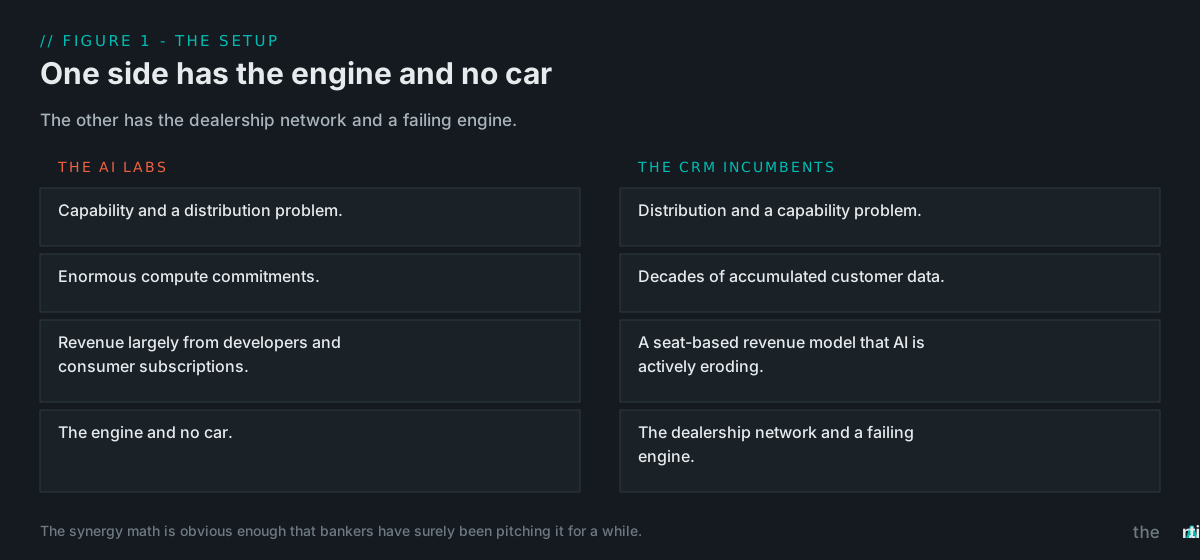
The AI labs have capability and a distribution problem. Enormous compute commitments, enormous losses, and revenue that comes largely from developers and consumer subscriptions. The margin lives in business workflows, and getting into business workflows one integration at a time is slow and expensive.
The CRM incumbents have distribution and a capability problem. Decades of accumulated customer data, deep procurement relationships, and a seat-based revenue model that AI is actively eroding. Their AI features are largely built on someone else's model, which means their most strategic capability is rented — and their pricing model assumes headcount grows, at exactly the moment their customers are automating headcount away.
One side has the engine and no car. The other has the dealership network and a failing engine. The synergy math is obvious enough that bankers have surely been pitching it for a while.
What would drive it
- Data access. Post-scarcity in public training data, a corpus of real business workflow records is one of the few genuinely scarce assets left.
- Revenue quality. Enterprise contracts are stickier and better-margin than consumer subscriptions.
- Defense. Every CRM incumbent knows an AI-native competitor eventually eats the seat model. Buying the engine is the standard response.
- Compute economics. A partner with a large, predictable enterprise workload makes infrastructure spend look far more rational.
What it would mean for you
Pricing gets repackaged, not reduced. The near-certain outcome is bundling: AI capability folded into a higher tier that costs more than what you pay now. The line item disappears; the total goes up. This is what happened every prior time a platform absorbed a category.
Your data becomes strategic to someone else. A merged entity has both your operational records and a reason to use them. Read the data terms on the day the deal closes, not a year later.
Lock-in deepens. Once the AI layer is native to the CRM rather than a connected tool, leaving means rebuilding both at once. That's the point of the deal.
Alternatives get squeezed. Independent tools built on the acquired lab's API become competitors to their new owner. API pricing, rate limits, and terms tend to move in one direction after that.
Innovation slows in the acquired product. Integration work absorbs years. It always does.
What to do about it now
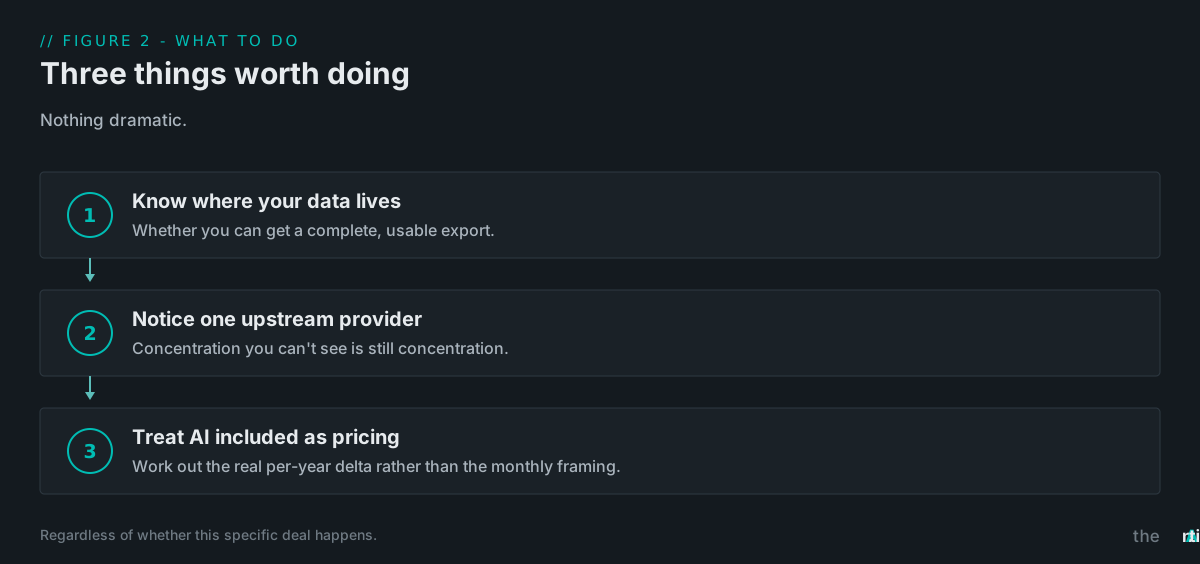
Nothing dramatic. Three things worth doing regardless of whether this specific deal happens:
- Know where your data actually lives and whether you can get a complete, usable export — records, history, attachments, and relationships, not a flat CSV.
- Notice how many of your tools depend on one upstream model provider. Concentration you can't see is still concentration.
- Treat "AI included" as a pricing event. When a vendor bundles AI into your tier, work out the real per-year delta rather than the monthly framing.
The structural point
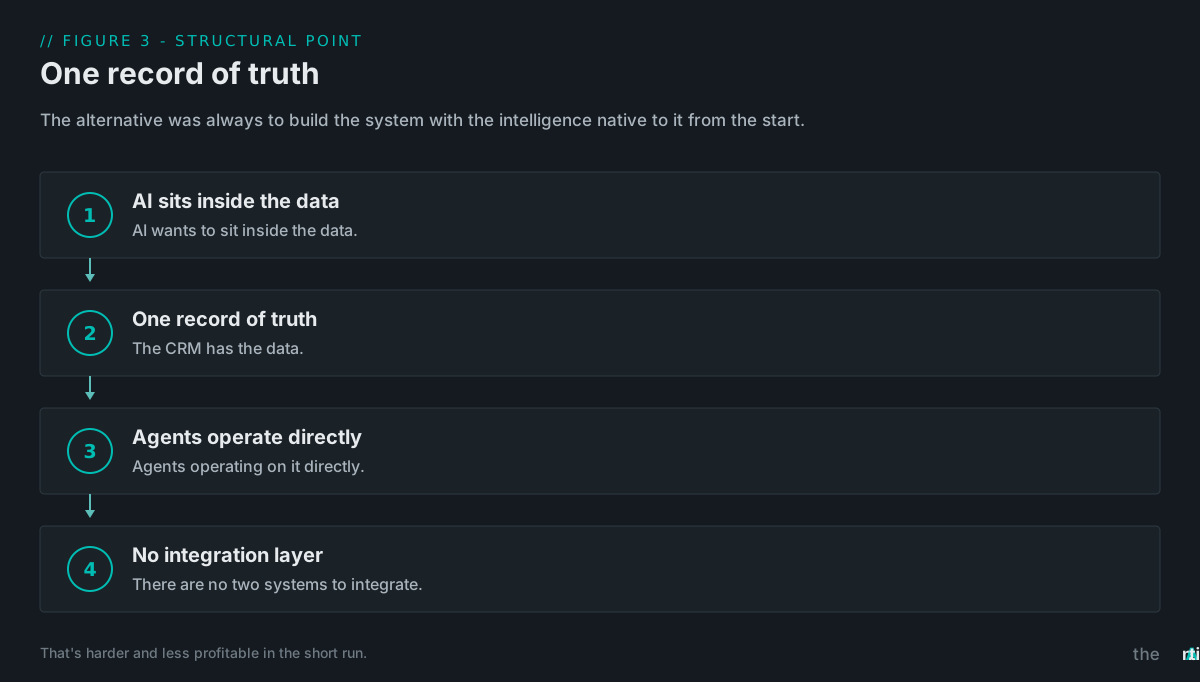
The reason this deal keeps looking inevitable is that the industry is trying to solve a design problem with an acquisition. AI wants to sit inside the data. The CRM has the data. So you buy the AI and bolt it in.
The alternative was always to build the system with the intelligence native to it from the start — one record of truth, agents operating on it directly, no integration layer because there are no two systems to integrate. That's harder and less profitable in the short run, which is why the incumbents didn't do it and why the acquisition route wins.
We built the other way, which is the whole reason this company exists. When the merger lands and the bundled pricing shows up in your renewal, the useful question won't be whether the deal was smart. It'll be whether you have somewhere else to go.
Watch for it. It's coming.
— ImaginAItion