When Claude De-Interfaces Salesforce, Who Will Customers Choose?
Editor's update
Salesforce has since launched AIforce. "Here, the UI is the AI," said their CEO.
The company with the most to lose from the interface disappearing just agreed it is disappearing — and accepted the infrastructure seat. Nobody is going to work in the software. They will work in their own chat, or in an interface they built to pull what they need from wherever it lives.
On August 26, 2026, Salesforce and Anthropic announced Claudeforce.
Here is what it is: Claude inside Salesforce, and — the part that matters — Salesforce inside Claude. A plugin puts the CRM's sales work directly into the AI assistant, so a rep can ask for the pipeline, update the deal, and draft the follow-up without ever opening Salesforce. Marc Benioff's line on the day, as VentureBeat reported it: "Here, the UI is the AI." The market loved it. Salesforce's stock jumped roughly 22% the next day.
We called this merger before it had a name. We laid out the full case in A Major AI–CRM Merger Is Coming. Claudeforce is it — in everything but the paperwork. Look at what's already fused: Salesforce has owned a piece of Anthropic since 2023, and its own SEC filing shows that stake is now its largest strategic investment. Claude runs inside Agentforce and Slack. And now Salesforce runs inside Claude.
So why no merger on paper? Because the ownership makes one impossible. Anthropic is already owned in pieces by Google, Amazon, Microsoft and Nvidia — and Microsoft sells a CRM that competes head-on with Salesforce (The Tangle). A buyer would have to unwind every other owner's stake and face the regulators on the way. So the merger happens the only way it can in this industry: through products, stakes and contracts.
Call it what it is: a merger of interfaces and interests. The paperwork is the only thing missing.
What "de-interfacing" means
For twenty years, the screen was the product. You bought seats so your people could log in and click. The vendor that owned the screen owned the habit, the training, the workflow — and the renewal.
This spring, Salesforce said the quiet part out loud. Announcing "Headless 360" in April, it declared: "Everything on Salesforce is now an API, MCP tool, or CLI command." The browser became optional. The user of the software, increasingly, isn't a person. It's an agent.
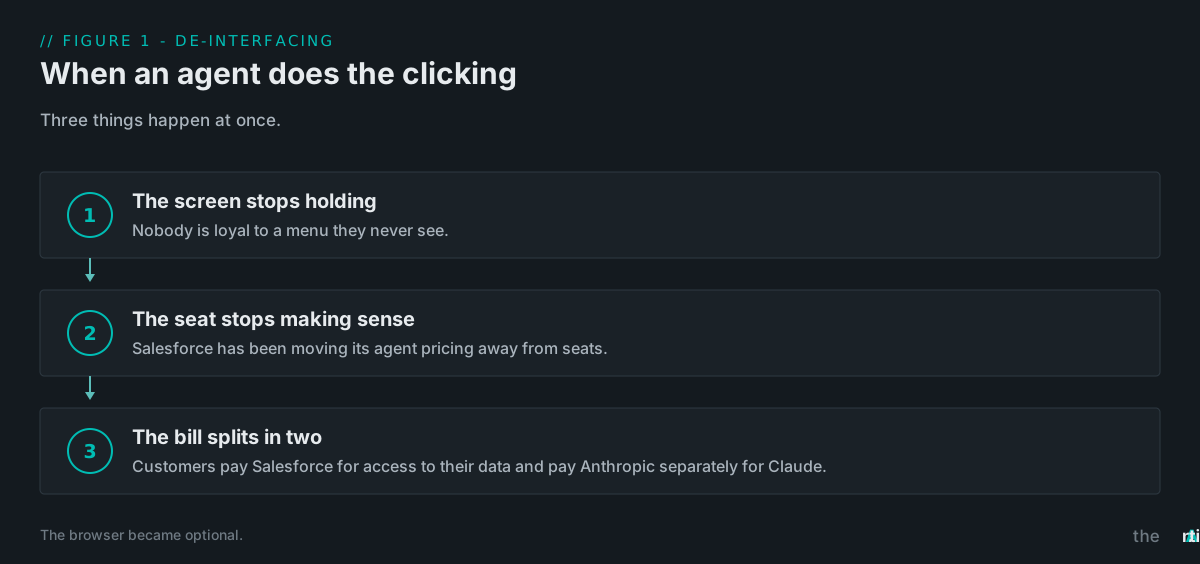
When an agent does the clicking, three things happen at once:
The screen stops holding the customer. Nobody is loyal to a menu they never see.
The seat stops making sense. Salesforce has been moving its agent pricing away from seats for two years — from $2 per conversation in 2024, to $0.10 per agent action in 2025, to what it now calls "headless consumption." (It hasn't abandoned seats; customers still want predictable bills.)
The bill splits in two. Under Claudeforce, according to VentureBeat, customers pay Salesforce for access to their data and pay Anthropic separately for Claude.
So who does the customer choose?
The old question was simple: which software will my people log into?
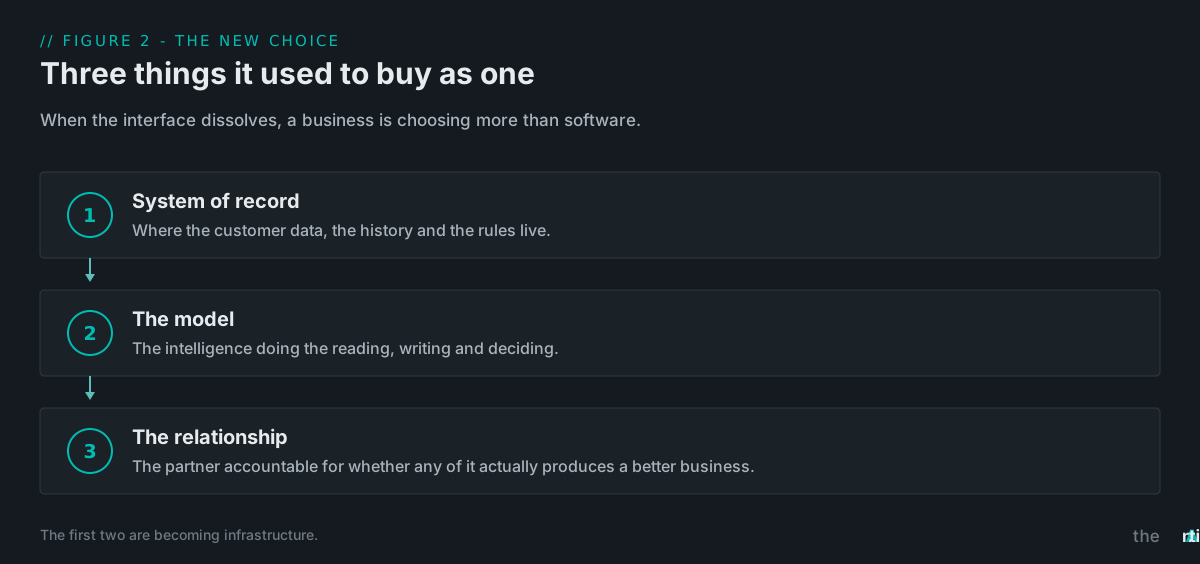
The new one isn't. When the interface dissolves, a business is really choosing between three different things it used to buy as one:
The system of record — where the customer data, the history and the rules live. Still valuable. But once an agent can read it through an API, it starts to look like plumbing.
The model — the intelligence doing the reading, writing and deciding. Powerful, improving fast, and sold to everyone. The same model is working for your competitor this afternoon.
The relationship — the partner accountable for whether any of it actually produces a better business. Who answers when the agent gets it wrong? Who knows your trade? Who does well only when you do?
The first two are becoming infrastructure. The third is the one that can't be commoditized — because it isn't software. It's accountability.
Why this matters most for small business
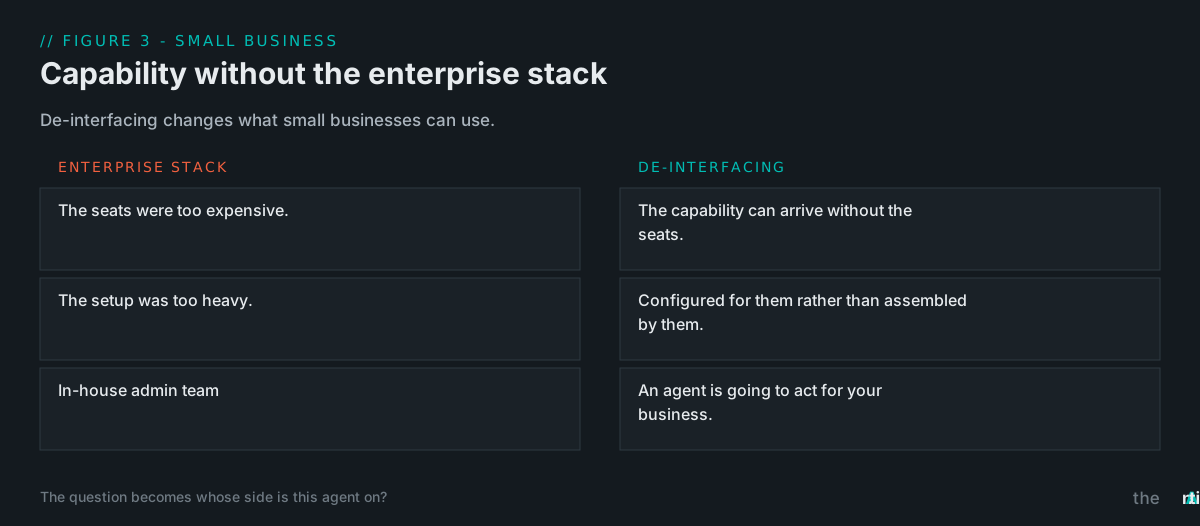
Most small businesses never bought the enterprise stack. The seats were too expensive and the setup too heavy. De-interfacing changes that: the capability can arrive without the seats or the in-house admin team, configured for them rather than assembled by them.
But it also raises the stakes on one decision. If an agent is going to act for your business — quote your customers, schedule your crews, chase your invoices — the question stops being "which tool has the best features?" It becomes "whose side is this agent on?"
Our view
Agents should work for the business they serve, on the systems that business already runs. The partner behind them should be accountable for outcomes, not usage — and should share in the value it helps create, not just bill for it.
That's the arrangement we're building in the nAItion. When the screen disappears, the relationship is what's left.
Sources
Salesforce newsroom, "Salesforce and Anthropic Announce Claudeforce," Aug 26, 2026 — salesforce.com/news/press-releases/2026/08/26/salesforce-and-anthropic-announce-claudeforce/
VentureBeat, Aug 26, 2026, on Claudeforce pricing and Benioff's "Here, the UI is the AI" (reported quote)
CNBC, Aug 27, 2026, on Salesforce's ~22% stock move (reported)
Salesforce 10-Q for the quarter ended Jul 31, 2026 (SEC), Anthropic stake ~45% of strategic investment carrying value
Salesforce Ventures, "Behind the Investment: Anthropic" (participation since the 2023 Series C)
Salesforce newsroom, Headless 360, Apr 15, 2026 — "Everything on Salesforce is now an API, MCP tool, or CLI command"
Salesforce newsroom, Agentforce launch pricing ($2 per conversation), Sep 12, 2024; Flex Credits ($0.10 per action), May 15, 2025
The Register, Dec 12, 2025, on customers pushing for predictable (seat-style) pricing