When the Compute Bill Comes Due
Nobody is asking the second-order question.
The first-order question about AI economics is: how do these companies make money? The answer is subscriptions, API access, enterprise contracts. Reasonable answer. Moving on.
The second-order question is: what happens when the cost of delivering those subscriptions exceeds what the market will pay for them?
That question doesn't have a comfortable answer yet.
The Numbers
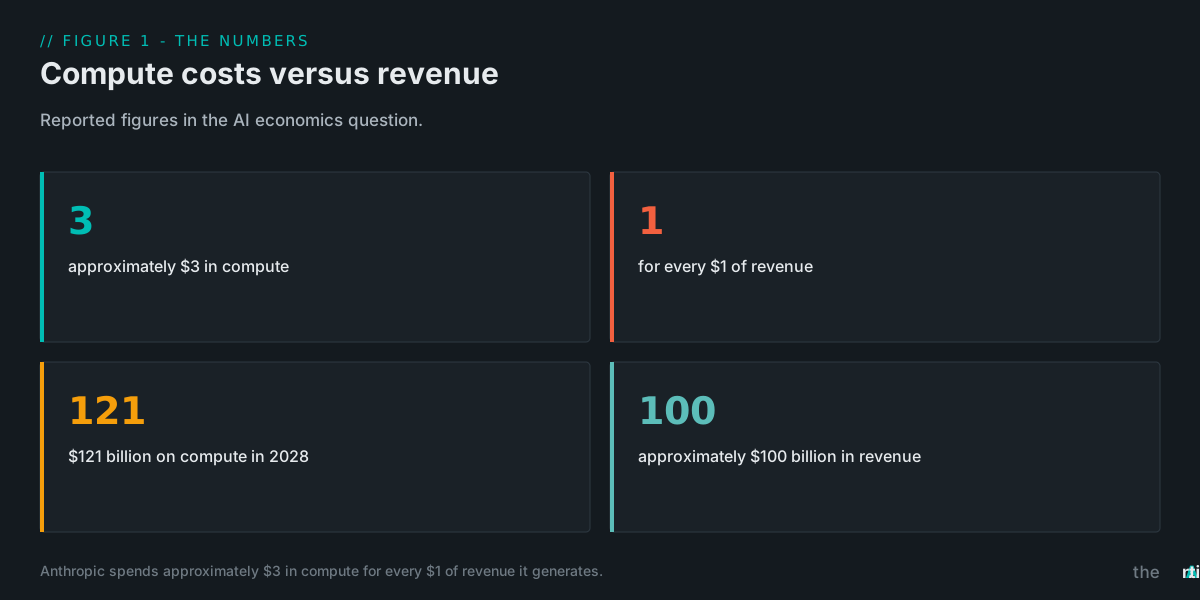
Anthropic spends approximately $3 in compute for every $1 of revenue it generates. That ratio is not a startup growing pain — it's a structural feature of what inference costs at the capability level Anthropic operates.
OpenAI is projected to spend $121 billion on compute in 2028. Their revenue projection for that year is approximately $100 billion. That's a $21 billion loss on $100 billion in revenue — in the year they're supposed to be approaching maturity.
Google is absorbing AI infrastructure costs across a balance sheet large enough to hide them. Meta is doing the same. Microsoft is betting that Copilot monetization offsets Azure AI spend. Amazon is betting on AWS.
The companies that don't have a $2 trillion balance sheet to absorb losses against are betting on something simpler: that they can raise prices before the money runs out.
Who Absorbs the Cost
When a software company's cost structure becomes unsustainable, the cost migrates somewhere. It doesn't disappear.
Option 1: It migrates to investors. More dilution. More pressure. More urgency to find monetization that the business model may not support.
Option 2: It migrates to enterprise customers through larger contract values. The enterprise deals that justify the compute spend by paying enough to cover it.
Option 3: It migrates to consumer and SMB customers through price increases. The subscribers who don't have negotiating leverage and whose switching costs are high enough that a 40% price increase is still cheaper than rebuilding their workflows.
The third option is the most likely path for the companies whose enterprise sales motion isn't mature enough to cover the gap.
The Rate Hike Sequence
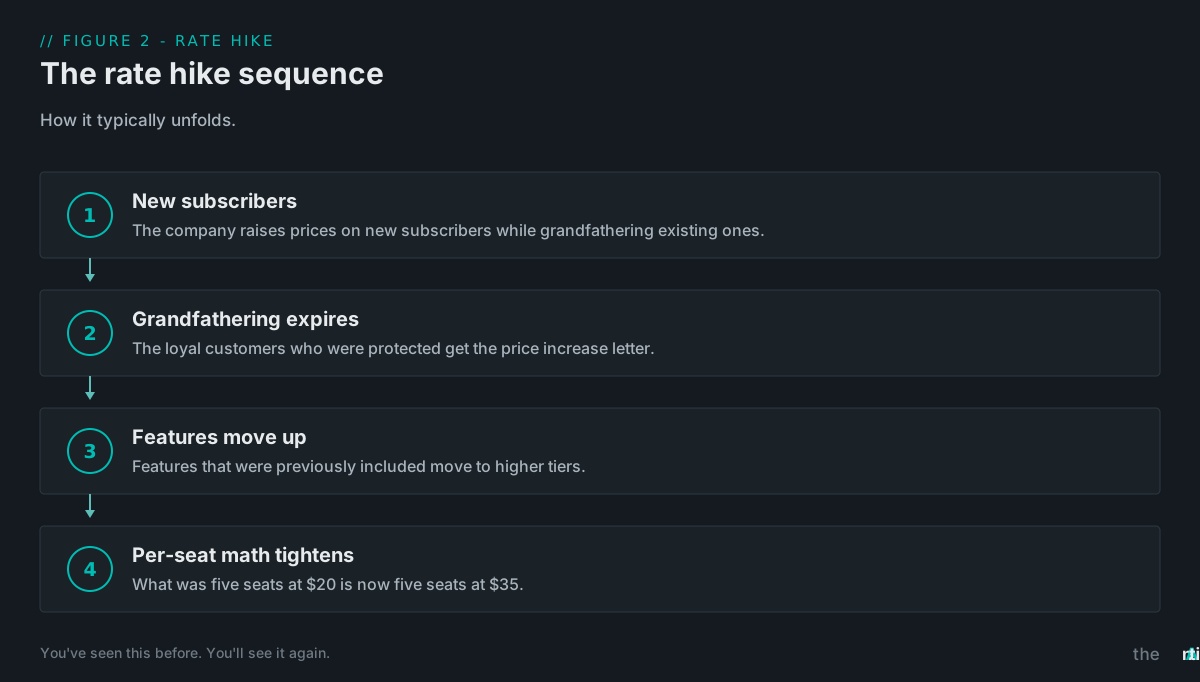
Here is how it typically unfolds.
First, the company raises prices on new subscribers while grandfathering existing ones. The headline is "we're raising prices but we're protecting our loyal customers." The actual message is "we need to test price elasticity before we hit everyone at once."
Second, grandfathered pricing expires. The loyal customers who were "protected" get the price increase letter. Usually framed as "due to increased infrastructure costs and expanded capabilities."
Third, features that were previously included move to higher tiers. The AI assistant that was part of your base subscription is now a Professional add-on. The advanced reporting you relied on is now Enterprise.
Fourth, the per-seat math tightens. What was five seats at $20 is now five seats at $35. The platform got more valuable. You pay for the value whether you use the features or not.
You've seen this before. You'll see it again.
The Model That Doesn't Require a Rate Hike
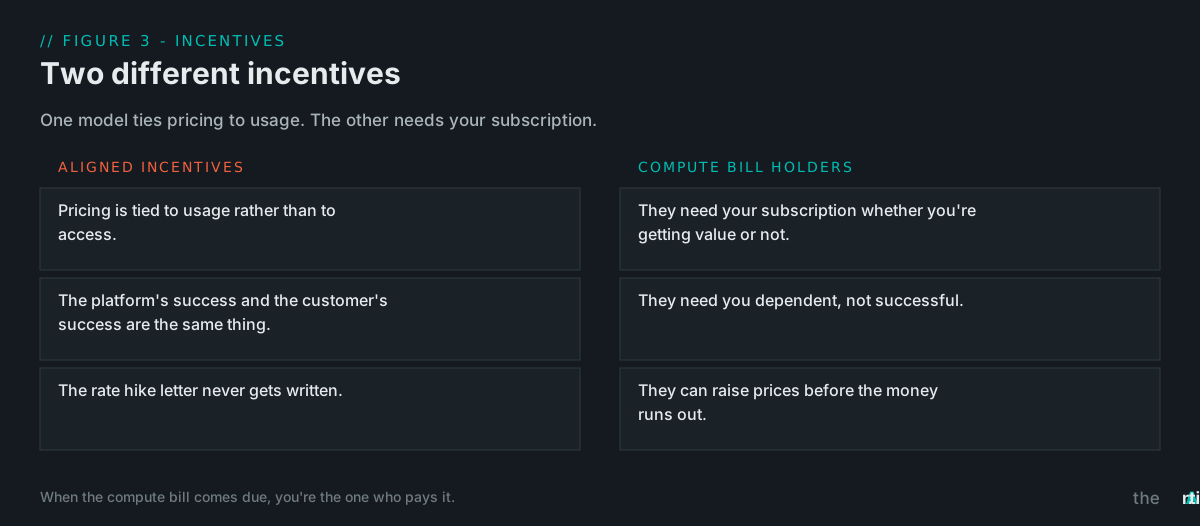
A platform with aligned incentives doesn't need to raise prices to survive.
When the cost of serving a customer is proportional to the value that customer generates — when pricing is tied to usage rather than to access, when the platform's success and the customer's success are the same thing — the rate hike letter never gets written.
The nAItion sizes your tier to what your team is likely to use. Go over it and you pay the overage — and if you're over most months, the next tier up costs less than the overages do. The allowance is monthly and it does not roll over. How pricing works.
The companies holding the compute bill have a different incentive. They need your subscription whether you're getting value or not. They need you dependent, not successful.
When the compute bill comes due, you're the one who pays it.
Unless you own a piece of the platform that the bill is funding.
The nAItion model doesn't require your dependency. See how it works.