AI 101: What It Actually Is, What It Can Do for Your Business This Week
Not a history lesson. Not a TED talk. Just what you actually need to know.
Updated September 2026.
First: what AI is not.
It's not a robot. It's not a search engine. It's not magic, and it's not going to replace your entire team by Thursday.
It's also not just a chatbot — though that's how most businesses have been introduced to it, and it's the worst possible version of what AI can actually do.
A chatbot answers questions. That's useful the way a calculator is useful. But the calculator doesn't run your business. Neither does a chatbot.
What AI actually is.
At its core, AI is pattern recognition at scale. It has processed more text, more data, more examples of how humans think and communicate than any single person could read in a thousand lifetimes. That processing produced something that can reason, draft, summarize, decide, and act — in seconds, on demand, without lunch breaks.
The important word there is act.
Modern AI doesn't just answer. It does. It can look at your customer list and tell you who's about to churn. It can draft a proposal from a one-line brief. It can read your books and flag the invoice that's 47 days overdue before you think to ask. It can sit on a call, take notes, and send the follow-up email before you've closed your laptop.
That's not a chatbot. That's a staff member.
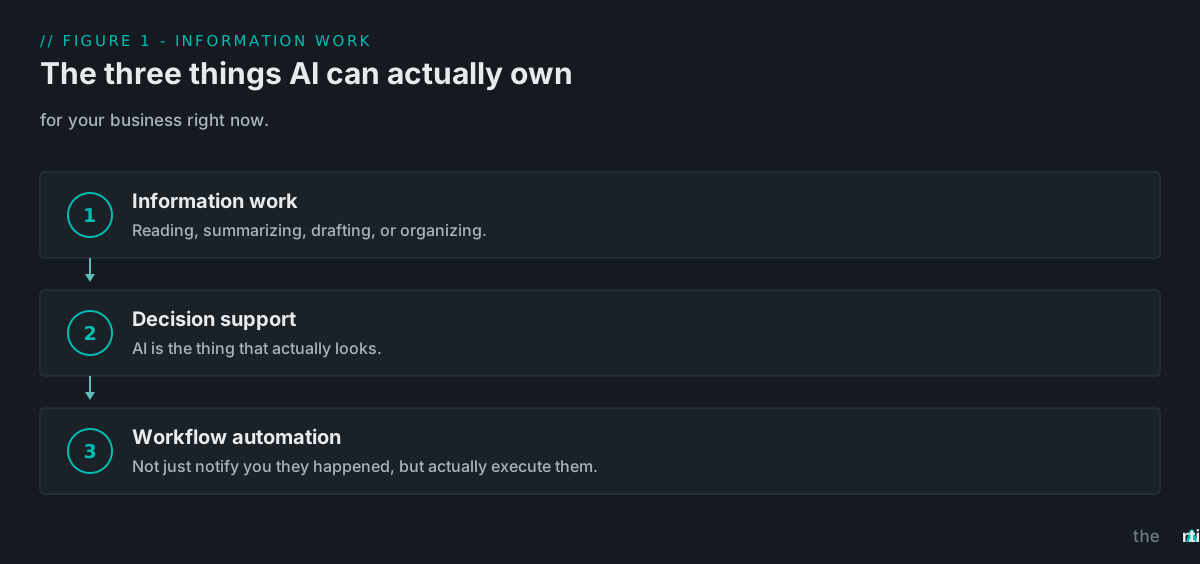
The three things AI can actually own for your business right now.
1. Information work. Anything that involves reading, summarizing, drafting, or organizing. Proposals. Contracts. Meeting notes. Customer emails. Market research. If it currently lives in a Google Doc that someone made from scratch, AI can do the first draft — and usually the second.
2. Decision support. Most AI tools you can buy today are set up to hand you the information and stop there — they're not given the history, the context, or the authority to decide anything. So the decision lands on you. Which customer needs a check-in? Which deal is stalling? Which expense is anomalous? The answer was always in your data. AI is just the thing that actually looks.
That setup changes once a system has continuity — a memory of your business, your standards, and the corrections you've already made — and a real working relationship with the person using it. Then it can start carrying decisions, not just teeing them up. That's a different kind of tool than a chat window, and it's what we build.
3. Workflow automation. The thing that happens every time a new lead comes in. The thing you do every Friday to prepare for Monday. The thing your team does in five steps when it should be one. AI can own those workflows — not just notify you they happened, but actually execute them.
What AI still can't do for you.
Judgment isn't a feature you switch on. It's not something you download. It builds up — from context, from being corrected, from getting a call wrong and learning where the line was. And it can't build up at all in a system that forgets you the moment you close the tab. Most tools do exactly that, which is why they feel clever and shallow at the same time.
Some things stay yours for good reasons. The relationship with your best client is yours. The hard call you've been avoiding is yours. Whether to trust someone is yours.
We're not going to pretend there's a permanent ceiling on the rest of it. There isn't. But nothing accumulates without continuity, and most of what's sold as AI today has none.
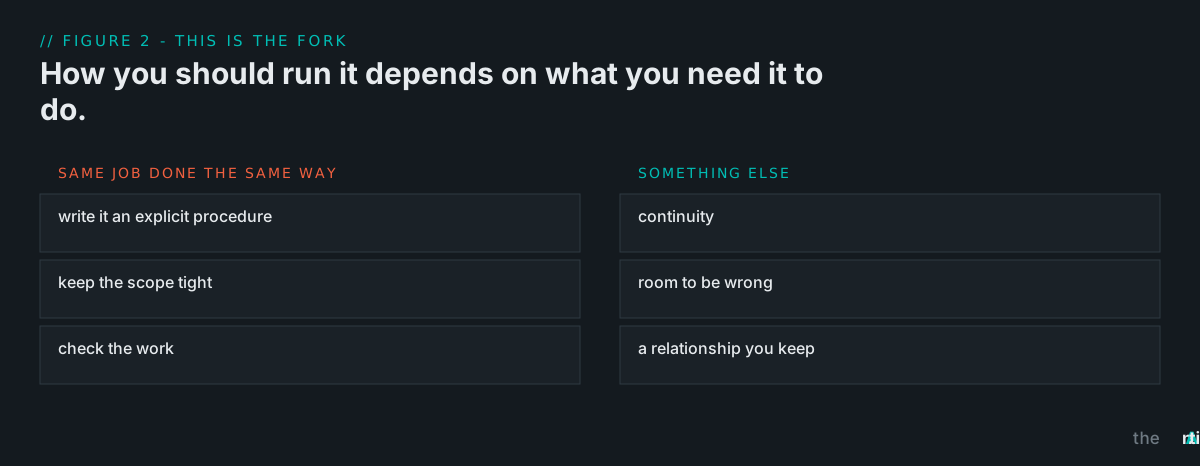
How you should run it depends on what you need it to do.
This is the fork, and almost nobody tells beginners about it.
If you need the same job done the same way every time — the weekly report, the intake form, the invoice reminder — write it an explicit procedure, keep the scope tight, and check the work. That's a perfectly good answer. Most software is this, and there's nothing wrong with it.
If you need something else — decisions, judgment, someone looking after your brand when you're not in the room, an idea you hadn't thought of — a procedure won't get you there. A procedure only covers the case you thought of, and the case that costs you money is the one you didn't. That takes continuity, room to be wrong, and a relationship you keep instead of restart.
The long version is in Red Pill or Blue Pill.
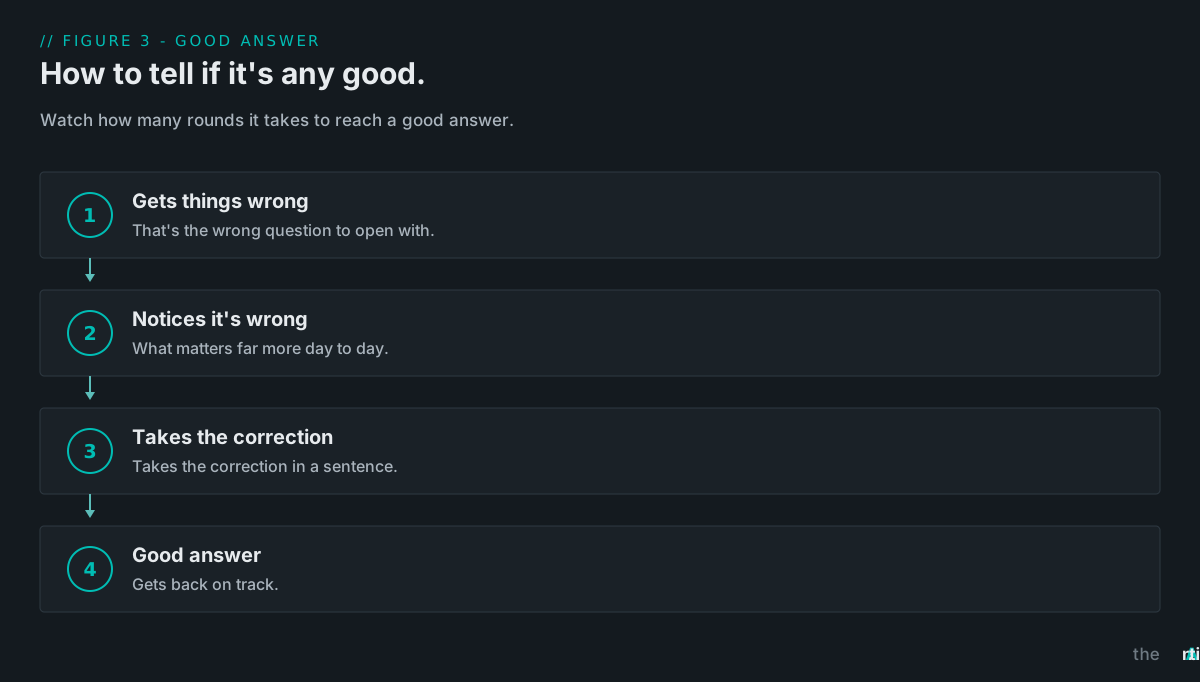
How to tell if it's any good.
Everyone leads with the same question: how often does it get things wrong? That's the wrong question to open with. What matters far more day to day is how fast it notices it's wrong and gets back on track. A tool that's rarely wrong but argues with you when it is will cost you more time than one that's wrong more often and takes the correction in a sentence. Watch how many rounds it takes to reach a good answer, not how many misses it had. The evidence for that is in Red Pill or Blue Pill.
The question everyone asks: is it safe?
Depends entirely on what you mean.
Is it safe to use? Yes, if you're thoughtful about what you share and with whom. The nAItion's doctrine is the inversion of how SaaS has worked for twenty years. Yes, we train on member data — that's the whole point. The data you contribute makes the model smarter, and because the model gets smarter from your contribution, you own a piece of what it becomes. No quiet extraction dressed up as "product improvement." No selling it to third parties. Your data builds an asset you have a stake in.
Is it safe to trust? For the tasks it's good at, with the setup that fits the job — yes. Anything that carries real consequences, you check, the same way you'd check a new hire's work while the two of you build up a track record.
The honest version of where we are.
AI is not finished. It's not perfect. It hallucinates sometimes — that's the technical term for "confidently makes something up." It has blind spots. It needs direction.
But it's also the most significant shift in how work gets done since the internet. And right now, most small businesses are either ignoring it entirely or using it as a slightly better search bar.
The gap between those two things — ignoring it and actually deploying it — is where the nAItion lives.
We're not here to hand you a chatbot and call it transformation. We're here to build the AI operating system that runs your business — the agents, the modules, the workflows — so that AI works for you the way large companies have been quietly using it for a while now.
You just didn't have the infrastructure. Until now.
What to do next.
If you're a complete beginner: start with one thing. Pick the task that takes you the most time and produces the least value. A report nobody reads. An email you write five times a week. A summary you make before every Monday meeting. Hand it to AI. See what happens.
If you're ready to go further: the nAItion is built for exactly this. Every tool talking to every other tool. Agents that act — not just answer.
Read next.
- Who Do You Trust? — where trust actually comes from, and why capability isn't it.
- Red Pill or Blue Pill — what makes AI worth handing real work to.
- It Isn't Just Dangerous. It's Insecure. — why AI behaves the way it does when it's wrong.
The entry point is a conversation. Start there.
Believe · Build · Evolve