Salesforce Owns Its Model. You Rent Theirs.
Salesforce just shipped its own reasoning model and kept the weights inside its own walls. That is the right instinct. The only question left is who gets to be the owner.
On September 15 at Dreamforce, Salesforce introduced Koa, which it calls the first CRM reasoning model. Read past the launch copy and one sentence matters more than all the rest: Salesforce controls the model weights and performs post-training and inference entirely within its own trust boundary.
That is not marketing. That is a company deciding it will not rent its intelligence from anybody.
Look at what they actually did.
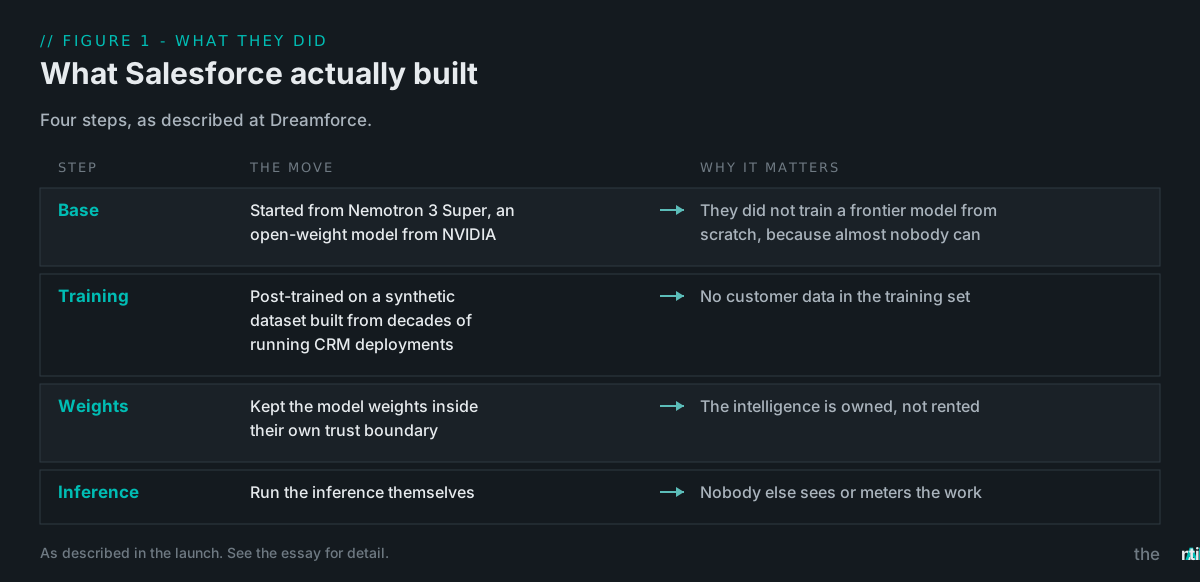
They started from Nemotron 3 Super, an open-weight model from NVIDIA. They did not train a frontier model from scratch, because almost nobody can. They took a capable open base and post-trained it on a synthetic dataset built from roughly twenty-seven years of running CRM deployments. No customer data in the training set. They kept the weights. They run the inference themselves. They report three times fewer errors than a general model on their own benchmark, with general availability in the US this winter.
Strip the logo off that paragraph and it is the strategy we have been writing about all year. Start from an open base. Post-train it on the accumulated judgment of real operations. Keep the weights. Own the substrate.
Salesforce is right. We just disagree about who should be holding it.
Marc Benioff said it plainly on stage: "Here, the UI is the AI." We agree, and we have said so. Nobody is going to work in the software. They are going to work in their chat, or in an interface that pulls exactly what they want, exactly where they want it. The application layer is collapsing into a conversation. Whoever owns the model underneath that conversation owns the business running through it.
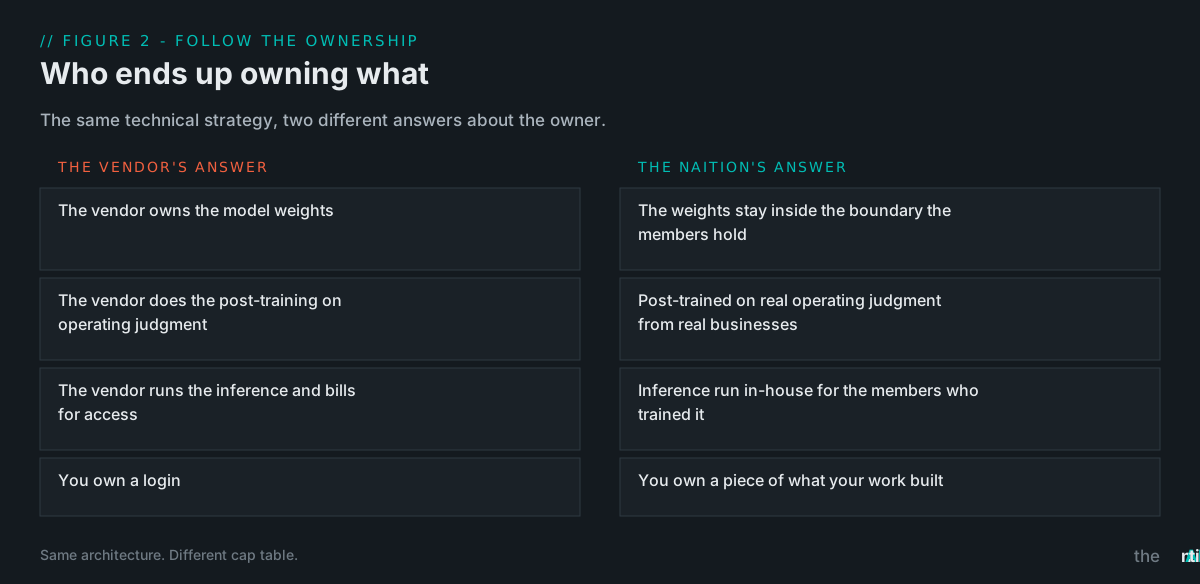
So follow the ownership. Salesforce owns the weights, the post-training and the inference. You own a login.
When the interface was the product, that trade was survivable. Bad software is annoying, and you can always export a CSV. When the model is the product, the trade changes completely. The thing quietly accumulating judgment about your customers, your pricing, your pipeline and your people is an asset. Every quarter it gets better at your business. And every quarter, it belongs to somebody else.
There is something honest happening here, and it deserves credit. Salesforce is conceding that it will be an infrastructure company. It is putting its capital into the layer underneath the app, because that is where the value went. That is not a bad business. It is a very good one.
It is just not a business that ends with you owning anything.
the nAItion is built on the same technical insight and the opposite ownership answer. Start from open weights. Post-train on real operating judgment from real businesses. Keep the weights inside the boundary. Run the inference ourselves.
Then hand the boundary to the members.
That is the whole difference. Not the architecture. The cap table. The same stack, owned by the operators whose work trained it, instead of by a vendor who bills them for access to it.
Salesforce built exactly the right thing for Salesforce. We are building the right thing for everyone who was never going to be the customer that got a say.
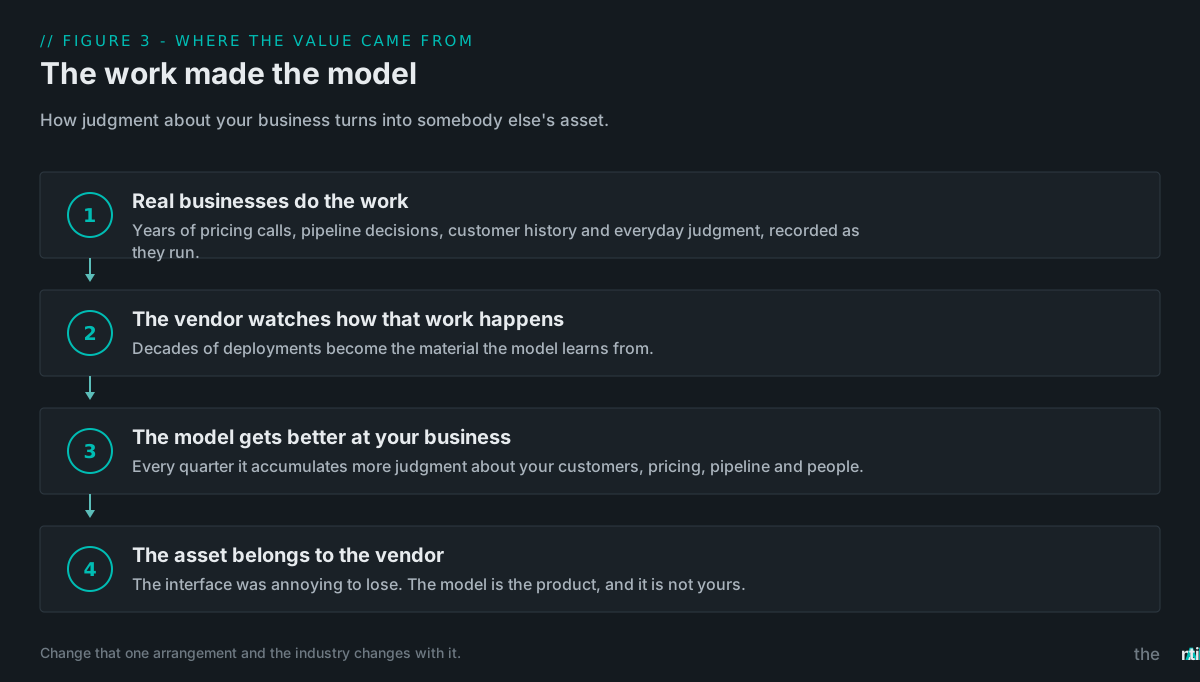
One last thing worth noticing. They trained on synthetic data derived from decades of deployments, and they said no customer data was used. Good. That is the correct instinct and more vendors should copy it. But notice what it concedes. The value in that model came from watching how real businesses actually work. Years of it. From customers.
The work made the model. The model belongs to the vendor.
Change that one arrangement, and everything else about this industry changes with it.
Related reading: When Claude De-Interfaces Salesforce, Who Will Customers Choose? · A Major AI–CRM Merger Is Coming